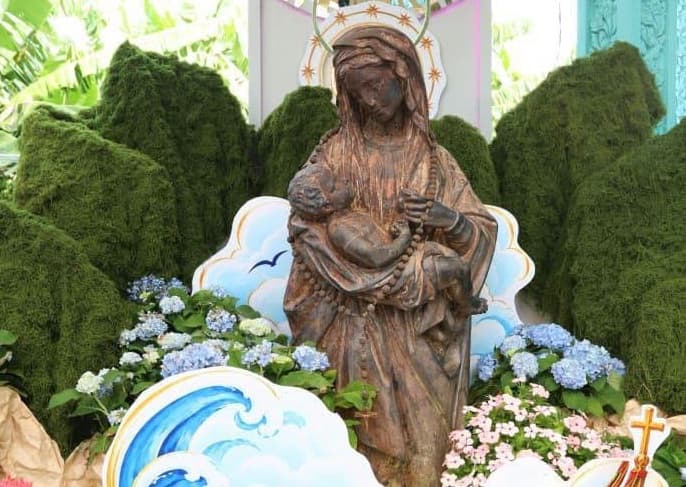
Phnom Penh (AsiaNews) — A crowd of Catholics from across the country and abroad packed a tiny village church in the Cambodian capital to capacity to mark the anniversary of the mysterious discovery of a statue of the Virgin Mary at the bottom of the Mekong River 15 years ago. According to some estimates, at least 1,000 people filled the church on November 21 and then spilled out into the courtyard of the “Mother of Peace Arey Ksat” church, on the riverbank in a small fishing village located across the river from downtown Phnom Penh.
The 2.3-meter-tall statue of Mary holding the Baby Jesus, discovered in 2011, and another found by Muslim fishermen at the bottom of the river in 2008, are two of the most venerated Catholic relics in all of Cambodia, a nation with a large Buddhist majority. No one knows for certain how the two sculptures ended up at the bottom of the river, although the most widely accepted theory is that they were wrapped up and thrown into the water to save them when the Khmer Rouge invaded the capital in 1975, destroying all religious symbols.
To give an idea of the size of the crowd that gathered for the event, consider that Cambodia’s largest church, the new St. Joseph Parish in the capital—consecrated this year—has a capacity of 700 people. “It was a very joyful and meaningful occasion for our Catholic community,” Fr. Vy Samnang, the parish priest of Arey Ksat, told AsiaNews. “Many people,” the priest added, “came from different areas to express their love and devotion to Our Lady. We welcomed everyone in the church courtyard and the surrounding areas, and despite the large turnout, everything took place in an atmosphere of prayer, peace, and brotherhood.”
Fr. Samnang stated that the statue has become a powerful symbol of faith, hope, and God’s presence in the community. “We believe that Our Lady’s arrival in Arey Ksat was not simply a coincidence. Arey Ksat,” explains the parish priest, “is located at the confluence of four rivers, a place considered particularly sacred and significant in Cambodian culture and history.” “For us,” he adds, “the value of the statue does not lie simply in its historical significance or its artistic beauty. Above all, it reminds us of Mary’s maternal love, her protection, and her constant invitation to follow Jesus Christ.”
As Fr. Samnang recalls, over the years the statue of the Virgin has become a symbol of interreligious solidarity. “Cambodia,” he emphasizes, “is a country where the majority of the population is Buddhist. We live side by side with people of different religions, including the Muslim community.” In this light, “we believe that faith should bring people together, rather than divide them.”
“As a priest,” he continues, “I feel called to help people discover the deeper meaning of this devotion: Mary always leads us to Jesus. She teaches us to trust in God, to love one another, and to care for the poor and the most vulnerable.” “My greatest hope,” the parish priest concludes, “is that Our Lady of the Mekong will continue to unite families, strengthen the faith, and become a sign of peace and brotherhood for all the Cambodian people, regardless of religion or origin.”
Bishop Olivier Schmitthaeusler, Apostolic Vicar of Phnom Penh, presided over the ceremony together with Coadjutor Bishop Pierre Hangly Suon. The French-born prelate addressed the crowd of the faithful, emphasizing that the Arey Ksat Shrine is a place that welcomes everyone, regardless of nationality or religious belief. At the same time, the bishop urged all Christians to take Mary as a model for their daily lives.
The Apostolic Vicar then invited Catholics to follow five principles: to be silent and listen to the Word of God; to entrust one’s life to God; to persevere with sacrifice and humility; to live according to the words “Thy will be done”; and to be the temple of God. Finally, he urged them to set aside time for prayer and silence amid the distractions of modern society, stating that the Word of God is often recognized in the gentle voice that speaks to the human heart.
Cambodia has just over 20,000 Catholics nationwide—out of a total population of more than 18 million—two-thirds of whom are of Vietnamese ethnicity.