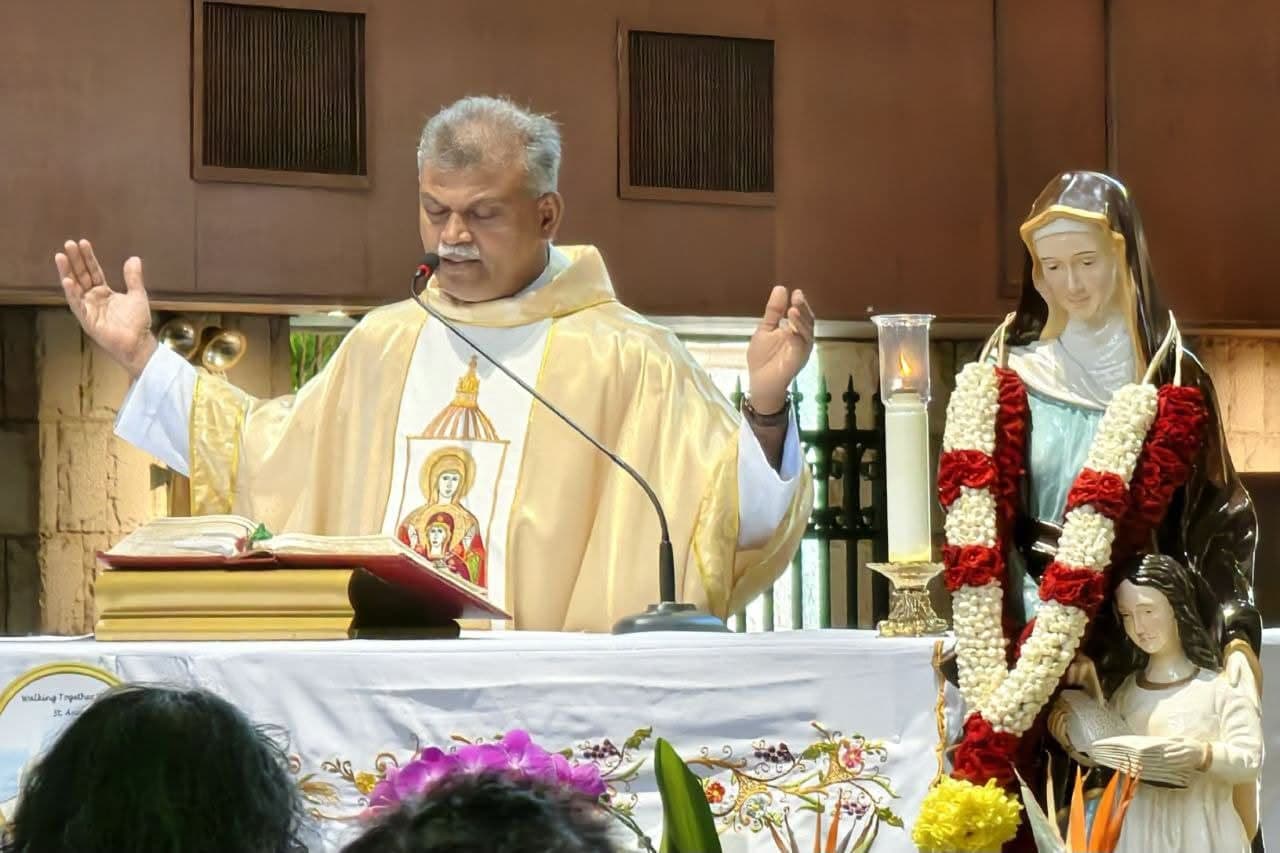
Penang (AsiaNews) – In this final week of July, churches dedicated to Saint Anne throughout Malaysia have entered one of the most intense periods of the Catholic liturgical year, with novenas, processions and special Masses attracting thousands of pilgrims ahead of the saint’s feast day, which falls on 26 July.
The annual celebration, which has become one of the largest Catholic pilgrimages in South-East Asia, has its roots in a missionary legacy that began with the work of the Paris Foreign Missions Society (MEP), whose priests helped to spread devotion in what was then British Malaya.
Whilst parish celebrations take place across Peninsular Malaysia – in Sabah and Sarawak – the spiritual heart of the devotion remains the Church of St Anne in Bukit Mertajam, Penang, where tens of thousands of pilgrims are once again taking part this year in the nine-day novena leading up to the feast of Saints Joachim and Anne, the parents of the Blessed Virgin Mary and the grandparents of Jesus.
For Catholics in Malaysia, July has increasingly become ‘the month of St Anne’, with many families making annual pilgrimages to seek her intercession for healing, family unity, children, vocations and perseverance in the faith. It is common for pilgrims to walk long distances, fulfil vows made in previous years or return as an expression of thanksgiving.
This devotion has also spread far beyond the borders of Penang. Churches dedicated to Saint Anne throughout Malaysia – including those in Singapore, Sarawak and Sabah – have organised novenas and special prayers, bearing witness to the enduring appeal of a saint venerated as the patroness of families, mothers, grandparents and couples praying for children.
A missionary legacy
The history of devotion to Saint Anne is inextricably linked to the missionary work of the MEP priests, who evangelised much of Peninsular Malaysia in the 19th century. The first chapel dedicated to the saint was founded in Bukit Mertajam in 1846 by Fr Adolphe Couellan, to serve a small but growing Catholic community, largely made up of migrants working in agriculture and trade. The chapel became a centre of Marian and family spirituality, with devotion to Saint Anne spreading.
A decisive moment came under the leadership of Fr Benoît-Marie Sempé, who served as parish priest at the end of the 19th century. Aware of the growing number of pilgrims, he promoted the annual celebrations of the feast of Saint Anne and encouraged Catholics from across Malaysia to make a pilgrimage to Bukit Mertajam. His pastoral commitment transformed what had begun as a local parish celebration into a regional pilgrimage attracting the faithful from diverse ethnic and linguistic communities.
As the number of worshippers grew, larger churches were built. The centrepiece of the annual pilgrimage is the Minor Basilica of Saint Anne in Bukit Mertajam, Penang, which was elevated to the status of Minor Basilica by Pope Francis in 2023, in recognition of its long history as one of the major pilgrimage sites in South-East Asia.
The basilica complex includes the current main church, completed in 1962, which replaced earlier structures built to accommodate the growing number of pilgrims. Today, the extensive grounds, the open-air altar, the Way of the Cross and the areas for prayer and devotion welcome tens of thousands of worshippers every July, making it Malaysia’s largest annual Catholic pilgrimage. The annual festival also attracts pilgrims from neighbouring countries such as Singapore, Thailand, Indonesia, the Philippines and other parts of Asia, bearing witness to the transnational nature of the Catholic faith, which was initially spread by missionary priests.
Among the thousands of pilgrims will be Joseph Michael Savrimuthu, who will take part in the celebrations at St Anne’s Church in Port Klang, in the Archdiocese of Kuala Lumpur. He told AsiaNews: “My devotion to St Anne began thanks to my late parents. Every year, my father would take all of us children to St Anne’s Church and ask our ‘grandmother in the faith’ to intercede for us, especially so that we might do well in our studies. It became an important family tradition.”
“As a child, I suffered from severe asthma and was often ill. My parents never stopped praying to Saint Anne for my recovery and for the well-being of all my brothers and sisters. When my health improved, our annual pilgrimage became not just a visit, but a journey of thanksgiving,” he added. “Although my parents have now passed away, we have carried on the tradition they began. Every year we make our pilgrimage to Saint Anne because it reminds us of their faith.”
Faith passed down from generation to generation
Although little is known historically about the figure of Saint Anne, Christian tradition has long honoured Anne and Joachim as the people who raised Mary in the faith, making them timeless models of family life and the passing on of the faith across generations. This theme resonates strongly in Asia, where respect for parents, grandparents and the elderly remains deeply rooted in many cultures. For many Malaysian Catholics, devotion to Saint Anne is not simply a pilgrimage, but an annual renewal of the family’s faith.
The popularity of the feast has taken on renewed significance during the Church’s Jubilee Year as well, as pilgrims seek reconciliation, healing and hope amidst economic uncertainty, family pressures and global conflicts. More than 175 years after the first MEP missionaries introduced the devotion to Bukit Mertajam, the feast of Saint Anne remains one of the most striking examples of how missionary evangelisation has taken deep root in Asia.