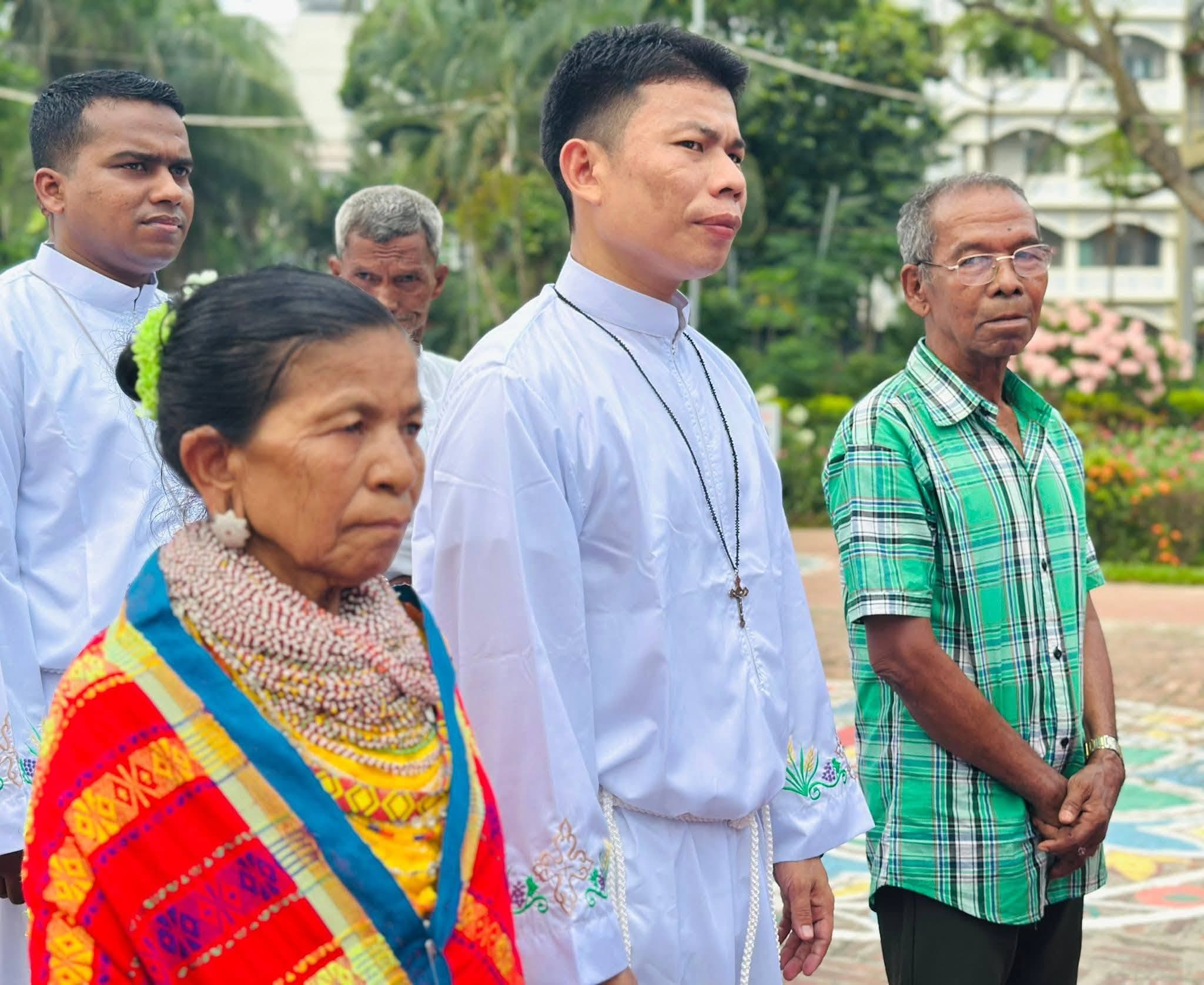
Bandarban (AsiaNews) – It was a moment that many Catholics in the remote Chittagong Hill Tracts, a hilly region in southeastern Bangladesh, never imagined they would live to see.
Hundreds gathered in Bandarban today to witness the priestly ordination of a member of their own community, marking a significant milestone for the Church in the country’s indigenous and tribal areas.
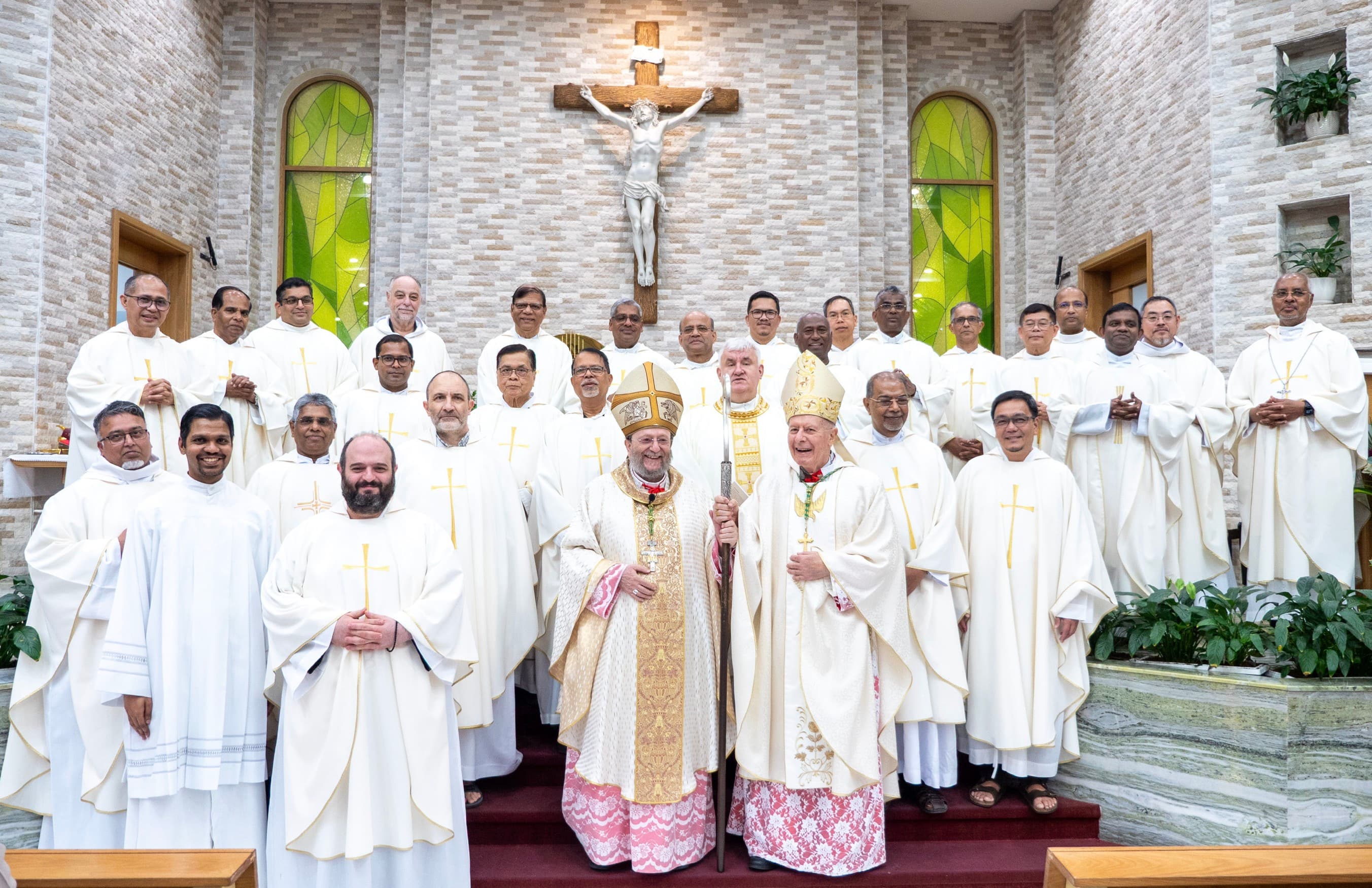
More than 500 people crowded inside the Bolipara parish church in Bandarban as Archbishop Lawrence Subrato Howlader, CSC, Metropolitan Archbishop of Chattogram, presided over the ordination of 29-year-old deacon Francis Sadhumoni Tripura.
For local Catholics, the ceremony was more than just a personal achievement; it was a historic event for a region long defined by geographical isolation, poverty, and limited access to educational opportunities.
Father Francis Tripura is the first clergyman to come from Bolipara parish, and the first to be ordained in the Chittagong Hill Tracts.
Although two other priests from the region had been ordained previously, their ceremonies took place outside the hill districts, making this occasion especially meaningful for the local Tripura community.
“This is a day of immense joy for our people,” said several of the faithful present at the celebration, reflecting a sense of pride shared across the villages scattered throughout the mountainous region.
In his homily, Archbishop Howlader described the priesthood as a call to serve rooted in the grace of God rather than in personal ambition.
“Francis received the first anointing at baptism and a second through Confirmation,” the prelate explained. “Today he receives a third anointing, not for himself, but to carry out the mission entrusted to him by God.”
The archbishop reminded the newly ordained priest that his vocation was inseparable from service to others.
“God calls certain individuals to this mission, and Francis has responded to that call,” he said. “From this day forward, he will work for the well-being of the faithful and help them understand the teachings of the Holy Bible.”
The prelate urged him to remain faithful to the Scriptures, to proclaim the Gospel faithfully, and to exercise leadership with humility and respect for the people entrusted to his care.
“Look at the love the faithful have shown you today,” he said. “You are called to sanctify God’s people through the sacraments and to serve them with reverence.”
For Father Tripura, his ordination marks the culmination of a journey defined by hardships, losses, and perseverance.
Speaking to AsiaNews after the ceremony, the newly ordained priest talked about growing up in a poor family, the ninth of eleven children.
His parents never suggested a religious vocation to him, and he himself had not dreamt of becoming a priest from a young age.
“My ambition was simply to receive an education and build a future,” he said.
He credits much of his spiritual awakening to the witness of the Congregation of Our Lady of the Missions (RNDM), whose hostel welcomed him during his school years.
“The selfless love, prayerful life, and service of the sisters deeply touched my heart,” he said. “A desire to become a priest slowly began to grow within me, but I kept it hidden because of fear and a lack of confidence.”
Later, financial difficulties forced him to leave the hostel, seemingly putting an end to his aspirations. Yet, what appeared to be the end became the beginning of a deeper process of discernment.
A decisive moment arrived in 2011, when he attended a thanksgiving celebration for the priestly ordination of Father Gabriel Tripura at Thanchi parish.
“Seeing the joy of the people and their respect for a priest made me realise that a priest is a living reflection of Christ on earth,” he said. “That day I made a silent promise to become a servant at God’s altar.”
After completing secondary school, Father Francis turned to his parish priest, Father Sudhir Das, who encouraged him to pursue his education.
His vocational journey took him to seminaries in Barishal and Dhaka, though the path proved to be anything but easy.
In 2016, an accident forced him to leave the seminary, a setback he describes as the most painful chapter of his life.
“To many people it looked like the end of my vocation,” he said. But “For me, it became an invitation to rely more deeply on God.”
In the years that followed, he maintained contact with the priests and continued to pray for an opportunity to return. Eventually, with the encouragement of local Church leaders, including the late Archbishop Moses Costa, he resumed his education.
Further trials would follow, along with other family hardships, including his father’s death, the loss of an older brother, periods of uncertainty outside the seminary, and even the destruction of his family home in a fire.
“At times it seemed there was no road ahead,” he said. “But I discovered that what appears closed in human eyes can become a new possibility in God’s hands.”
The ordination carries a significance that extends beyond the Church, given what it represents for the indigenous communities of the Chittagong Hill Tracts.
The region, home to various ethnic groups, including the Tripura people, has long struggled with economic marginalisation and limited access to educational opportunities.
For local Catholics, Father Tripura’s journey from a poor mountain village to the altar serves as a beacon of hope for many young people facing similar obstacles.
With approximately 3,300 Catholics, Bolipara parish stands out as one of the most vibrant communities in the area.
The ordination of its first priest is seen as a turning point, one that may offer fresh hope for evangelisation, youth ministry, and missionary outreach in a region where there is still ample room for the Gospel to spread among remote mountain communities.
Nevertheless, “This story is not about my plans,” the newly ordained priest said. “It is the story of God’s love, mercy, and faithful call.”