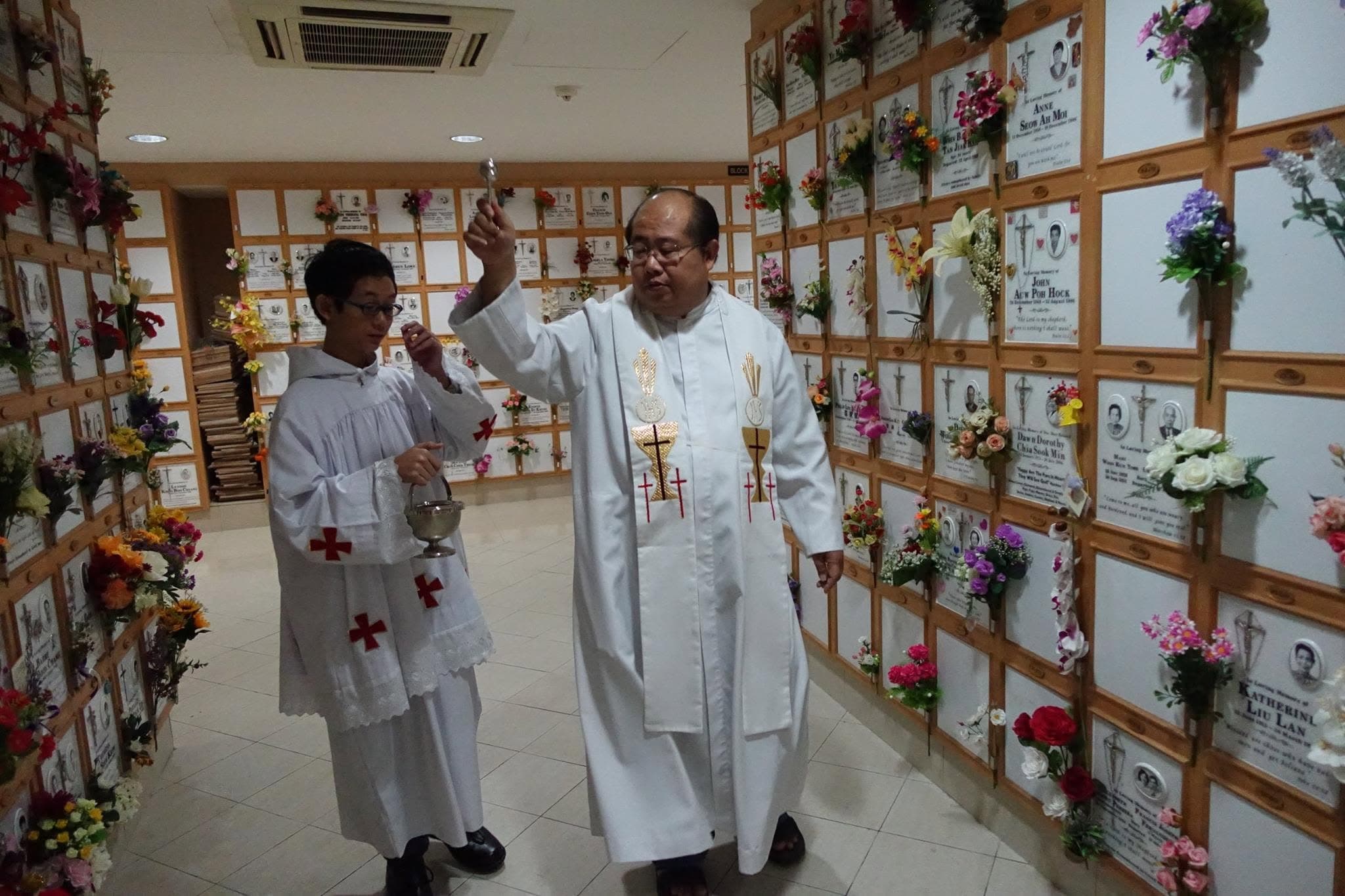
Singapore (AsiaNews) – A debate on cremation has opened up within the Church in Singapore. The island nation’s plan to introduce, from the second half of 2027, a ferry service for the scattering of the deceased’s ashes at sea does indeed offer families a further ‘option’ for commemorating their loved ones; however, the initiative also highlights the ‘divergences’ between evolving funeral practices and Catholic teaching regarding the treatment of ashes.
The National Environment Agency (NEA) has announced the launch of a two-year pilot scheme, with weekly sailings departing from the Pasir Panjang ferry terminal. The service will allow multiple groups to travel on the same vessel, at a cost of 50 Singapore dollars (just under 35 euros) per booking.
The initiative comes at a time when the city-state’s population is ageing and the number of deaths is rising. According to NEA estimates, annual deaths will rise from 26,500 in 2025 to around 40,000 by 2040, and approximately 82 per cent of the deceased are cremated.
In 2021, the government introduced facilities for the scattering of ashes on the mainland; their use has grown as families have begun to seek alternatives to traditional burial or the storage of ashes in columbaria.
However, for Catholics, the question of what happens after cremation is not merely a matter of cost, practicality or personal preference. It touches on issues such as the dignity of the human body, belief in the resurrection of the dead, and the Church’s guidelines regarding the proper disposal of ashes.
‘Dignified’ cremation
Historically, the Catholic Church has favoured burial because it reflects the Christian belief in the resurrection of the body, and cremation was not permitted, although certain restrictions have been lifted over time.
In 1963, the Vatican permitted the practice, provided it was not chosen to deny Christian doctrine. The 1983 Code of Canon Law subsequently stipulated that the Church strongly recommends burial, whilst permitting cremation, provided that it does not constitute a denial of faith in the resurrection.
The Church’s position, however, does not imply that ashes may be treated or scattered in any manner whatsoever.
In 2016, the Congregation for the Doctrine of the Faith issued the instruction Ad resurgendum cum Christo, in which it reaffirms that cremated remains must be treated with respect and, as a rule, kept in a sacred place such as a cemetery or a columbarium within a church, subject to appropriate authorisation.
The scattering of ashes into the air, onto the ground or into the sea is therefore prohibited, as is their division amongst family members or their preservation inside jewellery or other mementoes.
The Church’s position reflects the view that the human person constitutes a unity of body and soul and, although cremation does not prevent God from raising the dead, the remains of the deceased must continue to be treated with dignity and respect. This distinction takes on particular significance in Singapore, where facilities for the scattering of ashes on land have become an increasingly common option.
Lack of space
Singapore’s limited land area has long influenced the way in which families organise funerals. In government-run cemeteries, burial plots are granted for a period of 15 years, after which the remains are exhumed and handled in accordance with established procedures.
These constraints, combined with the rising number of deaths, have made cremation the preferred choice for many families. According to the NEA, the proportion of cremated remains scattered at inland sites rose from around 7 per cent in 2022 to 12 per cent in 2025.
A study on spaces dedicated to wake services, conducted by the Institute of Policy Studies at the National University of Singapore, found that 42 per cent of respondents expressed a preference for the scattering of ashes. Of these, 27 per cent opted for the sea, whilst 15 per cent indicated inland facilities. The proposed ferry service meets this demand by offering a more accessible solution for families wishing to scatter ashes at sea.
Chew Ming Fai, NEA’s Deputy Chief Executive and Director-General for Public Health, stated that the agency is committed to offering a “wider variety of options”, in line with people’s evolving needs and preferences. The agency will monitor public response and gather feedback during the two-year pilot scheme to determine whether the service should be continued, whilst funeral directors will help families navigate the various options.
Support for families
In this regard, Harmony Funeral Care (HFC), a funeral director in the city-state, has explained how the organisation of funerals and the requirements of the Catholic Church affect families who opt for cremation.
The guidelines explain that Catholic funeral rites are traditionally centred on the presence of the deceased’s body during the funeral Mass, and cremation may take place after the funeral rites. However, cremation is also permitted before the funeral rite, in accordance with current liturgical provisions.
On its website, HFC states: “ Our guidelines also emphasise that ashes should not be divided up to create keepsakes and that, for Catholics, they are intended to be placed in a sacred and appropriate resting place, rather than being kept at home as is customary”. “These considerations,” it adds, “may be relevant for families weighing up the practical advantages of cremation against their religious commitments”.
“It is also important,” the funeral firm advises, “to distinguish between the scattering of ashes and their storage in a sealed urn. Families should not assume that a practice permitted under general funeral regulations automatically complies with Catholic requirements. It is advisable to consult one’s parish priest or the diocesan authorities before making any decision, especially when considering scattering at sea.”
“The Church’s rules on the final disposition of ashes,” it concludes, “remain distinct from government regulations governing funeral services. The ferry service proposed by the NEA is a public initiative and does not constitute an endorsement by religious communities of every method of ash disposal.”
Despite doubts and uncertainties arising from differing requirements and expectations between the state and religious faiths, the experience in Singapore shows how demographic changes, a shortage of burial space and evolving preferences are transforming the way in which the deceased are commemorated.
Finally, for Catholics, the challenge lies in organising funerals in a way that meets practical needs, whilst never losing sight of the faith’s vision regarding the dignity of the deceased and the hope of the resurrection.