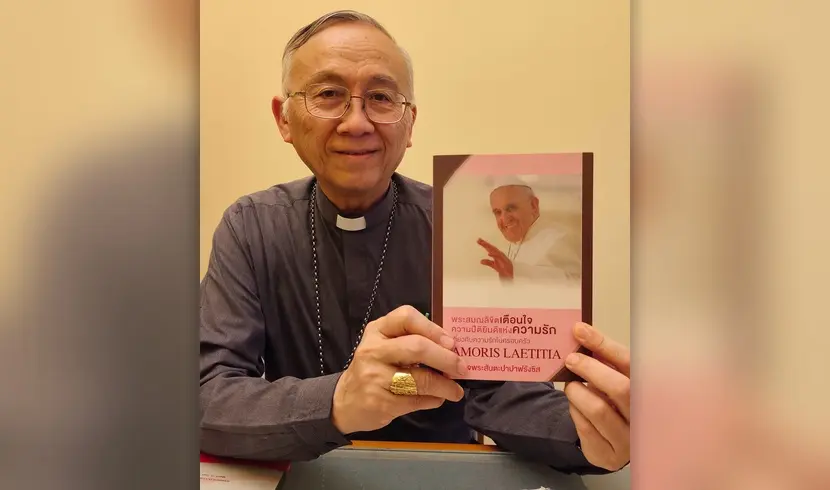
Rome (AsiaNews) – “With Amoris Laetitia, first Pope Francis and now Pope Leo XIV are asking us to put the family back at the forefront.” Monsignor Francis Xavier Vira Arpondratana, Archbishop of Bangkok and President of the Thai Bishops’ Conference, summarises in this way the challenge bequeathed to the Churches of Asia by the meeting “Ten Years On from Amoris Laetitia: Proclaiming the Gospel with Families Today’, which last week brought together in Rome the presidents of the world’s bishops’ conferences, alongside leaders of the Eastern Churches and couples from all five continents. Archbishop Vira begins by explaining the importance, for the various documents produced by the Vatican, of working on translations into local languages so that the texts can be effectively accessible to the faithful. “The translation of Amoris Laetitia into Thai took a year of hard work,” he says, showing us the text.
“The doctrine is clear, but it is important not to focus solely on that,” he adds. “We must also understand the challenges of real life and be close to people and empathetic,” he commented, speaking on the theme of the fragility of families, addressed in Chapter 8 of Amoris Laetitia, which was one of the items on the agenda of the Vatican meeting. The process of showing closeness and empathy has been facilitated over the past few days by the priority given to listening, in keeping with the synodal approach. And amongst the issues that have emerged, says the Archbishop of Bangkok, are those of globalisation, economic difficulties, falling birth rates, depression, and the challenges posed by digital technology and artificial intelligence. “The decline in birth rates in Thailand is drastic,” continues Archbishop Vira, echoing the reality in other Asian countries and, undoubtedly, in many European countries. But depression and psychological challenges should not be underestimated either, and the dioceses are working to support young people through their difficulties.
“Religious practice is on the decline not only amongst Christians but also amongst other religious communities,” testifies the archbishop, who sees a direct link between technological progress, greater prosperity and a drift away from the life of faith and community. “This should not, however, come as a surprise to us. Even the Old Testament speaks to us of these processes: people become wealthy, turn away from God, and then believe that God is punishing them. But it is not God who punishes; it is the way of life we lead that needs to be reformed.”
In a country where the Christian community accounts for just 1 per cent of a largely Buddhist population, 97 per cent of marriages are interfaith, states the president of the Bishops’ Conference. Marriage preparation is seen as important, but there is no structured provision to support couples in this diversity. A great deal of effort is instead devoted to Catholic education, with a far greater number of institutions than the actual Christian presence in the country would suggest.
“In Thailand,” explains Bishop Vira, “we have 370 Catholic schools and two Catholic universities. We invest in high-quality education, employing qualified teachers and purchasing state-of-the-art technology, to ensure our children are educated within a Catholic context.” Having been associated with the Thai catechetical office for many years, eventually becoming chairman of the National Commission for Catechesis, Monsignor Vira cannot help but emphasise this point: the formation of the laity and the empowerment and growth of the laity.
Returning to the meeting that has just concluded at the Vatican, the opportunity to listen to one another and to recognise the strengths and challenges that may be shared or that are specific to one context compared with another is a gift offered by the Universal Church. “It is clear that amongst us Asians, our ties are strong and we already know one another. When we gather for the plenary session of the Federation of Asian Bishops’ Conferences (FABC), we spend three weeks together and work to identify the common priorities of our pastoral work”, comments Bishop Vira, holding up the book containing the text of the Bangkok Document – the final programmatic and pastoral document of the last FABC assembly, published in 2023 – in which attention to the family and the accompaniment of young people are already central to the action points.