Hanoi (AsiaNews) – Almost a hundred residents of Hanoi’s Hồng Hà district gathered last Sunday evening to discuss a project for a major scenic boulevard along the Red River.
When police officers arrived and asked the residents to disperse, the locals challenged the request, arguing that the gathering was lawful.
The officers eventually left, and the meeting continued, according to the Vietnamese outlet Luật Khoa, which heard accounts from participants and reviewed videos shared by residents.
The protest took place amid an ongoing public consultation process, launched by Hanoi authorities on 7 September and scheduled to end on 27 September, regarding the Red River urban plan and the project’s route.
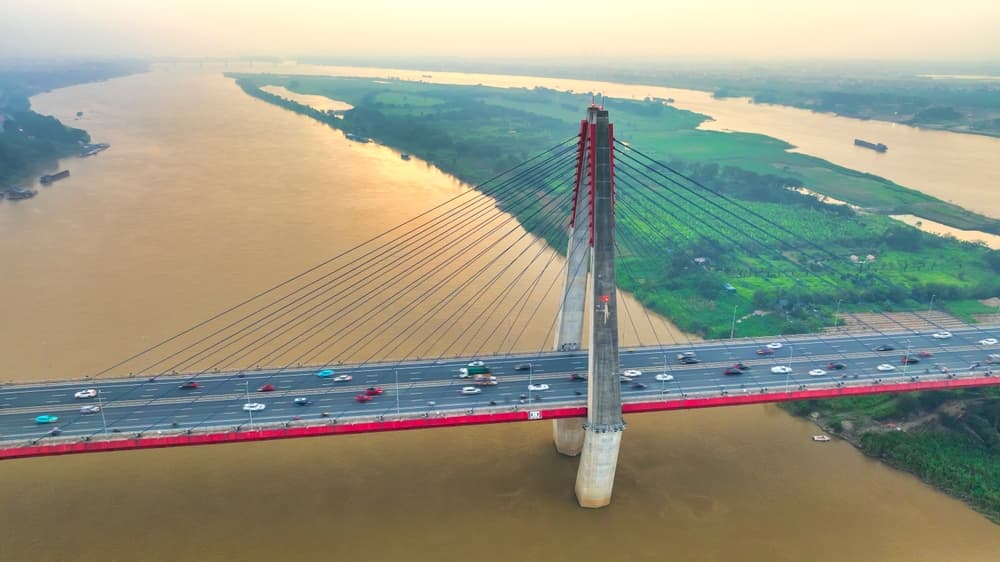
Known as the Red River Scenic Boulevard Axis (Trục Đại lộ Cảnh quan Sông Hồng), this vast and ambitious urban transformation programme for the Vietnamese capital seeks to transform both banks of the river into a modern green corridor featuring commercial and cultural activities.
The project covers an area of approximately 11,418 hectares (larger than the city of Paris) stretching 40 kilometres between the Hồng Hà and Mễ Sở bridges, spanning 16 districts and communes. The preliminary investment is estimated at 736.963 trillion dong (about US$ 28 billion), with construction between 2026 and 2038.
According to data provided by the city administration, the area covered by the project is currently home to some 70,474 households or 247,431 people.
Hanoi intends to ensure the resettlement of some of these families, estimating that between 79,000 and 85,000 housing units and plots in the Long Biên, Lĩnh Nam, and Đông Anh areas will be required to relocate the population.
The fate of entire neighbourhoods is one of the project's most controversial aspects. The urban plan divides settlements along the Red River into three groups: those slated for relocation, those to be rebuilt, and those to be preserved and redeveloped.
During the Sunday meeting, some residents pointed out that they had already been relocated once before, in 1997, from other parts of the capital.
One elderly resident explained his refusal to undergo a second relocation, arguing that the neighbourhood's infrastructure is already fully functional and that the planned compensation would not allow families to purchase new homes.
Other residents called for the existing residential area to be maintained in order to preserve community stability.
Concerns extend beyond the Hồng Hà area. On 17 September, during a meeting organised by the Hanoi Department of Construction, over 30 local community representatives submitted more than 100 comments on the project, voicing concerns over various issues, including flood safety, the protection of monuments and cultural heritage, implementation timelines, land use, and, above all, the guarantees provided to the population regarding the relocation process.
The authorities responded by saying that the guiding principle would be to guarantee living conditions equal to or better than existing ones and, whenever possible, to prioritise resettlement within the same neighbourhood or municipality.
The plan designates approximately 265 hectares of land for the resettlement of people in the areas affected by the project.
For the land that meets the specified criteria, Hanoi has also provided for monetary compensation at double the standard rates for residential, agricultural, and non-agricultural land.
Still, concerns have arisen in recent weeks regarding the procedures and timeline for the relocation.
On 16 September, the Hanoi administration approved Decision 127/2026; once it enters into force on 26 September, it will govern land reclamation even in cases where the permanent resettlement of the population has not yet been completed.
Some residents fear they may have to live in temporary housing for an extended period. They also believe this new measure contradicts earlier assurances from the authorities.
In June, the Chairman of the Hanoi People's Committee, Vũ Đại Thắng, had stated that the relocation of residents would only take place after the completion of new neighbourhoods equipped with all necessary infrastructure.
So far, the authorities have sought to contain the protests. As early as 30 June, Hanoi police warned people against exploiting disputes over land expropriation to spread false information or organise gatherings.
On Sunday, the same day as the impromptu gathering in Hồng Hà, the Ministry of Public Security’s newspaper, Công an Nhân dân, published an article titled “Beware of tactics involving disinformation and incitement to confrontation”, blaming “hostile forces” trying to exploit residents’ concerns about the project in order to fuel conflict with the authorities.
According to Luật Khoa, following initial resident demonstrations in May of this year, civil defence forces removed certain banners, and a website created to provide the public with information on the consultation process is no longer accessible from within Vietnam.
As the public consultation enters its final phase and a new expropriation procedure is set to take effect, residents along the banks of the Red River are calling, above all, for promises regarding resettlement to be turned into concrete guarantees before Hanoi’s major transformation project begins to alter the neighbourhoods where they live.