Kuala Lumpur (AsiaNews) – Singapore is once again turning to the sea as part of its territorial expansion plans. Prime Minister Lawrence Wong has announced plans to create a new western island by joining several islets south of Jurong, the latest chapter in the city-state’s decade-long effort to overcome its land shortage. The proposed island will bring together Semakau, Bukom, Pulau Sudong and several smaller islets. The government states that the expanded territory could support a new generation of industries, including advanced manufacturing and energy production, whilst not ruling out military purposes either.
Wong announced the plans during Singapore’s National Day Rally on 23 August, describing them as part of the country’s long-term development plans, which are the result of careful study. The proposal is significant not only for the industries it could host, but also because it demonstrates how Singapore continues to expand by reshaping its coastline and reclaiming land from the sea.
Today it covers an area of around 744 km², but at the time of independence in 1965, the island nation covered ‘only’ 580 km². In other words, Singapore has added over 160 km² of land over the decades – an increase of around 28 per cent – and much of this expansion has come through land reclamation.
Building Outwards
Land scarcity has been one of Singapore’s defining constraints since independence. Unlike larger neighbours such as Malaysia and Indonesia, the city-state has little room to expand inland. Its response has repeatedly been to expand outwards. Land reclamation has taken place in successive waves, transforming the coastline, filling in shallow waters and connecting offshore islands to the mainland or to one another.
The result is visible throughout the country: Changi Airport is partly situated on reclaimed land. Much of Marina Bay has been reclaimed. Jurong Island – now one of the world’s leading energy and chemical hubs – was created by joining several smaller islands and reclaiming the surrounding waters. Singapore’s east coast has also been extensively reclaimed, expanding industrial and port facilities at Tuas and elsewhere.
There is therefore no single point in time when Singapore ‘began’ to reclaim land from the sea. It has been an ongoing national strategy for decades, with major land reclamation projects undertaken at various times for housing, ports, airports, industry, transport and infrastructure. The government has previously estimated that Singapore’s land area increased by about a quarter between the 1960s and the 2010s through land reclamation and other land-creation measures. The next phase could be considerably more ambitious in strategic terms.
New Western Island
Wong cited Jurong Island as an example of what Singapore can achieve when it reclaims land for strategic industries. When it needed additional space for its petrochemical industry, the government reclaimed land and merged islands to create Jurong. Today, Jurong Island is a global hub for energy and chemicals, supporting thousands of jobs and industries still considered vital to the city-state’s economy and energy security. In this sense, the proposed western island appears to follow the same philosophy: first creating the physical space, then using it to host industries deemed essential to its future.
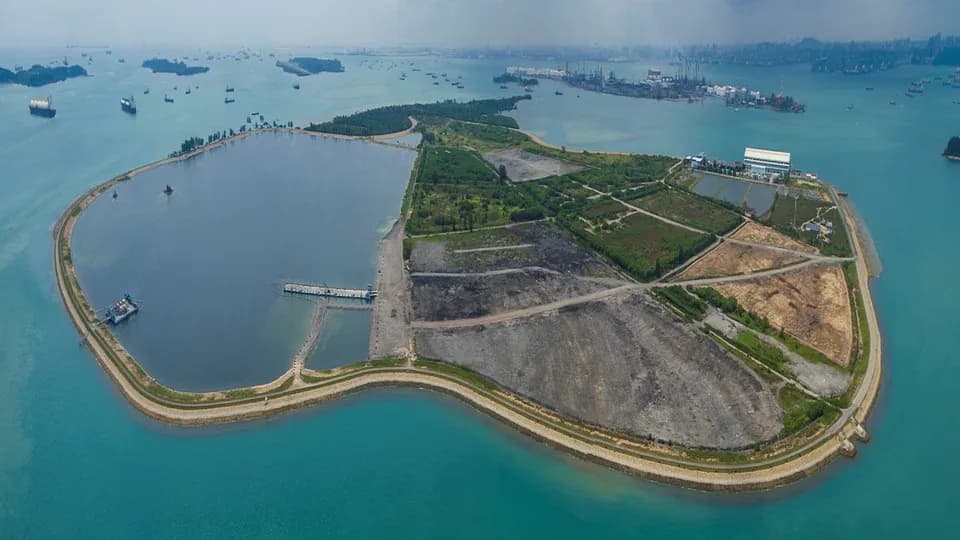
The location is particularly significant. Bukom is home to Singapore’s first refinery and remains part of the country’s energy and petrochemical infrastructure. Semakau is the site of Singapore’s offshore landfill, one of the most distinctive consequences of land constraints. Pulau Sudong, meanwhile, has a landing strip used by the Armed Forces during emergencies. Bringing these islands and the smaller surrounding territories into a larger landmass could therefore create a substantial strategic zone combining industrial, energy and defence functions. The government has yet to provide the full scale, timeline or engineering details of the proposed project. But the announcement sends a clear message: the search for space is far from over.
Land reclamation
The history of land reclamation is also an environmental one, the transformation of which has come at a significant ecological cost. Coastal habitats – mudflats, mangroves, coral reefs and intertidal zones – have been altered or lost as the coastline has been progressively reshaped. At the same time, Singapore has developed increasingly sophisticated environmental safeguards and mitigation measures. Its offshore landfill at Semakau, for example, was designed with an extensive marine containment system and has gained international renown for the way it has sought to combine waste disposal with environmental management.
The dilemma, however, remains: every new piece of land reclaimed from the sea brings economic and strategic opportunities, but it also alters marine ecosystems and coastal processes. The proposed western island will therefore inevitably raise questions about what happens to the waters and habitats surrounding Semakau, Bukom, Sudong and the other islands. There is also another challenge from which Singapore cannot find a way out: climate change. A country whose coastline has been extensively engineered is also one of the countries most exposed to rising sea levels and coastal flooding. The government has invested heavily in coastal protection, including a long-term national programme to reinforce vulnerable coastlines.
A hunger for space
Singapore’s land area may appear substantial on a map, but its population, infrastructure and economic ambitions make every square kilometre precious. The city-state is home to around six million people and must accommodate housing, industry, ports, airports, military installations, transport infrastructure, parks, reservoirs and public services within a strictly limited territory. Its land reclamation programme has therefore never been simply about gaining more land. It has been about deciding what sort of country Singapore wants to become.
In the 1960s and 1970s, land reclamation helped provide space for a rapidly industrialising nation. Later, reclaimed land supported new residential estates, commercial districts, airports and port facilities. Jurong Island demonstrated how land creation could also give rise to an industrial ecosystem. Now, the proposed Western Island marks another phase, in which the land itself is designed around strategic industries, energy resilience and national security. The sea thus becomes the final frontier. But unlike a conventional frontier, it cannot simply be occupied; it must be designed, funded, managed from an environmental perspective and protected from the very sea from which the land is created.
Engineering project
For Singapore, this is ultimately a story of survival, sovereignty and the limits of geography. It has joined islands together. It has filled in shallow waters. It has built ports and airports on reclaimed land. It has created Jurong Island from a group of islets. It has built an offshore landfill because there was not enough space on the mainland for waste. It is now considering another transformation: merging several southern islands into a larger western island to meet future industrial and strategic needs.
The result is remarkable. But it also raises a broader question for a world facing rising sea levels and ecological constraints: to what extent can a nation continue to reclaim new land from the sea before the environmental and climate costs become part of the equation? For Singapore, the answer has always been that necessity breeds innovation. The city-state may well be one of the world’s smallest countries, but it has never allowed its size to determine the scale of its ambitions.