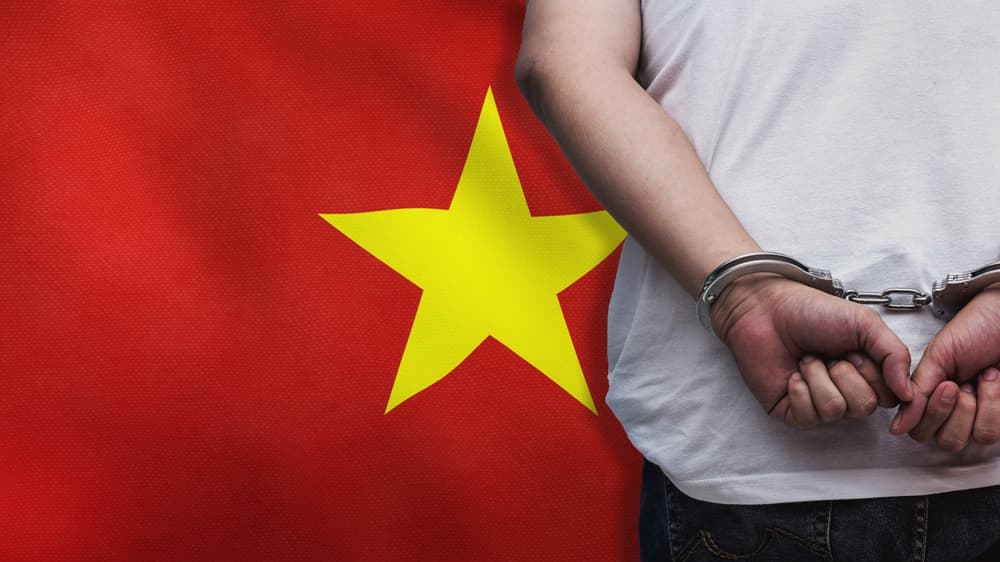
Hanoi (AsiaNews) – “I never crossed the border,” said Hiep Tran, an activist with Australian citizenship, to his family from detention in Vietnam, in a message sent via the Australian consulate.
Tran went missing on 18 September in Cambodia, where he had been staying with two other activists of Vietnamese origin.
Ten days later, Vietnamese authorities in Hanoi announced his arrest, confirming that they were also holding Nguyễn Đức Thuận, a Norwegian citizen, and Thái Công Trường Sơn. All three are accused of entering the country illegally to carry out acts of terrorism and sabotage.
Tran is a member of Việt Tân, a political organisation in the Vietnamese diaspora that Hanoi classifies as a terrorist group. Australian consular officials were only able to meet with him on 15 October, nearly a month after his disappearance.
His wife, Chloe Dang, stated that her husband is in a fragile psychological state, gripped by fear, and is suffering from blood pressure issues. According to the family, Vietnamese authorities have yet to provide sufficient details regarding the charges brought against him.
Transnational Repression
Hiep Tran’s case is just one more instance of transnational repression, the practices through which a state seeks to silence opponents and critics, even when they are abroad. In Southeast Asia, this frequently involves the authoritarian governments of Cambodia, Laos, Vietnam, and often Thailand as well.
According to Phil Robertson, director of Asia Human Rights and Labour Advocates, Hanoi “not only has the capacity to do this but also the political will” to abduct people abroad. “All they need is a willing partner.”
There are several precedents. In a recent interview with The Vietnamese Magazine, Robertson pointed to the case of Đường Văn Thái, a blogger critical of the government who disappeared in Thailand in April 2023, only to later reappear in Vietnamese custody.
In 2024, he was sentenced to 12 years in prison for propaganda against the state. Another case is that of Y Quỳnh B’Đăp, an activist from the Ê Đê minority and co-founder of the group Montagnards Stand for Justice.
After obtaining refugee status from the UN refugee agency and living in Thailand since 2018, he was extradited to Vietnam in November 2025, despite appeals from human rights organisations concerned about the risk of torture and mistreatment.
Online censorship and convictions for dissent
In Vietnam, many dissidents express themselves through blogs, videos, and social media, speaking out against corruption, abuses by the authorities, land expropriations, and restrictions on religious freedom. However, the Internet is also one of the primary spaces subject to state surveillance.
In its Freedom on the Net 2025 report, Freedom House gives Vietnam a score of 22 out of 100 for Internet freedom. A decree issued in November 2024 mandates that platforms identify and remove illegal content, verify user identities, and retain and provide data to the authorities, with limited safeguards against potential abuse.
In May 2025, the Ministry of Information and Communications blocked Telegram, accusing the platform of disseminating content directed against the government.
The country’s penal code also provides tools for prosecuting those who criticise the authorities of the Communist Party of Vietnam.
Article 331, for instance, is used to prosecute individuals who have exercised their freedoms in ways the government deems harmful to the interests of the state, an expression that Human Rights Watch (HRW) describes as vague and prone to arbitrary application.
In an April 2025 report, the organisation identified at least 124 people jailed between 2018 and February 2025 under Article 331.
Under the same provision, land rights activists Võ Thị Phụng and Nguyễn Văn Tống were charged in October of last year after they were detained for opposing the establishment of an industrial park on land confiscated by local authorities.
Another emblematic case is that of Hoàng Thị Hồng Thái, a political commentator who, for years, shared observations on the country’s political and social situation on social media, amassing 118,000 followers.
In April 2025, after questioning by the police regarding her posts, the blogger wrote that she had been forced to choose between continuing to express her opinions and caring for her autistic son. A few days later, she resumed her writing. Arrested on 7 January of this year, she was sentenced on 29 July to six years in prison for propaganda against the state.
According to HRW, more than 160 political prisoners are being held in Vietnam. For this reason, the organisation issued an appeal yesterday to Danish Prime Minister Mette Frederiksen, coinciding with the visit to Copenhagen of Vietnamese President and General Secretary of the Communist Party Tô Lâm.
In its statement, HRW slams the intensification of repression over the last decade, a period during which, as Robertson also notes, “the international consensus on pressuring Việt Nam has dissipated” because the international community “is so eager to trade with Vietnam that it overlooks human rights abuses.”
Vietnamese workers are (still) without trade unions
Three days ago, Hanoi signed a free trade agreement with the European Free Trade Association (EFTA), which comprises Switzerland, Norway, Iceland, and Liechtenstein; following the 2020 deal, European Union countries may soon sign new agreements as well.
According to Robertson, the fact that Nguyễn Đức Thuận is a Norwegian citizen may have facilitated access to consular services prior to the signing of the agreement, a sign that trade negotiations can be used as leverage against the Vietnamese government.
Yet, European countries have thus far limited themselves to acknowledging Hanoi’s promises without verifying whether the commitments made have actually been implemented, and this, despite the free trade agreement signed between the European Union and Vietnam, which includes provisions regarding labour rights, such as freedom of association and the effective recognition of collective bargaining.
A report published today explains that there are no truly independent trade unions in Vietnam, as the Communist Party continues to prevent workers from freely organising outside of state-controlled structures.
According to HRW, the reforms announced by Hanoi have failed to introduce effective procedures that would allow workers to establish and manage autonomous organisations. Furthermore, Hanoi has been arresting people who try to invoke these agreements to ensure respect for labour rights.
In 2019, journalist Phạm Chí Dũng was arrested for writing to Members of the European Parliament, urging them to postpone the ratification of the EU-Vietnam Free Trade Agreement until progress had been made on human rights.
In 2021, labour rights activists Mai Phan Loi and Đặng Đình Bách were arrested; they had sought to join the advisory group established under the agreement to monitor its implementation, which was intended to include civil society participation.
In April 2024, police arrested Nguyễn Văn Bình and Vũ Minh Tiến, officials who had advocated for more substantive reforms regarding freedom of association and trade union rights.
Despite this, in January of this year, Brussels and Hanoi elevated their relationship to a comprehensive strategic partnership. In fact, Europe has an interest in Vietnam’s mineral resources, seeking to boost cooperation to secure supplies of tungsten, rare earths, and other strategic minerals, to reduce its dependence on China.
It is against this backdrop that Vietnamese President Tô Lâm is visiting Europe.