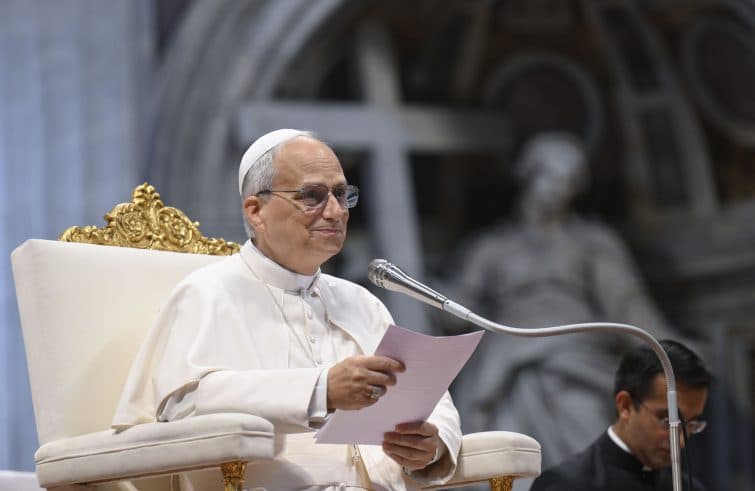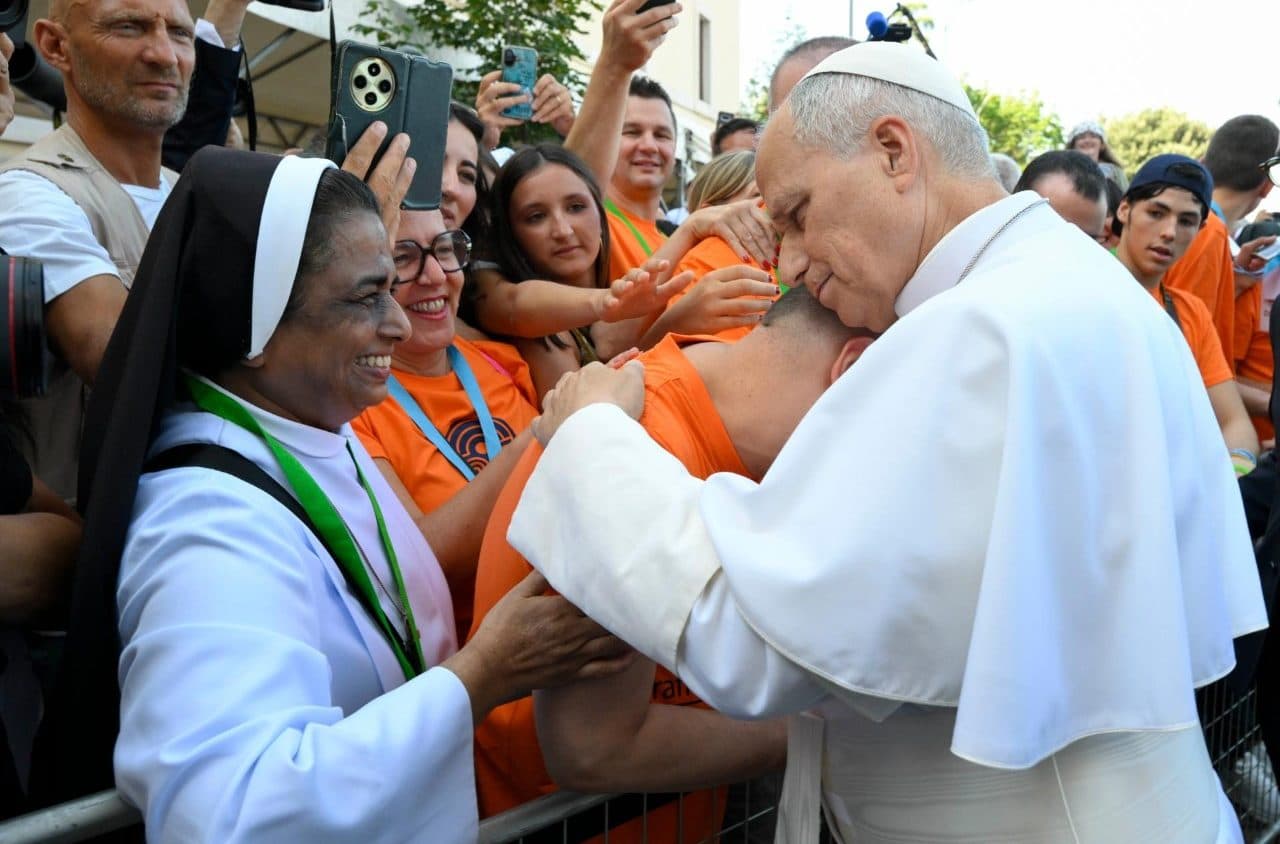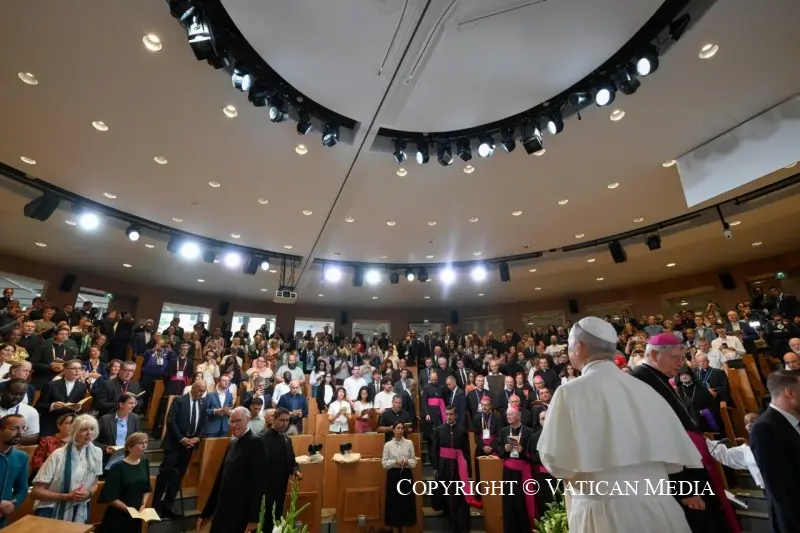
Parigi (AsiaNews) – This morning Pope Leo XIV visited the Institut Catholique de Paris, which he defines as “the intersection of science and faith that has, for centuries, helped to educate minds and hearts in the service of the Gospel.”
During his stay, he said that, “having listened to the testimonies of Jaodie Josué, Marielle, and Sophie – I am filled first and foremost with deep gratitude for God’s unfathomable work. Like you, and together with you, I am struck by the number of people returning to the threshold of the faith, and by the many adults seeking the sacraments of Christian initiation.”
To the pontiff, it may seem “paradoxical” that so many people rediscover the Gospel and faith in adulthood in “a society like that of France, which is marked by a deeply secularized culture.” Yet, “Your experience and your testimonies, dear catechumens and newly baptized, are a tangible sign of the action of God’s grace, which far surpasses statistical and sociological analysis.” This goes against a defeatist attitude that Pope Francis branded as “sterile pessimism”.
As an Augustinian, Leo was “reminded of what happened to Saint Augustine, one of the most famous catechumens in history. He was introduced to the faith by Saint Ambrose, and his faith was but a tiny seed when he was baptized. Yet that seed grew and multiplied, becoming a tree so large that, even today, we can find shelter beneath its branches.”
A “state of initiation”
Among those welcoming Pope Leo XIV in the courtyard of the Institut Catholique de Paris were the Metropolitan Archbishop Laurent Ulrich of Paris, and the Institute's rector, Father Emmanuel Petit.
This was followed by the testimonies of a Neocatechumen, a neophyte, and a companion, whom Leo XIV described as a “state of initiation” borrowing an expression “used by the French episcopate a few years ago”.
This, he added, means “discovering in them both an opportunity and a mission. The opportunity lies in the fact that, thanks to them, the community of believers can renew its own journey of faith and experience the joy of the Gospel in a new way.”
“The mission, however, consists in nurturing them and offering guidance, even after they have received the sacraments. We must joyfully welcome those who come to us, build on their spiritual experience, respect their personal history, and foster the essential proclamation of the kerygma, even drawing upon the forms they are familiar with from their own personal or communal journey. “
“In fact, we are called to reach out to our brothers and sisters, rediscovering God’s own way of acting, which is characterized by closeness, compassion and tenderness.”
The theme of initiation has been at the heart of the Church’s pastoral mission “since the years following the Second World War,” the pope noted, when “numerous proposals, and the theological and liturgical developments of those years largely contributed to the renewal of the catechumenate programs during the Second Vatican Council.”
“Although the circumstances today are different, you can draw upon this deeply rooted pastoral tradition regarding the accompaniment of catechumens. Moreover, let us not forget that the practice already in place was further strengthened in 1996, the year in which both the Letter to the Catholics of France and the latest French edition of the Rite of Christian Initiation of Adults were published.”
Turning to the issue of the “post-baptismal emptiness” that emerged in Marielle’s testimony, Leo explained that it is essential “to accompany and fully integrate these people into our communities and prayer gatherings after Baptism, offering them a welcoming environment and a formation that is as comprehensive as possible”.
“As newly baptized persons, they need to deepen their understanding of the foundations of the Christian faith, receive adequate formation in biblical and theological matters, and discover ever more fully the richness of doctrine and the various dimensions of Christian moral action that corresponds to the profession of faith.”
Enriching ourselves together
Leo then stressed that walking together “Along the pathways of the Christian faith, we enrich one another, we grow together as priests and laypeople, godparents and catechumens, pastoral leaders and the newly baptized.”
The practice of “walking together” means coming together “gradually and carefully with fraternal accompaniment,” as Saint Ambrose did with Saint Augustine.
For the pope, “some people come with a simple spiritual thirst, a search for meaning, and an attraction to the Gospel, while others arrive burdened by painful experiences, situations of loneliness, and profound difficulties.”
“It is here that a style of closeness, compassion and tenderness takes on its full meaning, and we must strike a wise balance in order to welcome them and listen to them, while also encouraging them to face the challenging demands of the faith.”
Lastly, Leo stressed the importance of celebrating the liturgical rites, which for some represents a “point of entry into the mystery of the faith itself.”
“Indeed, the liturgy cannot be regarded as something that comes ‘after’ catechesis, where one simply applies what has been learned along the way. On the contrary, it manifests and makes present Christ’s Paschal Mystery, and is, therefore, an event capable of revealing the meaning of the Good News and the very life of God. Through its rhythms, languages and rites, the liturgy forms part of the very journey of conversion and preparation for the sacraments.”
To carry out this mission, the role of “pastoral workers” is “of fundamental importance”; to this end, they must be trained “in the Bible, theology, liturgy and the spiritual life, but also in human qualities, so they know how to guide and accompany”.
“Looking at you, dear catechumens and newly baptized persons, I see not only the fruits of the Holy Spirit, who set you on this path, but also the promise of fruitfulness for the Church in France. In turn, be missionaries of the Gospel in this society!
“May the great witnesses of this beloved land sustain you on your journey. I think of Saint Thérèse of the Child Jesus, who teaches us, through her ‘little way,’ how trust opens the doors to grace, and of Saint Martin of Tours, an emblematic figure of sharing and fraternal charity.”
The poor, migrants, and young people
Before meeting the Neocatechumens this morning, on the second day of his apostolic journey to France (September 25–28), Pope Leo XIV visited the Maison Bakhita, a facility for social support and integration.
In the afternoon, the papal schedule included a Mass at the Place de la Concorde at 3:00 pm, a solemn Eucharistic celebration expected to draw around 600,000 of the faithful, with participants spilling into part of the Champs-Élysées.
Migration was the focus of the day, a topic in French political and social life characterised by tensions and, at times, violent conflict.
At the end of his stay in Paris, the pope will depart for Lourdes, where a prayer service is set for this evening at the Grotto of the Apparitions of Massabielle, within the Sanctuary of Our Lady.
At Maison Bakhita, a facility that hosts, trains, and offers outreach services to migrants, the sick, and the homeless, the pontiff spoke of an example of witness “to the whole city that it is possible to encounter one another and to live together in dignity and peace.”
“The name of your Center for Social Support and Integration, which refers to Saint Bakhita, inspires us to recognize the fundamental role of women in building a civilization of love, which is an alternative to a culture that tears communities apart and leaves cities sick with loneliness.”
Meeting with workers and beneficiaries, Leo stressed that, “the poor are not a sociological category, but the very ‘flesh’ of Christ”.
“[A] most important insight that inspires your commitment concerns the exchange of gifts, which takes place anew in every encounter. No one is so poor as to have nothing to give; no one is so rich as to have nothing to receive.”
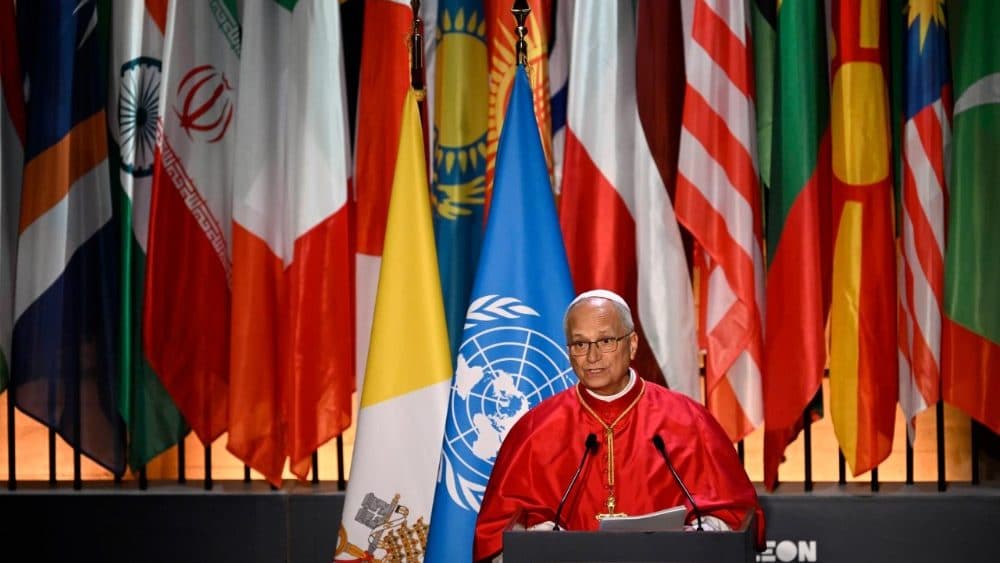
Speaking yesterday at UNESCO headquarters, the pope once again addressed the issue of war, stating that they “begin in the minds of men” and that, for that reason, “it is in the minds of men that the defences of peace must be constructed.”
In the evening, he engaged in dialogue and prayer with young people during a vigil at the Stade de France in Saint-Denis, emphasising how those who claim "God is dead" risk losing their way.
Interacting with young men and women, Leo urged them to pursue the revolutionary path of goodness, which "gives life” and “never takes it away.”
As part of this, the pontiff invited them to engage with other religions and face both external and internal conflicts, forgiving others and themselves for their own “anxiety and uncertainty.”
(Photo Vatican Media)