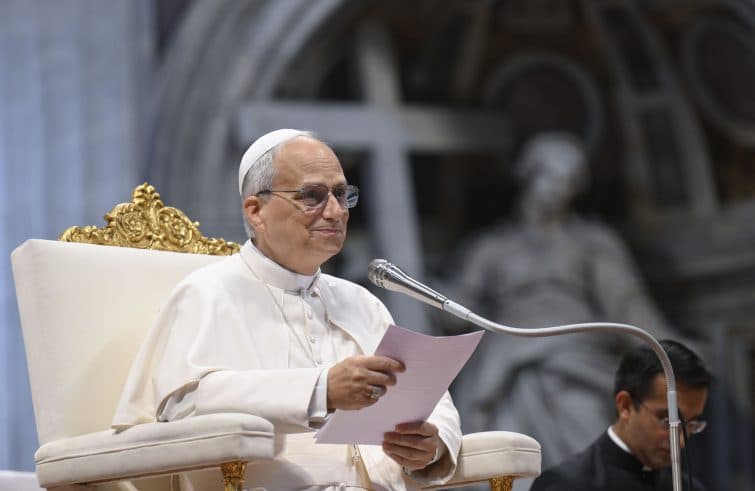
Vatican City (AsiaNews) – Pope Leo XIV addressed the thousands of faithful gathered for the general audience this morning in St Peter's Basilica, the second session in August devoted to the catechesis on the liturgical year.
Delving deeper into the “history of salvation” realised in Christ, Sunday, the weekly feast day, is the basis of the liturgical year since the entire “cycle of Christian feasts” is “punctuated by Sundays.” As the “original feast day”, it is crucial to celebrate it in the “best possible conditions” so as to include people who work on this day.
Mass for working people
In explaining the liturgical year, named after the work on the feast days and seasons of the Church by Benedictine Abbot Prosper Guéranger, the pope urged the faithful to attend Mass, including people who work.
“To sanctify Sunday, it is fundamental to celebrate the Eucharist. Listening to the Word and partaking of the Body of Christ entail, according to the Council Fathers, the coming together in unum (cf. SC, 106), that is, the joyful gathering of the faithful.”
“In this assembly,” the pontiff explained, “the Christian community makes visible its communion with the Lord and bears witness to its belonging to Christ and its fidelity to the Church.”
At a time in history when technology and artificial intelligence are gaining increasing ground, combined with the introduction of online Masses at the height of the COVID-19 pandemic, Leo noted that, “This assembly cannot be substituted by a solely virtual presence, nor can it be reduced to a merely passive gathering.”
The liturgical assembly takes place in fact in the active participation of brothers and sisters, called together to “thank God who ‘has begotten them again, through the resurrection of Jesus Christ from the dead, unto a living hope’” (1 Pet 1:3)
“In this regard, I urge everyone,” and this is the heart of Leo’s appeal today, “to seek the best conditions to ensure that even those who cannot take time off work on Sundays can participate in Holy Mass.”
Christ's work of salvation
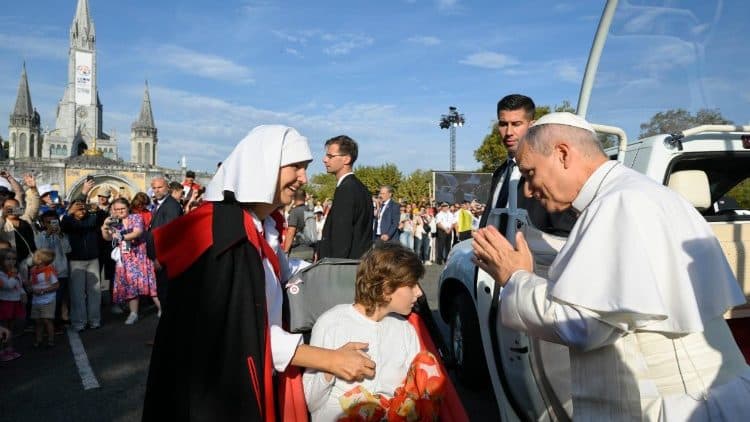
Before delving into the sixth catechesis on Sacrosanctum Concilium, continuing the series dedicated to the Documents of the Second Vatican Council, the pope walked down the central nave of St Peter's Basilica, greeting the faithful present and blessing objects of worship and rosaries.
In his address, he focused on the value of the liturgical year in the life of every believer, citing Pius XII's Encyclical Mediator Dei, in which it is stated that it “is not a ‘cold and lifeless representation of events of the past, or a simple … record of a former age.”
Instead, the liturgical year is “Christ Himself who is ever living in His Church. Here He continues that journey of immense mercy which He lovingly began in His mortal life … with the design of bringing men to know His mysteries and in a way live by them.”
Sunday, Leo stressed, quoting Saint John Paul II, is “the day of the Lord, the day of the Church, the day of man and, finally, the ‘day of days’,” the "weekly Easter" that, beginning with the Resurrection, directs human time towards “Christ’s Second Coming.”
The pontiff went on to explain that the liturgical year is not a simple recollection of past events, but the "constant renewal of the work of salvation, which Christ accomplishes in history."
As she journeys along this path, the Church "remains in touch with the Lord's redemptive action," placing the celebration of Easter at its centre.
From the weekly and annual Easter to Pentecost, from Lent to Christmas, the veneration of the Virgin Mary and the memory of martyrs and saints, the liturgical year is an opportunity to retrace “in sacramental form, the teaching of the history of salvation”. Thus, it represents “the guiding principle and the essential framework for all pastoral action.”
Solemnity of the Assumption
Finally, in his greetings in Italian to those present at the end of the general audience, Leo addressed a thought, among others, "to young people, the sick, and newlyweds.
“In a few days," he said, “we will celebrate the Solemnity of the Assumption of the Blessed Virgin Mary. I am pleased to urge you to constantly direct your prayers to the Mother of God, follow her example, in fully embracing the vocation of 'familiarity' with the Lord and concern for others.”