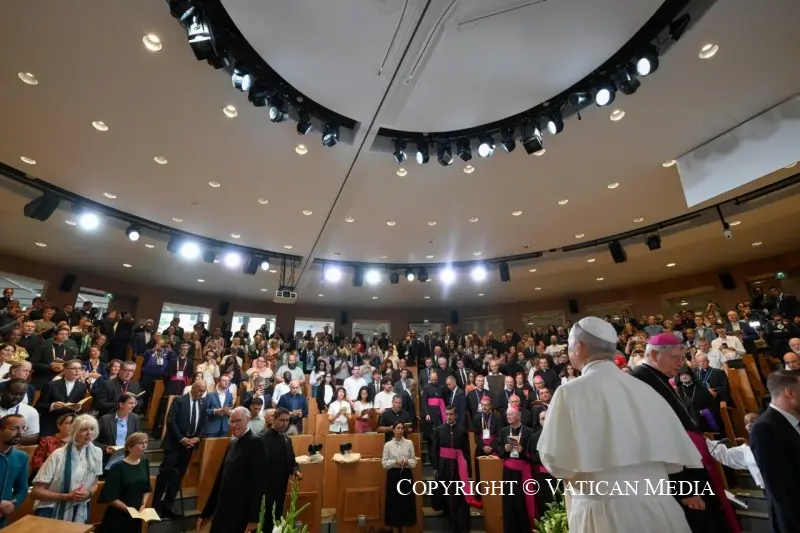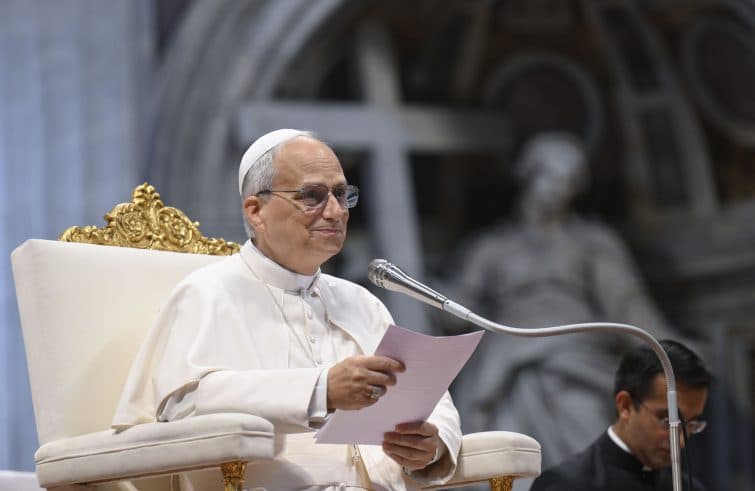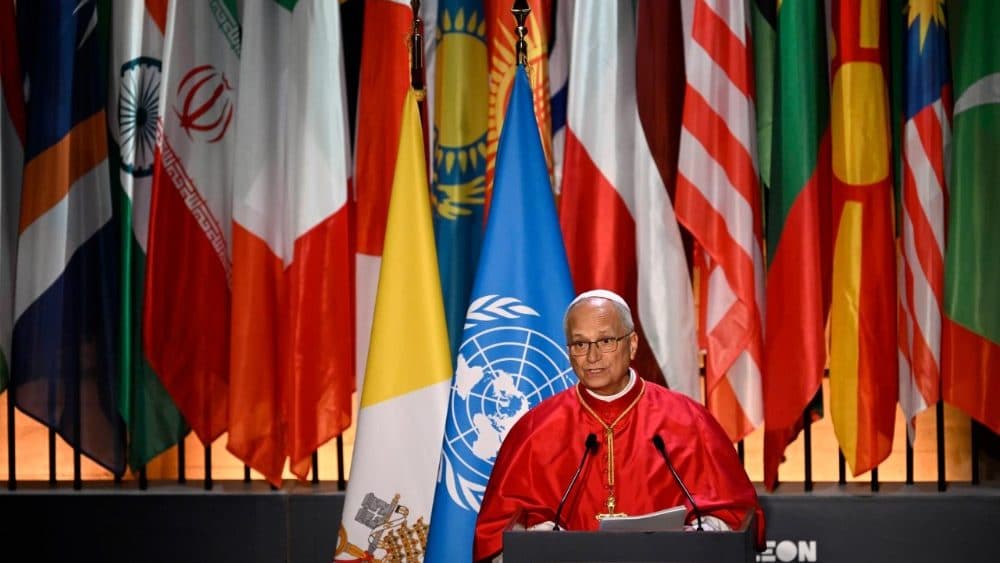
Parigi (AsiaNews) – This afternoon, on the first day of his apostolic journey to France (25-28 September), Pope Leo XIV visited the headquarters of the United Nations Educational, Scientific and Cultural Organization (UNESCO) in Paris.
Speaking at this venue, he said that, “Since wars begin in the minds of men, it is in the minds of men that the defences of peace must be constructed”, an idea that underscored the establishment of the UN agency in 1945, following half a century of wars, conflicts, and an atrocious loss of human life.
“The effort to build a just world is in fact the basis of international cooperation,” Leo explained, “so that peoples everywhere may be at peace and prosper.”
The pontiff arrived at the UNESCO headquarters welcomed by Director-General Khaled Ahmed El-Enany Ali Ezz and Mgr Roberto Campisi, Permanent Observer of the Holy See. Here he described himself as a “witness of peace.”
The Holy See, he noted, considers the institution a “privileged partner in the service of the common good”, with which it has worked since 1952, “offering its specific contribution to the dialogue among nations.”
For the pope, the agency ought to be considered a “place where humanity can reflect on itself;” at the same time, “promoting education, science and culture is impossible without at the same time improving the lives of men and women who are engaged in these activities.”
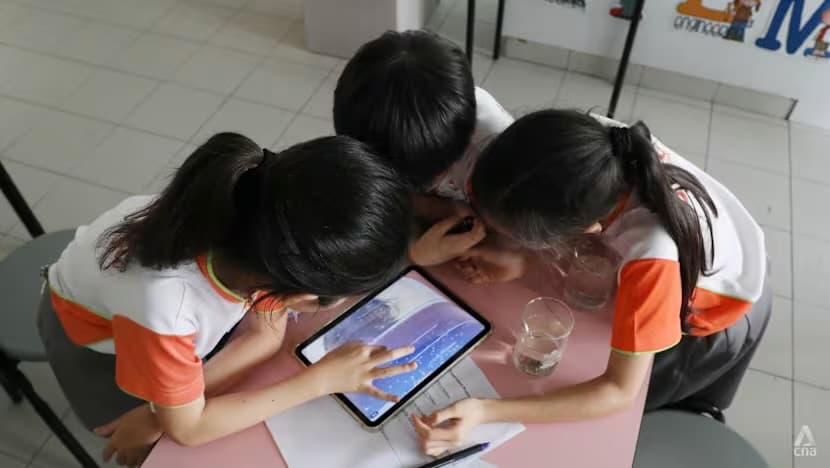
Speaking about education, Leo highlighted the Church’s “ancient tradition” in this domain. Indeed, “For centuries, her communities have founded schools and universities, taught people to read and write, and have been present even in the poorest and most remote places.”
But that is not enough. Irrespective of “the efforts that are made, [. . .] “No education can be considered complete if it fails to address the question of life’s meaning.”
In his address to UNESCO in 1980, Pope John Paul II said that “to educate means to help people to ‘be’ more and not merely to ‘have’ more, and to acknowledge in them that transcendence of the person.”
Pope John Paul II visited France seven times during his pontificate.
What does it mean to be human?
This afternoon, Leo XIV raised a thought-provoking question at the Pavillon d’Honneur, which “urgently calls for a response”, namely “What does it mean to be human? Every culture is challenged by this question”.
“Even in the twenty-first century, after all, we cannot take for granted that we know who the human person is or what it means to live as a human being,” he said. “Indeed, every generation is called to grapple with this question, especially in the face of tragedies that, regrettably, occur even today.”
The pontiff offered an answer to the question by sharing three insights. “[T]he human person is,” first of all, “someone who is conceived and born. Thus, first of all, to be human means to be a child. None of us chose to be so,” he said.
Secondly, Leo highlighted our innate poverty, given that we are all born... “naked and in need.” And “Forgetting the circumstances of our birth obscures the very idea of human life”.
Finally, “to keep alive the memory of our common humanity is to recognize its grandeur – that is, its immense potential – even though it is diminished by many forms of evil and injustice.”
“[T]he human being is one who grows, learns and works with both hands and mind,” he added. Yet, “we must recognize that the most terrible of ‘human works’ is war, for then science itself is placed at the service of an inhumane will to destroy and to kill.”
Quoting from the opening sentence of the Preamble to the Constitution of UNESCO, he said: “it is in the minds of men that the defences of peace must be constructed.”
AI and human dignity
The pontiff emphasised that the words of the UNESCO constitution have lost none of their force after 80 years.
“Peace is genuine when it springs from the virtue of justice rather than from a mere contract, and from an upright will rather than from an unstable balance of interests. Indeed, only an upright will can recognize in the other a brother or sister, a person like oneself,” he said.
He went on to warn about a “process of dehumanization” that risks impoverishing “ideas and relationships”. In fact, highlighting the “paradox” according to which while some “artificial systems” are attributed to intelligence, “we struggle to recognize the inalienable dignity of human persons, whose lives are judged according to the criterion of efficiency and, when deemed no longer productive, are rejected and discarded.”
In reality, “The human being is certainly one who is born, but also one who dies. Our dignity is not destroyed by illness or suffering, nor is it dependent upon our abilities. Rather, it calls for loving care at every stage of life.”
The peace of Pentecost makes communion possible
Stressing the harmony expressed within UNESCO when it “gives a symphonic voice to the highest aspirations for the good and the care of humanity,” the pope invoked two biblical images: the Tower of Babel and the square of Pentecost.
Regarding the first, he noted that, while the communication tools available to us today are “faster”, “at the same time, we are witnessing new forms of isolation, material and spiritual poverty, and abandonment.”
In light of this, Leo called for a “shared ethical foundation,” against information that is far from “wisdom”. What is more, “Artificial intelligence amplifies this problem. Although such systems can correlate data, they cannot answer questions that concern the meaning of human life, which is rooted in lived experience. Yet human beings cannot live without meaning. Meaning is the oxygen of the mind.”
In the square of Pentecost, “a message of peace is received as good news by people of every nation,” he said. “It is not the domination of Babel, but the peace of Pentecost, that makes such communion among all peoples possible. Every culture, therefore, realizes its highest wisdom when it seeks peace and the good of all, bearing witness to the authentic meaning of our humanity.”
Thus, “All form part of the unity of our existence. For this reason, cultivating the earth also means cultivating the humanity that inhabits it. Education and science are called to this task,” he added.
Reiterating the appeal made by his predecessors Benedict XVI and Francis, Leo said that we must “care together for the human person and for creation”.
There is a “touchstone by which we can assess our commitment”, namely the “care we show for the littlest and for the poor: children in their mothers’ wombs and in the various theaters of war, persons with physical and intellectual disabilities, the elderly, migrants refugees, and all those arrogantly excluded as unproductive. They are the true test of our claims to respect human dignity”.
At the Élysée Palace, he said no one should be resigned to the inevitability of war.
This morning, Pope Leo XIV delivered his first address in France to the authorities at the Élysée Palace. Shortly before, President Emmanuel Macron had highlighted a "message of peace, brotherhood and hope" shared with the Holy See.
The pontiff spoke of the “pain, which offends human dignity and cries out to God for justice” across the world, urging people not to resign themselves to any "inevitable" war, calling on them, “instead to persevere in the promotion of dialogue and diplomacy, in order to preserve peaceful societies that respect the dignity and rights of individuals and peoples.”
“May France, faithful to its traditional values, work for a peace that is unarmed and disarming, and responsibly offer its unique contribution to that goal,” Leo said.
“Liberty, equality and fraternity are not simply words emblazoned on the front of your public buildings; they refer to universal ethical imperatives that also find in the Gospel message an inexhaustible source of inspiration and fulfilment,” he added.
In his address, the pontiff also mentioned the recent restoration of Notre-Dame Cathedral in Paris following the 2019 fire. This afternoon, after his visit to the UNESCO, he celebrated Vespers at Notre-Dame with bishops, priests, deacons, consecrated persons, and seminarians.
Speaking about the restoration, he said that this was “not only an impressive technical achievement but also a symbol of renewed hope. It showed that something considered irreparably destroyed can be reborn through mutual cooperation”.
“May this remarkable achievement encourage all those responsible for the country’s political, social and religious life to work tirelessly and as one, inspired by a firm and lively hope,” he said.