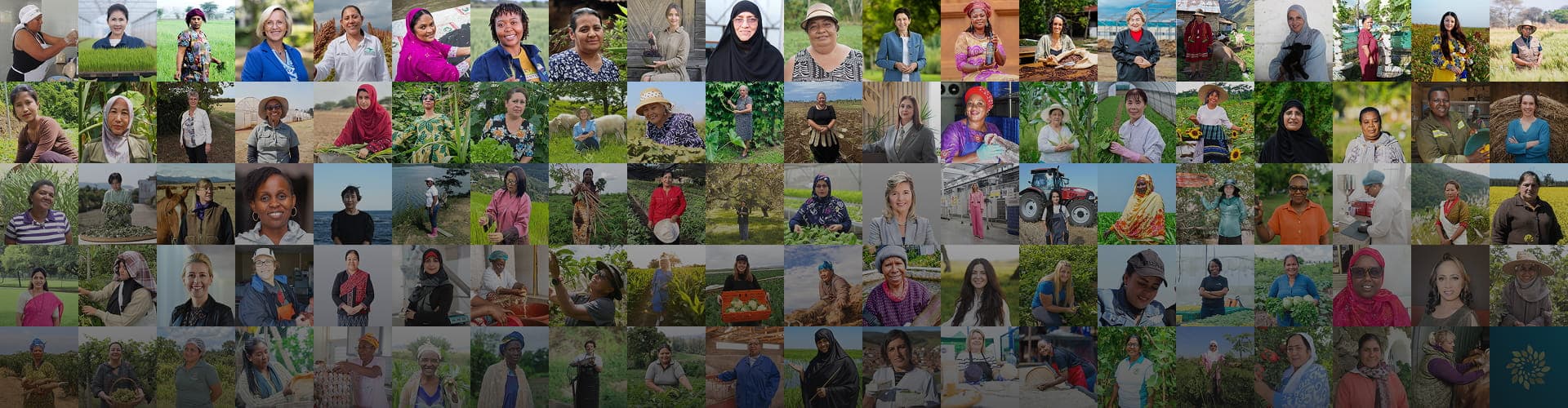
Rome (AsiaNews) – Some have helped plant millions of trees in a region threatened by desertification; others are promoting environmentally friendly coffee production; and still others are transforming a local crop into new job opportunities for women in their communities. These are just some of the stories of Asian women included by the FAO, the United Nations Food and Agriculture Organisation, among the 100 Women Heroes in Agrifood Systems and Rural Development, an international initiative that recognises women’s contributions to agriculture, food security and rural development.
The 100 women were selected as part of the International Year of Women in Agriculture 2026, proclaimed by the United Nations to draw attention to the role of women in food production and the challenges that still limit their access to resources.
The award was presented on 15 October in Rome, at the FAO headquarters, during the World Food Forum, to mark International Day of Rural Women. A total of 609 nominations were received, submitted by 131 member countries of the organisation. Here we share some of the most inspiring stories from the Asian continent.
India: strawberries bring new opportunities to the countryside
In the village of Sangau, in the Indian state of Mizoram, ZT Lalrithangi has set up an agricultural enterprise specialising in strawberry cultivation and developed an integrated system that combines fruit production with fish and poultry farming. Her farm, covering two acres, generates an estimated annual income of between 600,000 and one million Indian rupees. Lalrithangi shares her expertise with other farmers, participates in local groups and creates job opportunities for young people in the area. For her contribution to agricultural innovation, she has been named the best female farmer in the horticultural sector of Lawngtlai district for 2025–2026.
Onion seeds in Bangladesh and Pakistan
In northern Bangladesh, Bilkis Khatun has built a business specialising in the production of onion seeds, turning climate-related challenges into an opportunity for rural development. In a region prone to drought, she has introduced techniques such as hand pollination, which have enabled her to increase yields and consolidate her business. Her commitment, however, is not limited to production: Khatun has trained and supported over a hundred women across five villages, helping them to set up profitable seed-production businesses. As the head of the Charol onion seed producers’ co-operative, she promotes collaboration among farmers and the promotion of local seed varieties.
In Awaran, in the Pakistani province of Balochistan, Aqsa Mirwani has been working for over ten years to improve economic opportunities for rural families. As the first woman in her tribe to obtain a degree, she has helped to reorganise the local onion supply chain, connecting producers in Awaran with the main markets in Karachi and Quetta and facilitating small farmers’ access to new commercial opportunities.
She is also the founder of the Amma Naeema Foundation, the first women-led organisation in the area, through which she promotes education, community development and women’s participation in public life. Through the Aman Agahi project, she has reached over 600 women and trained 30 peace ambassadors, committed to fostering dialogue and social cohesion.
Korean female divers: guardians of the sea
The selection includes Sung Jung-hee, aged 74, the sole representative from South Korea. She is a haenyeo, one of the female divers who harvest fish and shellfish by free-diving without oxygen tanks. She works in Guryongpo, in the city of Pohang on the country’s east coast, and is the head of the local fishing community and president of the Gyeongbuk Province Haenyeo Association.
The technical skills required for this work, along with knowledge of the seabed, tides and natural cycles, have been passed down amongst the women for generations. The haenyeo communities have developed shared practices for managing marine resources, respecting the periods required for stock recovery. The haenyeo culture of Jeju Island was inscribed on UNESCO’s Intangible Cultural Heritage List in 2016; in 2023, the FAO also recognised Jeju’s traditional fishing system as a Globally Important Agricultural Heritage System.
In Indonesia: sustainable coffee and new local enterprises
Istiqamah is a coffee farmer from Aceh province and serves as secretary of a cooperative comprising 980 members who manage over 1,200 hectares of farmland. The cooperative promotes sustainable production systems and agroforestry practices that integrate crop cultivation with the conservation of trees and the environment. Her work also aims to ensure fairer participation by small-scale producers – particularly women – in the various stages of the coffee supply chain, from cultivation to market access. For Istiqamah, women farmers should not be regarded merely as support labour, but as key players in economic and production decisions.
Rulyantina, originally from the province of Banten, has instead developed new commercial opportunities based on Talas Beneng, a local variety of taro, a tropical plant grown for its tubers. She has transformed this resource into a range of products, aiming to reduce waste and expand marketing opportunities, including on national and international markets. One of Rulyantina’s objectives is to enable women, including those who look after the home, to earn an income without having to leave their village to seek employment.
Vietnam: farming crustaceans whilst protecting mangroves
In southern Vietnam, Lam Ngoc Bao Han has developed an eco-friendly model for farming prawns, crabs and fish in the mangrove forests of Ca Mau province. She is the founder of Nhà Cua Family and leads the club of agricultural producers and entrepreneurs in the town of Cai Doi Vam. Her business seeks to reconcile food production with the conservation of a coastal ecosystem that is vital for biodiversity and coastal protection. Among the tools used is biochar, a material derived from agricultural by-products, incorporated into a production model that aims to reduce waste and use resources more sustainably.
From China: a life dedicated to combating desertification and moxibustion
Among the women honoured is Yin Yuzhen, who has led a long-standing environmental restoration effort in the sandy Mu Us region of northern China. For decades, she has been planting trees in an area threatened by desertification, contributing – alongside her family and other reforestation initiatives – to the restoration of nearly 5,000 hectares of land and the planting of over eight million trees in the area. Her work has helped to combat environmental degradation and enabled local communities to continue their agricultural activities.
China is also represented by Yu Jinxiu, who practises Qichun moxibustion, a technique of traditional Chinese medicine recognised as part of the country’s intangible cultural heritage. For over twenty years, she has been working to preserve this knowledge and turn it into professional opportunities. According to the FAO, she has trained more than 30,000 practitioners and helped to create employment and business opportunities, particularly for women, people with disabilities and economically vulnerable groups.
In Mongolia with the camel-herding communities
In Mongolia, G. Altantsetseg chairs the Bayanlag Sutai Khugjil cooperative, which brings together male and female camel and sheep herders. Here, livestock farming is a vital resource for communities in arid areas, where alternative economic opportunities are limited. The co-operative helps to sustain a form of livestock farming linked to the nomadic way of life and traditional knowledge of animals, particularly the Bactrian camel, a species adapted to the region’s harsh climatic conditions. Camel milk, meat and wool are important resources, but the distance from markets and the difficulties involved in collection and processing often reduce the herders’ earnings.
Spices and employment for Iranian women in rural areas
Azadeh Ahmadi is an entrepreneur from Isfahan, Iran, and founder of the Sha’sha’e spice brand. After training as a translator and English teacher, she set up a home-based business which later became a licensed food enterprise, with products sold throughout the country and even on international markets. She has created employment opportunities for female heads of households and enabled many women in rural areas to earn an income through home-based production and sales.
Farming in the Yemeni desert using solar irrigation
In Yemen, Gawhara Hasan Saleh Qasem has transformed 7.2 acres of desert land into a mixed farming and livestock enterprise. Her production model is based on soil restoration techniques, solar-powered irrigation systems and the diversification of crops and livestock. Her farm produces various varieties of organic crops and rears cattle, sheep, goats and poultry. It also provides employment opportunities for displaced women and families, in a country where conflict and economic hardship have exacerbated food insecurity across the entire population. Her work aims to combat desertification, preserve arable land and make food available at affordable prices, without the use of chemicals.
Inequalities that persist to this day
The experiences recognised by the FAO demonstrate the extent to which the work of rural women can impact food availability, the protection of ecosystems, the transmission of knowledge and the potential to generate income. At the same time, however, the organisation emphasises that women’s contribution to agri-food systems continues to face disparities in access to land, finance, training and new technologies.
According to FAO data, women account for 41 per cent of the global workforce employed in agri-food systems. Yet women farmers generally work on smaller plots than men, and the productivity gap stands at 24 per cent. Furthermore, in paid agricultural work, women earn on average 82 cents for every dollar earned by men.