Milan (AsiaNews/Agencies) - By 2035, Muslims will outnumber Christians, becoming the largest religious group on the planet. This is according to the Pew Research Center in Washington—one of the world’s most authoritative research centers—in its new report “The Future of World Religions: Population Growth Projections, 2020–2070” released yesterday. This research is conducted primarily by cross-referencing current demographic trends at the local level. It is therefore based on a medium- and long-term projection, assuming that no unexpected factors will alter current trends. Within these limits, however, the picture provided is very detailed and highlights certain changes already underway not only globally but also in each of the world’s regions.
According to this study, therefore, over the next fifty years both the number of Christians and the number of Muslims are set to grow, but Islam will grow more rapidly. If current trends continue, by 2070 there will be over 3.6 billion Muslims and nearly 3 billion Christians out of a total world population of over 10 billion people. Muslims and Christians will be the only religious groups analyzed to maintain a growth rate equal to or higher than that of the world population, projected to be around 29%. Hindus will also continue to increase in number but will decline as a proportion of the world population. The same trend is projected for Jews. Buddhism, on the other hand, will experience a decline both in the number of adherents and as a percentage of the global population.
The Impact in the Asia-Pacific Region
This trend is primarily explained by the projection that most of the world’s population growth will be concentrated in Africa: by 2070, more than a quarter of the world’s population will live in sub-Saharan Africa (compared to 14% today). And since the vast majority of the region’s inhabitants are currently Christian or Muslim, high birth rates and rising life expectancy will contribute to the growth in the number of adherents of both religions worldwide.
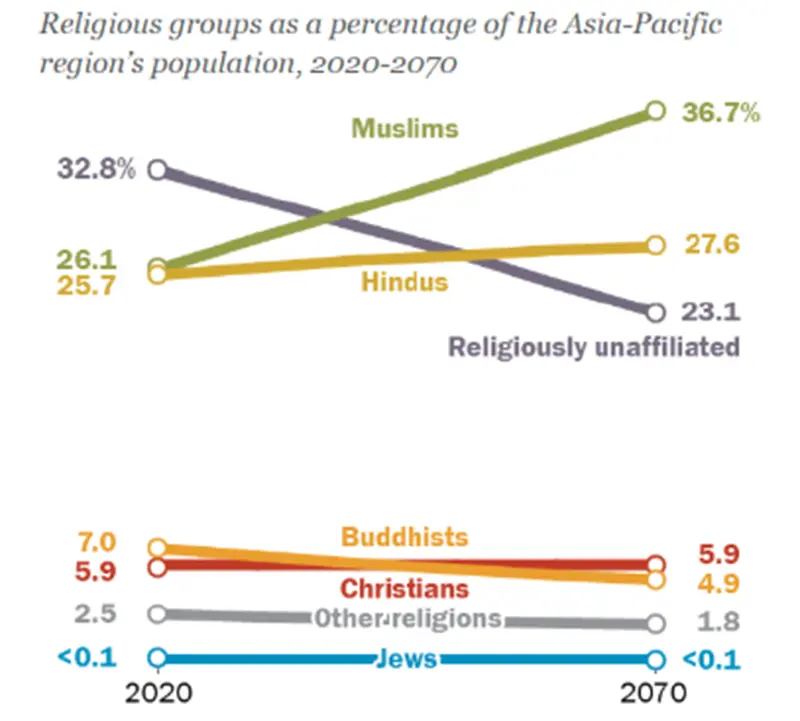
But demographic change will also have a very strong impact on the Asia-Pacific region. In 2020, this region was the most populous in the world, with approximately 4.5 billion people, accounting for 58% of the global population. But if current demographic trends continue, by 2070 this percentage will have dropped sharply to 48%, and this shift will have a profound impact on the continent considered the cradle of the world’s religions. It should be noted that the sharpest decline, in fact, concerns people in the Asia-Pacific region who declare they have no religious affiliation: driven by China’s sharp demographic decline, the number of non-believers in the Asia-Pacific region could fall to 1.1 billion by 2070, down from the current 1.5 billion. In percentage terms, this means a shift from the current 32.8% of the continent’s population to 23.1%.
Pakistan Overtaking Indonesia
Islam, on the other hand, is projected to be the fastest-growing religion even in the Asia-Pacific region (a geographic area that, according to UN classifications, does not include the Middle East): in fact, Pew Research predicts that by 2040, Muslims will outnumber people with no religion, becoming the largest group. And according to these projections, by 2070 they could reach 1.8 billion people (a increase of 619 million compared to 2020), rising to 36.7% of the total population of Asia and Oceania.
Already today, after all, this region of the world is home to four of the five countries with the largest Muslim populations (Pakistan, India, Indonesia, and Bangladesh), and this will remain the case in the coming decades. However, the ranking could change, with Pakistan rising to first place, followed by India, while Indonesia would drop to fourth place (surpassed even by Nigeria).
More Christians Than Buddhists in Asia
The Pew Research Center also forecasts further gradual growth for Hinduism: by 2070, it is expected to have nearly 1.4 billion adherents in the Asia-Pacific region, an increase of 191 million compared to 2020. It would thus become the second-largest religion in the region, after Islam, rising to 27.6% and also surpassing the group of non-believers. Buddhism, on the other hand, appears increasingly destined to decline: according to these projections, its adherents would drop from about 316 million in 2020 to 240 million in 2070, falling from 7% to 4.9% of the Asia-Pacific population.
Significantly, according to these estimates, by 2070 Buddhism would also be surpassed by Christianity: taken together, the various Christian denominations would remain stable at 5.9% of the continent’s population, with a slight increase of 22.5 million adherents. This would bring their total to 291 million people, making them the fourth-largest religious group after Muslims, Hindus, and non-believers. Conversely, other religions as a whole (Shintoists, Taoists, Sikhs, Jains, Zoroastrians, etc.) are also projected to decline, falling from 2.5% to 1.8% of the total Asia-Pacific population.
Despite this decline, the Asia-Pacific region would still remain the primary center for the spread and presence of followers of Eastern religions. According to Pew Research Center projections, by 2070, 99% of the world’s Hindus and 96% of the world’s Buddhists will live in the Asia-Pacific region. The Asia-Pacific region will also continue to be the region with the largest number of people with no religious affiliation. Again, relative to the global population, if these trends are confirmed, the region would become home to about half of all Muslims on the planet and 10% of Christians.