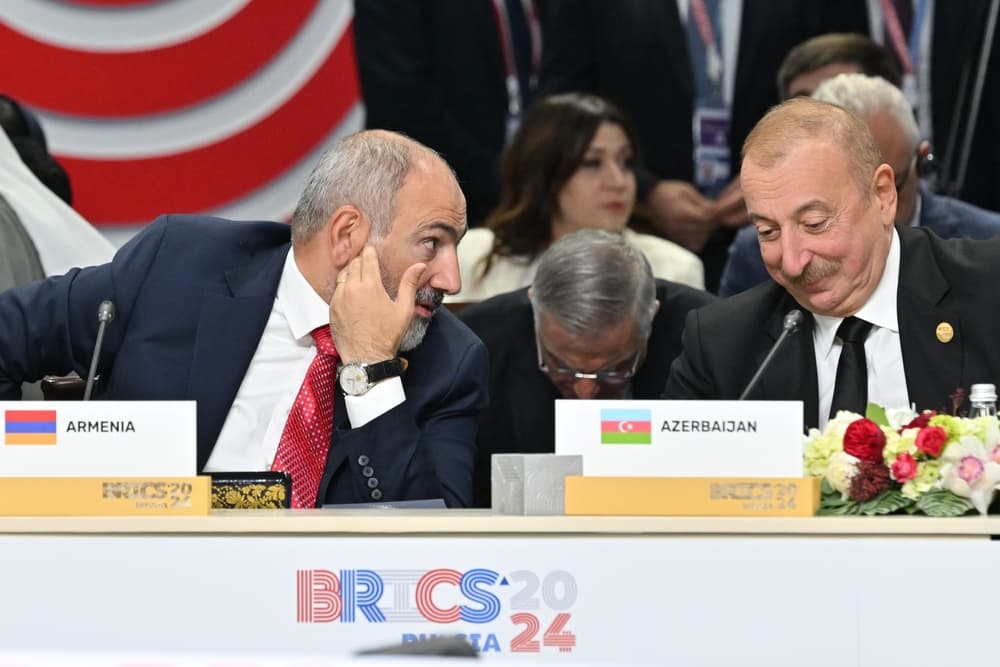
Yerevan (AsiaNews) – The statement made in recent days by Armenian Prime Minister Nikol Pashinyan, according to which “peace between Armenia and Azerbaijan should last 400 years or more”, may at first glance seem like political hyperbole. In reality, this statement conceals a far deeper meaning: the Prime Minister is in fact speaking of the need to break a historical cycle in which territorial maximalism, dependence on a favourable international context and the support of an external protector have repeatedly led Armenia to outcomes contrary to those expected.
It is significant that Pashinyan is not simply speaking of peace, but of its “irreversibility”. This is a fundamental difference: the end of the war may be the result of a shift in the balance of power, whilst irreversible peace requires a change in the very political philosophy of the state. And if one interprets his words in this way, then Yerevan faces a far more arduous task than signing an agreement with Baku: to decide once and for all whether Armenia intends to build a future within internationally recognised borders, or to continue to leave room for territorial revanchism. The issue is particularly urgent because the current historical cycle of the Armenian-Azerbaijani conflict began with a completely opposite idea: in the late 1980s, it was the Miatsum, a movement for the unification of Nagorno-Karabakh with Armenia. Territorial claims became a key factor in the rapid escalation which, following the collapse of the USSR, led to a full-scale war. Subsequently, the Armenian side controlled not only the former autonomous region of Nagorno-Karabakh, but also seven adjacent districts of Azerbaijan.
In the decades that followed, the belief that the status quo could be maintained indefinitely took root in Armenian politics, and this is where the strategic error emerged: the frozen conflict proved to be not a solution, but merely a postponement. Whilst negotiations remained fruitless for years, the balance of power shifted and, with it, the regional reality. Ultimately, the project launched under the banner of territorial unification brought Armenia neither greater security nor a stable regional position. On the contrary, the conflict contributed to the closure of the borders with Azerbaijan and Turkey, limited the country’s economic opportunities and increased Yerevan’s dependence on external security guarantees, particularly those provided by Russia. The political idea that promised national triumph ultimately condemned the Armenian people to decades of deprivation, isolation, military risks and hostility with neighbouring countries.
It would be an oversimplification to claim that the Sovietisation of Armenia was a direct consequence solely of Yerevan’s territorial ambitions, given that Bolshevik Russia had taken control of the entire South Caucasus in the 1920s. A century later, it is impossible not to notice the historical analogy: both then and later, there was a gap between the nation’s maximum potential and the state’s actual capabilities, as well as the hope that the external context would help to consolidate the desired territorial structure. In both cases, the shift in the balance of power proved stronger than political expectations.
This is precisely why Pashinyan’s current rhetoric is more significant than yet another declaration of peace, as many commentators claim; in reality, he is proposing an alternative model of existence for Armenia – one that does not seek security through territorial claims, but rather by creating a secure state within its internationally recognised borders. Peace with Azerbaijan requires not only the signing of a treaty, but also the abandonment of any hope that, under more favourable international circumstances, the outcome of the conflict might once again be reversed. If Yerevan has truly learnt this historical lesson, the peace agreement with Azerbaijan will be more than just the end of a decade-long conflict: it could mark the point at which Armenia abandons the struggle for an imaginary future fuelled by nostalgia for a glorious past, in favour of the preservation and development of the existing state. And perhaps this is precisely the key to those four hundred years of peace of which Pashinyan speaks today.