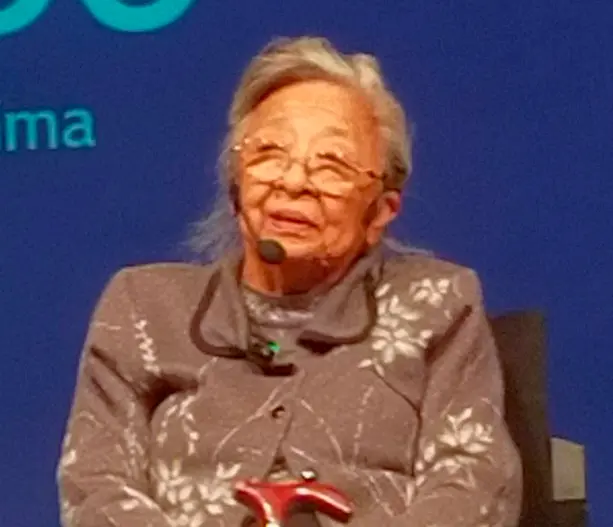
Milan (AsiaNews) – “If we do not tell today’s children and young people what happened, we are not doing them any favours. If they know the past, they will know what to do and what not to repeat.” Koko Kondo was eight months old on 6 August 1945, when the US atomic bomb levelled Hiroshima. She has no memories of the explosion, but she grew up surrounded by its consequences.
Today, aged 81, she continues to travel to tell that story, especially to young people. Because, as she reiterated during a meeting with over 300 young people organised on 29 October by the Youth for Peace group of the Community of Sant’Egidio at the Teatro del Pime in Milan, “children are wonderful: they are the ones who will carry the next century forward”.
Her family’s home was situated just over a kilometre from the hypocentre of the explosion that struck the city of Hiroshima. Her mother managed to pull the little girl from the rubble, whilst her father, who was elsewhere, devoted himself in the days that followed to helping the survivors. Koko grew up in her father’s church, which was also attended by young women who had suffered severe burns.
Through her testimony, however, Koko also recounts how her anger, over time, shifted direction, moving from hatred towards the men who had dropped the bomb to the realisation that, in reality, the true enemy is war itself. This change began when Koko was ten years old, during a trip to the United States with her father, the Methodist Reverend Kiyoshi Tanimoto.
In 1955, her father brought 25 young women who had survived the bombing to the United States; they had been severely disfigured and required plastic surgery which was not available in Japan at that time.
Shortly afterwards, the family was invited to appear on *This Is Your Life*, a popular American television programme dedicated specifically to Kiyoshi Tanimoto. Among the surprise guests was Captain Robert Lewis, co-pilot of the Enola Gay, the aircraft that had dropped the bomb on Hiroshima.
Koko had no idea who she was going to meet. When she saw Lewis, her first impulse was to attack him: “I wanted to punch him, bite him or kick him”. She didn’t, partly because she was in front of the cameras and knew that her father, a pastor, would not have approved.
During the programme, the presenter asked Lewis how he had felt after dropping the bomb. The officer recounted how he had returned to fly over the city and seen it had vanished. As he spoke, his eyes filled with tears.
“I hated him. But when I saw him crying, I thought: if I mustn’t hate this man, then I must hate war itself – the war that we human beings have brought about.” At the end of the programme, Koko stood beside him and took his hand. She couldn’t speak English, but that gesture was the only way she had of conveying to him what she had realised: it wasn’t people who should be hated, but war.
“It changed me,” she says today. She has not seen Lewis since, but that episode has become the very essence of her testimony. It does not mean forgetting what happened or denying responsibility, but refusing to allow violence to continue to breed more violence, Koko emphasises.
During the interview, she also shows an item that her parents have kept all their lives: the little dress she was wearing on 6 August 1945. “Of course, it was completely burnt. I don’t know how long I wore it,” she says.
Looking at it reminds her that she survived and, above all, just how precious every child’s life is. “I hope that no child in the world will ever have to go through a similar experience. They have their whole lives ahead of them: they must be able to live them. And we adults must support them.”
Koko Kondo returned to live in Hiroshima a few years ago, near the Peace Park, where she goes for walks when the weather and her health allow. The city has become modern, but those places continue to take her back to the past.
Her faith, nurtured alongside her father, a pastor, remains a guiding light in her daily life: “I always ask myself if I’m doing the right thing.” But the message she conveys to young people is not directed solely at those who share her religion or her history. It is a universal appeal, addressed to children in every country and to all adults who have a responsibility to protect them.
“It’s easy to go in the wrong direction,” she observes. That is why we must understand what has happened and learn to recognise what must not be repeated. The younger generation, she insists, must not be left to face the consequences of adults’ decisions alone. “They are the ones who will carry us forward into the next century. If they are not there, there will be no one.”