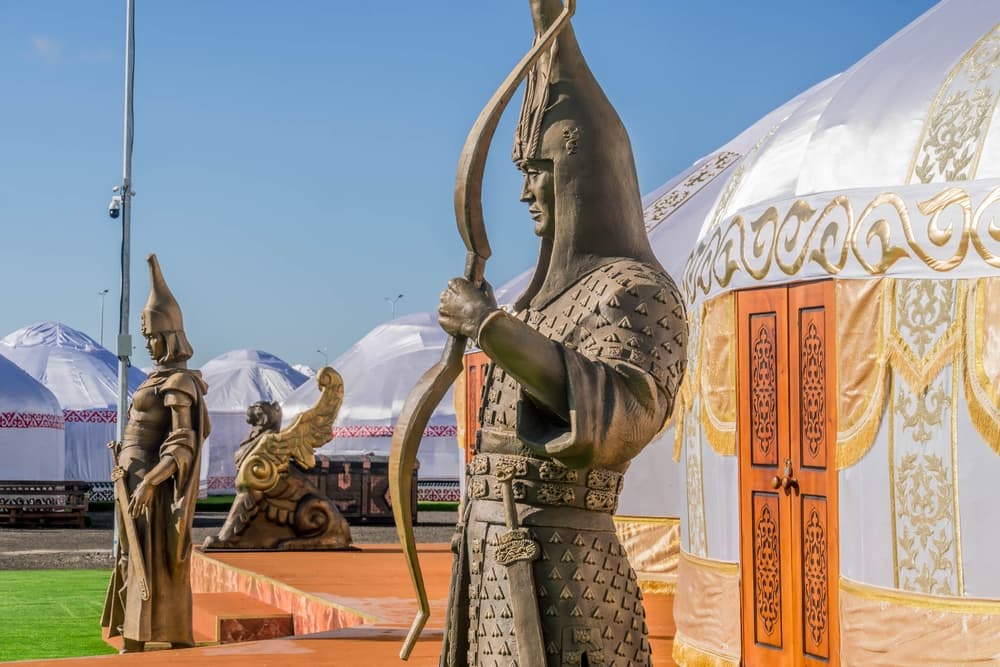
Astana (AsiaNews) – Kazakhstan – which has just solemnly celebrated the elections for the new Kurultaj, the People’s Assembly that recalls the ancient gatherings of Karakorum in Mongolia – is increasingly turning to the history of the Ulus Džoči, the Golden Horde of the Tatar-Mongol period which occupied Russia, Central Asia and the Middle East – as one of the key sources of its national identity. The state is establishing specialised research institutes, funding research and restoring monuments from the Golden Horde era. Meanwhile, neighbouring Uzbekistan has for decades been constructing a national historical narrative centred on Amir Timur, the great Tamerlane.
In October 2021, the government of Kazakhstan adopted a resolution establishing the Scientific Institute for the Study of the Ulus Džoči. Officially, the aim is to fill the gaps in the history of the Golden Horde and the Kazakh Khanate, to translate medieval sources and to formalise this heritage within an academic context.
The concept of this historical legacy is currently being actively promoted by Kasym-Žomart Tokaev himself, the President of Kazakhstan, who has repeatedly stated that the Ulus Džoči is one of the most important historical foundations of the Kazakh state: “The era of the Golden Horde is both a crucial part of Kazakhstan’s national history and a period of civilisational evolution… ‘The historical memory of most peoples recalls the achievements of sovereigns and talented military leaders more vividly than the monotonous work of reformers and prominent thinkers,’ Tokaev stated at the international symposium ‘The Golden Horde as a Model of Steppe Civilisation: History, Archaeology, Culture, Identity’.
To this end, the Mausoleum of Džoči Khan in Ulytau is currently being restored, funds have been allocated for large-scale research, and specialised research centres have been established in Astana.
In Soviet historiography, the Golden Horde was viewed primarily through the lens of conquests and the ‘Tatar-Mongol Yoke’, whilst in the early decades of Kazakhstan’s independence, the main focus was on the history of the Kazakh Khanate from 1465 onwards, after Russia had by then freed itself from Tatar rule.
According to Žaksylyk Sabitov, director of the research institute for the study of the Ulus Džoči, during the early period of post-Soviet independence, the young Kazakh republic did not promote the idea of the Golden Horde’s legacy for several reasons:
“any inclination towards a growing national consciousness could have led to civil war, as we have seen in Moldova, Georgia and other countries that began with an active and romantic national ideal, which then degenerated into civil conflict”. Under the first president, Nursultan Nazarbayev, great attention was paid to the idea of a modern and independent Kazakhstan, understood as a state born in the modern era.
However, in the second half of the 2010s, interest in earlier historical periods increased significantly. Sabitov himself attributes this process, in part, to the changed geopolitical landscape, beginning with Russia’s annexation of the Ukrainian peninsula of Crimea (another historic homeland of the Tatars) in 2014.
A similar process of re-evaluating the past has been observed in neighbouring Uzbekistan, which has built a significant part of its national historical narrative around the figure of Emir Timur and the Timurid era since the collapse of the USSR.
Tamerlane has become one of the state’s principal symbols, with monuments in the main squares, a prestigious state honour named after him, and school textbooks presenting him as an exceptional statesman and military leader.
It was precisely the rehabilitation of this imperial identity that long hindered Central Asian integration; initially, no country in the region apart from Uzbekistan harboured such ambitions, and now Kazakhstan too has caught the ‘fever’, with its symbol being the Ak-Orda presidential palace in Astana, which evokes the glories of the Tatars. “
“Two similar imperial identities are emerging, and they will clash with one another,” says the Uzbek anthropologist and political philosopher Bakhtyor Alimjanov. As the Soviet era recedes further into the past, across the vast expanses of Eurasia, people are increasingly recalling the “great rulers” of the Middle Ages, their “great victories” and the boundless Great Steppe.