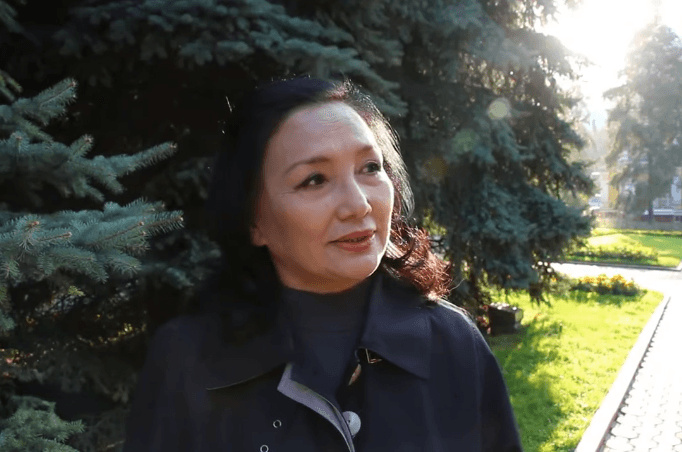
Astana (AsiaNews) – She paints landscapes, loves the mountains and describes herself as an “urban shaman”: one of the main goals for the artist and environmental activist Saltanat Tašimova is to protect the picturesque Kok-Žailau area on the outskirts of Almaty, Kazakhstan’s main city, through public actions and mystical rituals. In a conversation with Azattyk Asia, the painter explains why she opposes the construction of a ski resort which, according to government plans, is intended to boost tourism and the economy.
Saltanat has been hiking in the mountains since 2012 and has been involved in environmental activism ever since. On the road to Kok-Žailau lies the start of the Ile-Alatau National Park, a special protected area that could soon be transformed into a building site: the country’s authorities have announced the construction of a ski resort. The Almaty SuperSki resort is planned near Kumbel Peak and the Three Brothers Peak; the project will cover around 1,000 hectares and include approximately 60 kilometres of ski runs, with sixteen cable cars planned to transport tourists. The resort is due to open at the end of 2028; the authorities regard the construction as “the realisation of Almaty’s tourism potential”, emphasising that the existing resorts at Medeu and Šymbulak “are no longer able to cope with the growing influx of tourists”. They also promise job creation and greater prosperity thanks to investment in tourism.
Centuries-old trees are set to be felled to build a 6-kilometre road connecting the Kok-Žailau area. Saltanat points to the tree trunks marked in red along the path; the authorities explain that the axe will fall on endangered tree species, not on trees planted by humans. The environmental activist points out that there is an exception to this claim: “They’re talking about the plateau where they planted trees because avalanches used to occur there, to hold back the snow.” A scientist, Vladimir Vukolov, who is also a skier, said he had unearthed bodies at Kok-Žailau in the 1970s, and that pine trees were planted to prevent this from happening again. Now, if the trees are felled to build ski runs – both on the plateau itself and on the slopes – deaths could occur, as avalanches are a daily occurrence.
The Ministry of Ecology in Astana has stated that 472 endangered trees “have lost their originality and their genetic code” due to hybridisation, and officials claim that 70 per cent of these trees are infested with pests and diseases, occupying just 0.1 per cent of the national park’s territory. Saltanat also expresses concern for the animals living in and around the Kok-Žailau area: “A fox was spotted near the Esentai shopping centre,” she recalls, referring to a video that recently went viral on social media; “The animals are already suffering because of urbanisation, which is encroaching further and further into the mountains; they have nowhere to go.” If a cable car is built on the Pioniere, Kumbel and Tre Fratelli peaks, it will encroach on the territory of the snow leopards, who will either flee to Kyrgyzstan or simply die, given that there are also many poachers in these parts.
The government justifies the construction of the resort on the grounds of the need to create comfortable conditions for holidaymakers: toilet facilities and public rest areas. “I’m in favour of ecotourism, provided nothing is built, and if anything is built, it shouldn’t be heavy structures that damage the trees or the soil,” explains Tašimova, “tourists come here to enjoy the unspoilt beauty, where at least there is the appearance of being unspoilt. Instead of developing ecotourism, it seems they want to turn this place into yet another city park, complete with a wide road and a cable car”.
Saltanat puts on her jewellery and her shamanic robes, takes a cup and pours some milk.
The ritual begins: she sprinkles the milk in four directions, ‘nourishing’ the spirits of the forest, the air, fire and the earth. Then she beats the drum, dances and twirls. She repeats the movements many times. She then explains how she came to Tengrism, an ancient nomadic religion based on the worship of Tengri, the eternal blue sky. At the Almaty Art Museum, Saltanat is showcasing her solo exhibition, featuring the paintings ‘Tree of Tengri’ and ‘Alma Ana – the progenitor of Sivers’ apple tree’. She has also produced a series of postcards on the theme ‘Me and the Tree of Kok-Žailau’, depicting a girl standing next to a tree marked with a red sign. There is a red mark on the girl’s forehead, the same as the one on the tree marked for felling, which destroys the harmony between humankind and nature.