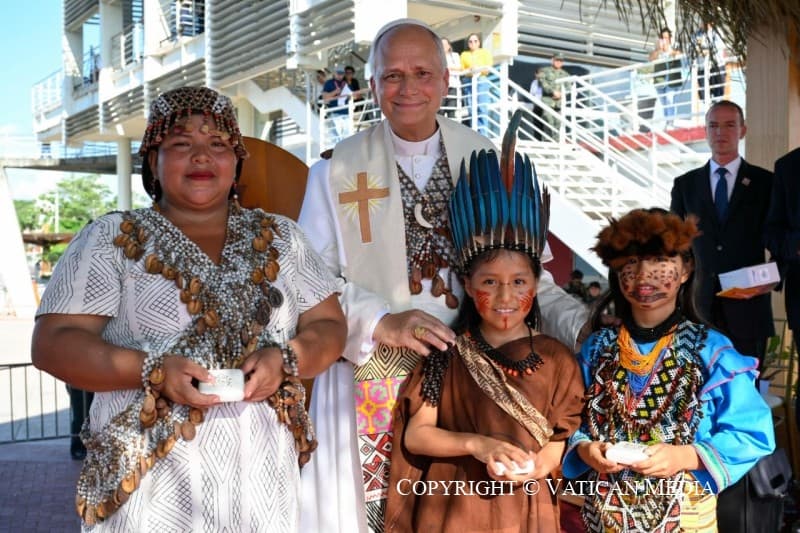
Pucallpa (AsiaNews) – “The Church admires the resilience and capacity for new beginnings of the Amazonian peoples. You are witnesses of our Lord Jesus Christ, who rather than coming down from the cross, gives his life for his people.” This is the powerful message that Leo XIV delivered yesterday to indigenous communities around the world, whilst meeting representatives of the Amazonian peoples, together with the missionaries who carry out their ministry alongside them, at the Malecón Puerto Callao in Pucallpa, in the Peruvian Amazon.
Following in the footsteps of Pope Francis, the pontiff who authored the encyclical Laudato Si’ and who, in January 2018, opened the path to the Synod for the Amazon in Puerto Maldonado alongside these same peoples, Leo XIV sought to listen to their testimonies on the banks of the water that is so vital to life in the forest.
Together with them, he denounced the world’s slowness in changing its paradigm and the wounds inflicted on these brothers and sisters by a vision of humanity’s relationship with creation that, in the rush to exploit raw materials without limits, ends up killing people.
The Pope told the peoples of the Amazon: “Following in the footsteps of Pope Francis, during his memorable visit to Puerto Maldonado, I come as a shepherd to listen to your stories and to walk alongside you. I wish to strengthen you in faith and hope, supporting you in your search for the justice and peace that this land so greatly needs. The years I spent as a missionary and as a bishop in this beloved land of Peru taught me what it means for the Church to walk alongside humanity in order to serve the Lord faithfully. This is essential if we are to become like Jesus Christ and follow him here and now, as we await his return.”
The blood of those who defend their land
Walking together today, however, means giving voice to the cry of these peoples. “It speaks to us of wounds that have not yet healed, but which have, in fact, worsened,” says the Pope from this platform to the whole world. "The cry of the earth and the cry of the poor are inseparable, exposing patterns of exploitation and economic activity that threaten the balance of creation. Protecting the Amazon rainforest cannot be separated from concern for the people who live there: indeed, integral ecology, social justice and the spiritual life go hand in hand.”
Yet in the Amazon – as is also the case in many regions of Asia – even defending one’s own home can cost one’s life today. “In recent years,” recalls Leo XIV, “many indigenous leaders have been killed for protecting their territories. The blood of these brothers cries out to God and to humankind, demanding justice.”
He also highlights other unacceptable realities: the right to access healthcare and education is denied due to geographical distances and institutional neglect. And then there is the vulnerable situation in which so many women, girls and adolescents find themselves, the violence and sexual abuse they endure, which leave deep wounds, often amidst the silence of complicity and impunity. “In every sphere,” comments Prevost, “corruption and arbitrariness undermine the fundamental trust in the goodness of the human person; but this causes the Gospel to burst forth as an even stronger call to personal and communal conversion, offering renewed hope of healing, consolation and reparation.”
A “moral and educational rebirth” for Pucallpa
He calls for a “moral and educational rebirth” for Pucallpa. “Let us work towards a quality education that speaks your languages and values your ancestral knowledge, whilst never ceasing to prepare the younger generations for the great global challenges,” he urges. But it is above all the paradigm shift suggested by the encyclical Laudato Si’ that Pope Leo also calls for: the transition from “the tendency to view this immense region as a reserve of resources to be extracted” to an “integral ecology, an expression of the civilisation of love”.
““You know well the damage caused by indiscriminate deforestation and the pollution of rivers and other waters through illegal mining and oil spills. These are not isolated accidents, but the consequences of the irresponsible exploitation of natural resources, which undermines the very existence of communities.”
He also mentions “the insidious shadow of drug trafficking, which preys on the poverty of young people by luring them with false promises of wealth and uprooting them from their own culture”. Even in these dramatic situations, he explains, the Church’s social teaching “helps us to read the signs of the times under the guidance of the Holy Spirit. In it, the ancestral knowledge you possess can meet the Church’s heritage of wisdom, in order to safeguard your rights, acquired over the course of generations”.
“Christ never abandons us. Christ is with you. The Church is with you, and you are her members. We are the body of Christ!”, Leo XIV assures the peoples of the Amazon. He recalls the fruits of the Synod held in 2019, with the desire for a Church that increasingly bears the face of the Amazon. “It is true,” he adds, “that the laborers seem few: your Vicariate, as large as entire countries, has only twenty-five priest.” Hence his “gratitude to the religious men and women and to the lay pastoral leaders who, with heroic fidelity, safeguard the faith in the most remote villages. We must support their formation and recognise their ministerial service,” says the Pope.
“Our talents for restoration”
These are the very same themes that the Pope took up again later, in his homily during the Mass celebrated before 100,000 people at the Villa Deportiva Regional Ucayali. “The health of our lives and that of the earth we inhabit,” he reminded the congregation once more, “go hand in hand: therefore, anything that harms the dignity of life destroys the beauty of the earth. Human initiative and care for creation go hand in hand: therefore, anything that exploits labour plunders the environment. Social peace and ecological balance go hand in hand: therefore, violence against the people is violence against the earth, and violence against the earth is violence against the people.”
But from Pucallpa, drawing inspiration from the Gospel reading proclaimed during Mass, the Pope also called on the indigenous peoples themselves to be the agents of change. “Very little has been done, and very slowly, whilst the means to plunder and pollute creation have accelerated. Faced with these evils, let us not bury the Lord’s gifts, which give us the strength to repair and heal the suffering caused by a greedy thirst for domination,” urged Prevost. “It is up to us, to each and every one of us, to respond with consistency and courage, saying to the Lord: ‘Thank you for the gifts you give us! We want to use them for the good of all’. It is therefore up to us, to each and every one of us, to say to our neighbour: ‘You are a brother or sister to me. Let us cultivate together the talents that will bear the fruits of a good life in this city, in our country, and in the future we wish to build as a time of justice and peace’.”