Bishkek (AsiaNews) – On the outskirts of Oš, in southern Kyrgyzstan, lies a neighbourhood known locally as Lyuli Mahalla. It is home to a Central Asian Roma community, the Lyuli. For generations, their main sources of income have been begging and collecting scrap metal. However, in recent years, the local authorities have stepped up their efforts to integrate this ethnic group, as reported in a feature by Azattyk Asia.
At dawn, at the bus stop in the village of Jany-Mahalla – which means ‘New Mahalla’ – men and women hurrying to work begin to gather. They are employees of the municipal company Tazalyk, and they are sweeping the streets of Oš city centre. “It’s a good thing; cleaning is a rewarding job,” says Toktokan Raimžanova, a resident of Jany-Mahalla who works for Tazalyk.
The company’s employees set off in minibuses, following those who work at the brickworks and on building sites. In the past, most of the residents of Lyuli Mahalla would head into town early in the morning to collect scrap metal. Now, many have found work and have started working for the city’s cleaning and gardening companies.
Lyuli Mahalla is home to around 1,200 households and has a population of nearly 6,000. The neighbourhood covers a total area of 54 hectares, with densely packed houses and narrow streets. Previously, this area belonged to the Kara-Suu district, but in 2024, as part of a territorial reform, it was annexed to the city of Oš.
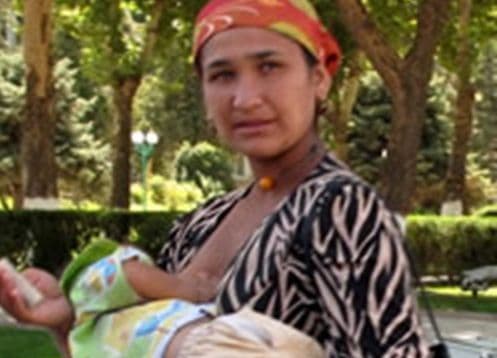
Most of the neighbourhood’s residents do not have regular employment, and many women are forced to beg on the city’s streets. “It’s not about theft or prostitution; if you see someone in need on the street, you give them money and some bread. And sometimes, even those who have performed the Hajj organise meals and give to charity,” explains Yuldužon, one of the residents. She says she started begging on the streets when she was homeless and had a child to look after. She used to ask for money to cover her daily needs, then she met her current husband, who lives in the Lyuli neighbourhood, and settled in Jany-Mahalla.
In recent years, the local authorities have urged the residents of Lyuli to give up begging, and young people have started looking for work in other sectors. Yuldužon’s stepson, for example, left for Russia to work; after saving up, he returned and is now renovating their home. Access to education is limited for the local population; Yuldužon says she would have liked her daughter to train as a seamstress, but due to a lack of money to pay for her education, her daughter never learnt the trade.
In Lyuli Mahalla, many people used to live without documents – without birth certificates or passports – which made it difficult for them to send their children to school or take them to the doctor for check-ups and examinations; the local authorities, however, claim that this problem has now been virtually resolved, and only 5 per cent of the population is currently undocumented, whilst the rest are studying and some have attained higher education.
The Lyuli community speaks its own language, distinct from Kyrgyz and Uzbek, the most widely spoken languages in Osh. “Our language is similar to Tajik, but it has differences and dialects: it is similar to the languages of Iran, Afghanistan and Tajikistan; we speak Farsi,” explains village head Umidulla Narmyrzaev.
For many years, society has associated the Lyuli community exclusively with begging, and although these areas are close to the city, many people are unaware of their daily lives. The former village remains closed to outsiders, and rarely does anyone wander through its streets. The current generation of Lyuli are striving to integrate into society, gain an education and learn a trade. The city authorities had previously announced plans to regenerate the neighbourhood, which recently became an official part of the city. However, it is still difficult to imagine when this plan will be realised, and exactly how things will change.