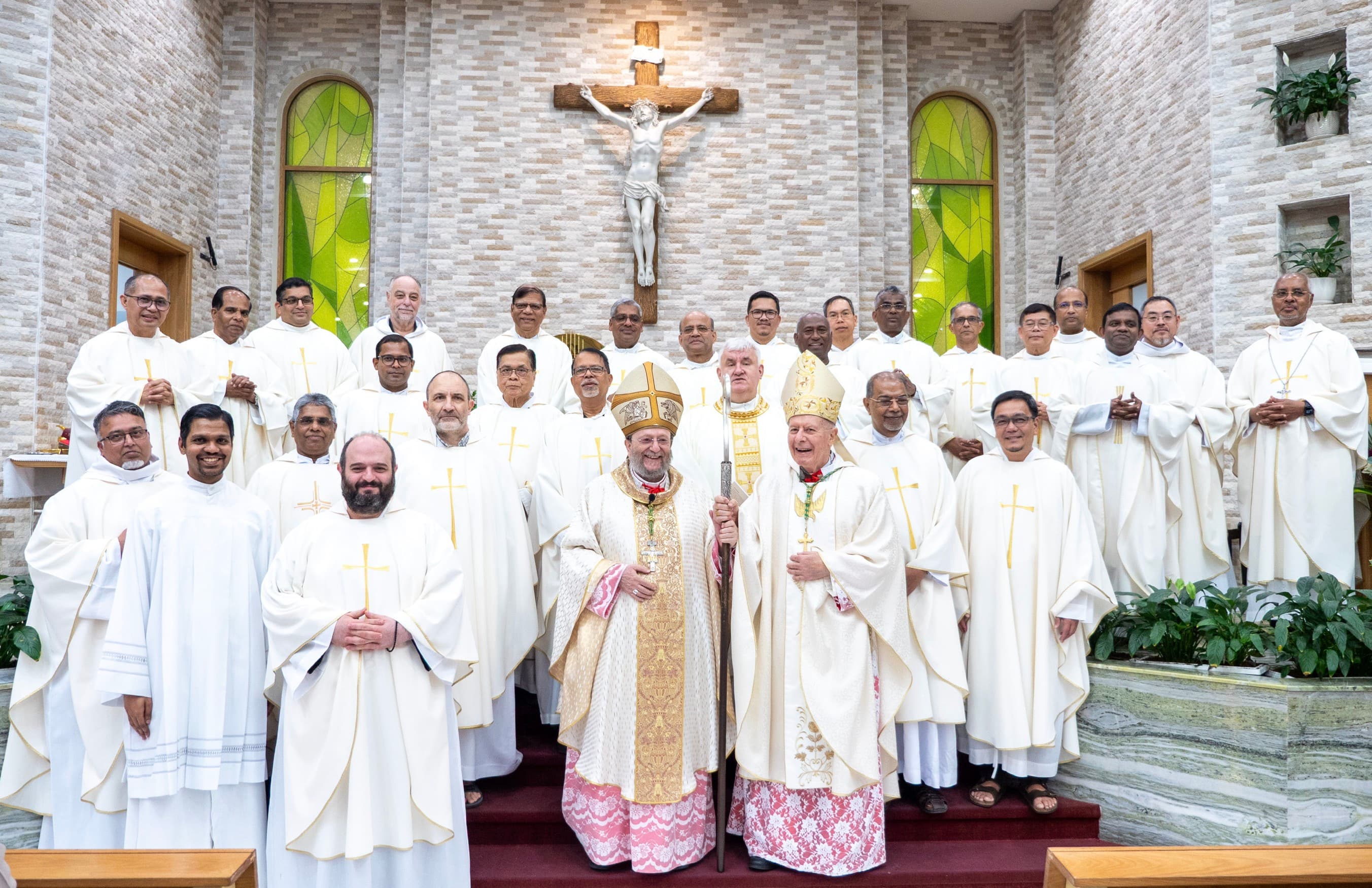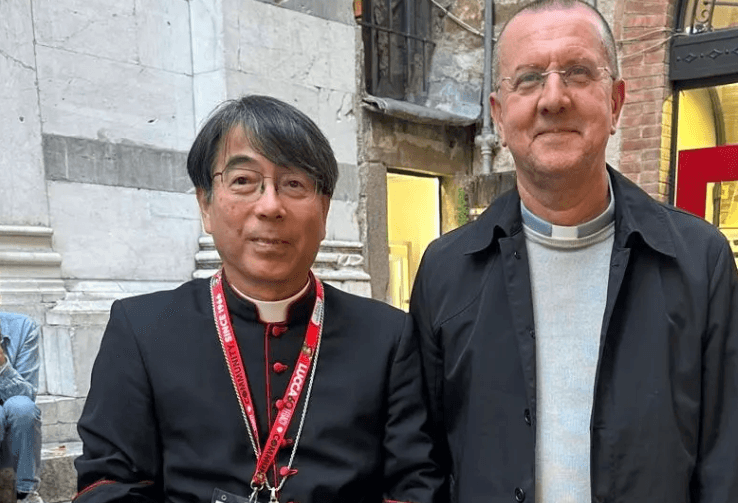
Milan (AsiaNews) – Today, Japan is “a mission country” where Catholics must rediscover “the spirit of evangelisation” within a community that “is dwindling”, and this is “no easy task”. From this perspective, “we have a great deal to do”, and migrants represent “a model and an example of faith”. This is what Msgr Peter Michiaki Nakamura, Archbishop of Nagasaki (pictured with Fr Ferruccio Brambillasca, a PIME missionary – ed.), explained to AsiaNews, describing the life of a Church that must rediscover the joy of proclaiming the Gospel in a context still haunted by the tragedy of the nuclear holocaust.
On the subject of the atomic bomb, the local archdiocese intends to take the surviving head of the wooden statue of the Virgin Mary – destroyed during the explosion of ‘Fat Man’, the plutonium bomb that fell on 9 August 1945 right in the area of the cathedral – on a pilgrimage to the United States for the first time in 16 years. At the end of the month, the face of the Virgin will be taken to New York by Bishop Nakamura for the conference on the review of the Treaty on the Prohibition of Nuclear Weapons, and then on to Los Alamos, New Mexico, the site where the atomic bomb was developed.
Witnesses to the Faith
On the missionary front, Monsignor Nakamura emphasises that “there is still no real commitment to evangelisation; moreover, Japan is a developed society and people, who are for the most part well-off, believe that faith is not all that necessary”. Hence the call to convey “the value of the Gospel, its richness” to a society that must rediscover “this passion. And to do so, we [Christians] too must become ‘poor’ not only economically, but above all spiritually. If we ourselves do not become poor, humble – he states – and evangelised, we cannot evangelise others”.
Born on 21 March 1962 in Saikai, in Nagasaki Prefecture, Bishop Nakamura was ordained a priest in 1988 as a member of the diocesan clergy, before going on to complete his studies in moral theology in Rome at the Alfonsiana Academy. On his return to Japan, he carried out his ministry by teaching at the minor seminary in Nagasaki and the major seminaries in Fukuoka and Tokyo, and through pastoral work in the parishes of Togitsu and Uematsu. Appointed Auxiliary Bishop of Nagasaki by Pope Francis in May 2019, a few months before the Pope’s apostolic journey to Japan, he succeeded his predecessor, Bishop Joseph Mitsuaki Takami – himself a Hibakusha – on 23 February 2022; Bishop Takami had led the diocese since 2002.
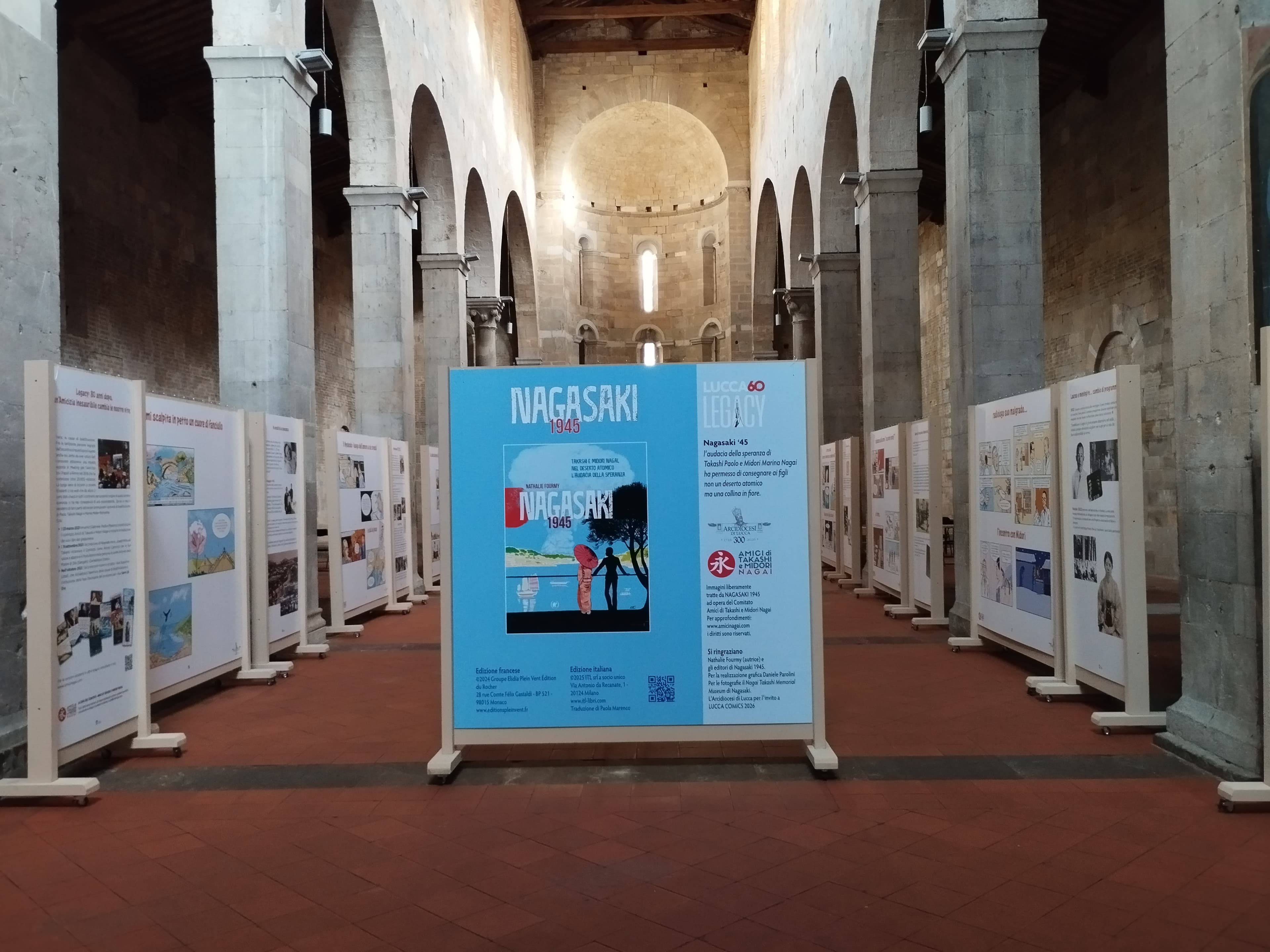
We met him a few days ago during his visit to Lucca, in Italy, where he took part in the opening of the exhibition “The Legacy of Takashi and Midori Nagai” at the “Nagasaki ‘45” pavilion of Lucca Comics&Games 2026, dedicated to the theme of “Legacy”. A testimony of faith in a world marked by the nuclear holocaust that devastated the city in southern Japan, featuring period photographs and cartoons that retrace the story of Takashi Paolo Nagai and his wife Midori, a descendant of the community of hidden Christians.
“Of Hiroshima, after the bomb was dropped, we have the image of a city in protest, of demonstrations. In Nagasaki, however, precisely because of the faith that characterises it, what emerges,” emphasises Monsignor Nakamura, “is the portrait of a Church [and a city] that prays.” Nagai too, he adds, “contributed to this image of a Church that prays and helps people. He did not think only of himself, but bore witness to the faith by helping people. For this reason, he is remembered not only as a doctor of the body but also of the soul, partly due to the teaching he received from his wife. Whilst the Church of Nagasaki is more reminiscent of the Church of Peter, with a strong and steadfast faith, Nagai’s example marks a turning point and directs it towards a Church of Paul, ad gentes, a missionary Church. From a Petrine faith to a Pauline one. Midori maintained a simple, genuine spirituality; thanks to this, Takashi was converted.”
The martyrs and the atomic bomb
The Archdiocese of Nagasaki, a city with over 1.3 million inhabitants, 4.5 per cent of whom are Catholic [over 59,000, figures updated to early 2022], is a metropolitan see centred on the Cathedral of St Mary, with the Basilica of the Twenty-Six Holy Martyrs of Japan serving as its co-cathedral. The territory is divided into 72 parishes, with 135 priests, of whom 89 are secular and 46 are religious; among the religious are 60 men and over 600 women. The city is also famous for having been the site of the martyrdom of many Christians during the early stages of the evangelisation of this Asian country. The 16 faithful killed between 1633 and 1637, on the orders of the Tokugawa shogun, were canonised by John Paul II in 1987. To these were added a long series of martyrs, including 26 Christians crucified in 1597 and a further 205 martyrs killed by the Japanese authorities between 1617 and 1632.
“What is lacking,” says Monsignor Nakamura, “is faith in action. We need greater enthusiasm and a greater capacity to stand alongside the poor and those in need, because we are very closed in on ourselves.” It should be remembered that the local Church “remained for 250 years without priests or structures”; nevertheless, it managed to “maintain and defend the faith, which runs deep.” “Today,” the prelate continues, “the problem is passing it on to others, whilst a climate of fear and difficulty persists when it comes to proclaiming the Gospel. Having lived in hiding for many years” like the early Christians in the catacombs, today “it is difficult to come out into the open and show the face of a faith that is present and steadfast”. In this context, the example of the martyrs remains essential, as they were able to “give their lives for the Gospel”, emphasises the Archbishop of Nagasaki: “The greatest message they convey,” he explains, “is that for them God was so ‘important’ that they gave up what was most precious to them. They were not able to give their lives because their faith was strong and steadfast, but only because they realised that God was with them, accompanying them on their journey’.
Another issue that remains relevant today is that of the atomic bomb, because even now “many are asking why it happened”, why God allowed this tragedy to occur, but “they have no answers”. The bomb fell near the cathedral, raising questions about the very presence and existence of God, who would have allowed such an atrocity. Added to this were the accusations from the city’s other inhabitants – the non-Christians – who blamed them, holding them morally responsible. The nuclear bomb, Monsignor Nakamura confirms, has “left its mark on people’s consciences”, but there is one “positive” aspect: “just as happened in times of persecution, when Christians fled only to return later, the same thing happened with the atomic bomb. ‘The bomb destroyed everything,’ he explains, ‘and many fled, but they returned, and the first thing they rebuilt was not their homes, but the cathedral, the church – the heart of community life. From there, they embarked on a new journey of faith.’
The migrant Church
As well as the atomic bomb and the martyrs, the Catholic reality in the Land of the Rising Sun is characterised by a third significant component, one that is difficult to integrate in certain areas, particularly in the major cities: the migrant Church, made up of workers from the Asian continent, particularly from Vietnam. “In my diocese, which is primarily agricultural and rural,” says the prelate, “there aren’t many of them; there are far more in Tokyo or other major cities. “What is certain is that bringing together and integrating the local and foreign communities,” he adds, “is no easy task.” The issue is being addressed at the level of the Bishops’ Conference, and “in some dioceses, integration works better and more effectively than in others; however, the ideal,” he emphasises, “is to have a single Church – certainly not a ‘Church of foreigners’ and a ‘Church of the Japanese’ running parallel to one another.”
The task, explains Bishop Nakamura, is to “create initiatives where people pray together; Mass must be celebrated in common, if possible in different languages”, because the risk in this case is that they remain “separate”. On the contrary, the community must be “one and united” despite its diverse elements, a task that is “not easy”, starting with the difficulties linked to “language”. “The bishops,” says the prelate, “are rightly paying close attention to this, and the path must be one that looks towards unity, even though there are many foreigners and, in terms of the Catholic population, they have already outnumbered the Japanese themselves in absolute terms.” “When I look at the foreigners,” he says, “the image of the martyrs comes to mind, because despite so many sacrifices – the hard work, and in some cases exploitation – they never fail to come to church and remain steadfast in their faith. And this is a very beautiful image and testimony.” “They are the true missionaries, witnesses even for us [Japanese],” concludes Monsignor Nakamura, “because they show us that, despite hardships and difficulties, they maintain their faith. This is an important message, a call to evangelisation through deeds rather than words.”