Jerusalem (AsiaNews) – In the wake of the US midterm elections, which saw Donald Trump’s defeat, many observers are speculating on potential shifts in US-Israel relations, while post-election consultations are underway in the Jewish state following the inconclusive vote on 27 October.
Amid the various perspectives, analyses, and displays of political strength, one question remains: Will outgoing Prime Minister Binyamin Netanyahu manage to remain at the helm of Israel, or will he be ousted by the main opposition leader, Gadi Eisenkot? A key variable is the potential support of Arab parties, which achieved a remarkable performance at the polls.
Yet, in the shadow of the political manoeuvring and power struggles stretching from Washington to Israel, and amid a broad indifference, Jewish settlers continue to progressively seize Palestinian homes and land, from Jerusalem to Jericho.
Settlers and the Army
Yesterday, in one of the major towns in the West Bank, a group of Israeli settlers forcibly seized at least eight Palestinian homes.
Palestinian news agency Wafa reported the incident in Al-Duyuk al-Tahta, a village west of Jericho, where settlers arrived with their families, broke down doors, and took over houses while the owners were away. Israeli sources, by contrast, claim that the properties were purchased through a secret transaction.
Israeli troops entered the town and nearby refugee camps to facilitate the movement of military vehicles along the roads.
In the past, Jewish settlers have repeatedly broken into and occupied homes in Al-Duyuk al-Tahta as part of the expansion of settlements (which are illegal under international law) in the area.
For its part, the Palestinian Wall and Settlement Resistance Commission (CWRC) reported that Israel has confiscated 2,536.44 dunams (approximately 253 hectares) of land belonging to three villages northwest of Ramallah, designating it as “state land”, thereby placing it under state ownership.
The CWRC noted that the order, issued on Tuesday, concerns land belonging to the villages of Beitillu, Al-Mazra'a al-Qibliya, and Deir Ammar, near the Jewish settlement of Kerem Reim.
Under such a procedure, Israeli authorities can allocate land to expand settlements, jeopardising agricultural land and restricting the development potential of Palestinian villages.
Yesterday, Israeli soldiers also raided the area surrounding the Thabet Thabet government hospital in Tulkarm, West Bank, and searched the home of Mohammed Ibrahim Shahada, the Fatah secretary in the Tulkarm refugee camp.
The military’s surprise
Commenting on the settlers’ latest move in Jericho, the Israeli military stated that they were forced to divert combat troops from security missions along the Jordanian border to facilitate the settlers' entry.
In a statement, the Israel Defence Forces (IDF) criticised the uncoordinated arrival, acknowledging that they had been caught by surprise.
According to Ynet, Jewish families moved into eight homes located in Area C, which is under full Israeli civil and military control, following a covert operation to purchase the properties.
The initiative was spearheaded by the pro-settler Nachala movement, with the support of the Binyamin Regional Council. Security teams prepared the operation, keeping it under wraps until the moment the families took possession of the homes.
However, the properties are situated right next to Area A, which is under the civil and security control of the Palestinian Authority, posing potential security risks to the new residents.
Consequently, the army deployed troops to the area, operating on the premise that the new residents must be protected. In the coming days, the IDF intend to establish a protective perimeter around the occupied homes.
According to official Palestinian data, approximately 750,000 Israeli settlers live in 194 illegal settlements and 400 outposts scattered throughout the occupied West Bank, including East Jerusalem.
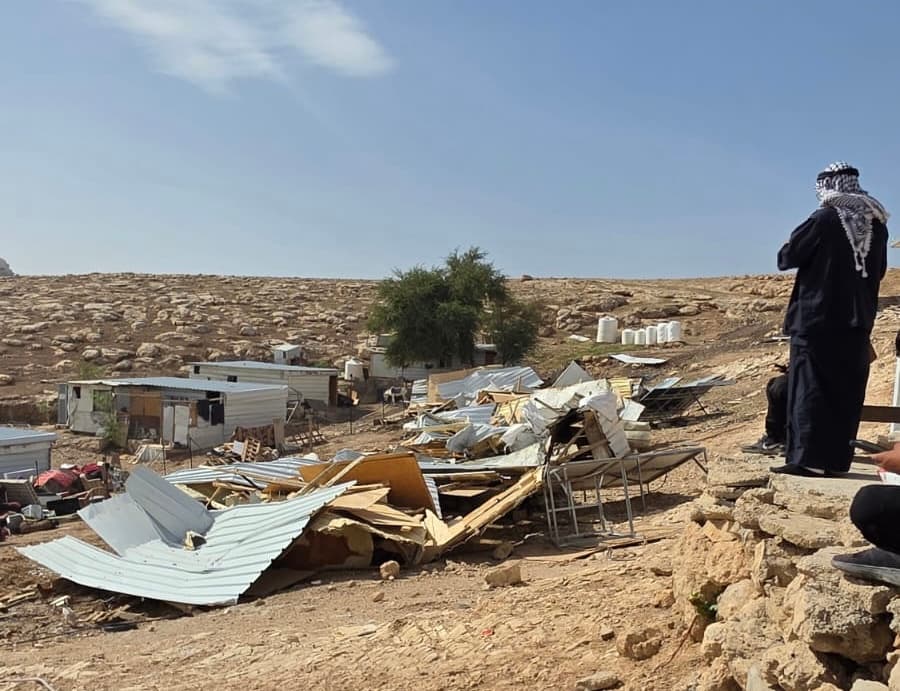
Meanwhile, in the Holy City, Israeli authorities for the first time began the demolition of a Palestinian Bedouin community since new development plans for E1 area were announced.
Nearly half of the structures in Bir al-Maskub, a Palestinian Bedouin community located within the area designated for the E1 settlement, east of Jerusalem, were razed to the ground, resulting in the displacement of approximately 20 residents.
Furthermore, demolition orders for all remaining buildings have been renewed, fuelling fears that the entire community could be destroyed as Israel pushes forward with one of its most controversial projects in the West Bank.
Bedouins in Jerusalem
The demolitions affected four residential complexes, including homes, kitchens, and sanitary facilities.
According to Bimkom-Planning and Human Rights, Ir Amim, and Peace Now, this the first known case of destruction of structures belonging to Bedouin communities within the E1 area since the plans were recently accelerated.
The demolitions, the NGOs state in a note, represent “a significant escalation in Israel's efforts to advance E1, a settlement project involving 3,401 housing units east of Jerusalem.”
The renewal of demolition orders, which date back to 2008, for all structures still standing in Bir al-Maskub raises “fears that the entire community could be destroyed.”
Other Bedouin communities in the area, home to hundreds of Palestinians, could also face “similar measures.”
Guy Yifrah, the mayor of the nearby Israeli settlement of Ma'ale Adumim, stated that the demolitions were carried out at the initiative of the municipality, following a request submitted to Coordinator of Government Activities in the Territories (COGAT), the Israeli unit that coordinates government activities in the Territories).
However, the demolished structures were located more than a kilometre away from the nearest homes in Ma'ale Adumim. According to the three NGOs, the demolitions were not dictated by local planning needs, but are instead part of “an effort to remove Palestinian residents from land earmarked for a new Israeli settlement.”
Furthermore, the demolitions took place while legal challenges against the plans for the E1 area are reportedly still pending before an Israeli court.
The E1 project, which envisions the creation of a large settlement between Jerusalem and Ma'ale Adumim, has drawn opposition from the international community, as it threatens to fragment Palestinian territory and undermine the prospects for an independent state.
The fate of the Palestinian Bedouin communities in the area has also been the subject of legal proceedings.
In response to the legal challenge, the Israeli government argued that the Bedouin way of life, characterised by movement and grazing across vast areas, and an absence of formal planning or a defined property regime, cannot serve as an obstacle.
According to the NGOs, this reflects a policy that views Palestinian communities as an impediment to the settlements.
“Israel has moved from settlement planning to displacement on the ground. The demolition of nearly half the structures in Bir al-Maskub, along with renewed demolition orders for the rest, marks the beginning of an effort to erase an entire Palestinian community.”
“E1 is not simply about building thousands of homes for Israeli settlers. It also involves dispossessing Palestinian communities and driving them from their homes and land to make way for a new settlement.
“What has begun in Bir al-Maskub could spread to other communities where hundreds of Palestinians live. These actions raise grave concerns about the forcible transfer of a protected population, in violation of international law.”
This perpetuates a policy of expropriation, which, as in the past, results in permanent seizures, with the land and homes never returned.