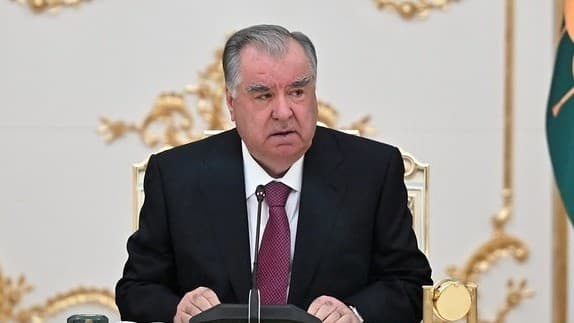
Dushanbe (AsiaNews) - Tajikistan’s President, Emomali Rakhmon, has signed a decree banning all types of inspections at small and medium-sized enterprises until January 1, 2029.
Inspections conducted by tax authorities will be exempt, according to the decree published on the presidential website; the decree also states that the government must submit the necessary legislation to implement the moratorium within one month.
The commentary accompanying the decree emphasizes that the decision aims to support entrepreneurship, strengthen the country’s industrial and export potential, eliminate unjustified and repeated inspections, and create favorable conditions for investment.
The authorities note that between 2008 and 2026, a moratorium on business inspections was declared in Tajikistan five times: in 2008, 2011, 2018, 2022, and 2025. According to the authors of the document, these measures have had a positive impact on the development of the business and manufacturing sectors, contributing to investment and job creation. Matters related to the new moratorium will be governed by the law “On the Moratorium on Business Inspections.”
During the moratorium, the application of legislative provisions regarding inspections of small and medium-sized enterprises is suspended, within the limits provided by law.
A moratorium on commercial inspections is currently in effect in the country, originally declared from January 1, 2025, to January 1, 2027. This moratorium has been extended through 2029, as announced by the president during a meeting with entrepreneurs and investors in Dushanbe on the occasion of Entrepreneur’s Day in Tajikistan.
Thanks to the simplification of administrative procedures, the number of entrepreneurs in the country has increased: as of October 1 of this year, according to the Presidential Statistics Agency, there were over 401,100 active commercial entities registered in Tajikistan. Of these, 42,500 were legal entities and 358,600 were sole proprietors.
Compared to the same period last year, the total number of business entities increased by 18,200, or 4.8%. The number of legal entities increased by 1,000, or 2.4%, while the number of sole proprietors increased by 17,200, or 5%.
Sole proprietors thus account for 89.4% of all active business entities in the country, while legal entities account for 10.6%. Of the 358,600 active sole proprietors, 183,600 are dehkan farms, whose owners can pass their businesses on as inheritance; 72,200 operate under a special-conditions certificate; 61,100 operate under a license, and 41,700 operate under a simple certificate.
Thus, more than half of all sole proprietors in the country are dehkan farms, which account for 51.2% of the total number of sole proprietors. Over the course of the year, the number of sole proprietors operating under a license grew the fastest, by 11.5%. The number of sole proprietors operating under a special-conditions certificate increased by 9.6%, those operating under a license by 6.6%, and those operating under a certificate by 1.1%.
From January through September 2026, 35,817 new business entities were registered in Tajikistan. The largest number of new legal entities was registered in Dushanbe: 663, accounting for 37.4% of the total. 417 new legal entities were registered in the Sugd Region, 334 in the republican-level districts, 287 in the Khatlon Region, and 70 in the Gorno-Badakhshan Autonomous Region.