Beijing (AsiaNews) – The Henan-based Pang Donglai retail group has, in recent years, become a leading player in the Chinese retail sector. In a climate where many companies are collapsing due to blind, capital-driven expansion and physical supermarkets are struggling to compete with online sales, this company is not driven by profit or capital expansion; it boasts a huge cash flow, a fact that is the envy of many entrepreneurs. It is said that every year this company distributes profits to its employees on a large scale, based on the value of their role, and in March this year it caused a stir and sparked heated debates across the internet precisely because it announced a distribution of capital or company profits totalling nearly 4 billion yuan.
Not only that: at a time when the safety of food and everyday consumer goods has become a major concern for many Chinese citizens, this company – named after its founder Yu Donglai and which started from scratch in Xuchang, in the heart of Henan – has always insisted on serving customers to high quality standards, becoming renowned for its clean and hygienic environment, fair prices and a rigorous quality control and risk management system – so much so that it has been compared to the ‘Chinese Sam’s Club’ (Sam’s Club is, in the minds of the Chinese, synonymous with a guarantee of product quality – Ed). The fact that ‘Pang Donglai has withdrawn a certain product from the shelves’ has even become, for many people, the criterion for judging whether a product is good or bad.
Anxiety over food safety
If we look at the consumer market as a whole, however, this model stands in stark contrast to the ever-present anxiety over safety felt by Chinese citizens. Since the turn of the millennium, with the growth in per capita GDP and increased purchasing power, quality issues with everyday goods have become impossible to prevent: from clothing containing highly toxic dyes, to furniture containing formaldehyde, tiles with radioactivity levels exceeding limits, drinks with additives exceeding limits, and fruit and vegetables with pesticide and antibiotic residues exceeding limits. And in rural areas and towns below the third tier, these threats are even more serious due to the low-end market: whilst consumers in first- and second-tier cities can, to a certain extent, ‘avoid the risk’ thanks to greater access to information, purchasing power or the choice of retailers, the most remote rural areas, lacking any choice, often become the final destination for the dumping of obsolete production capacity and industrial waste.
At a time when the concept of ecological civilisation – according to which ‘clear waters and green mountains are mountains of gold and silver’ is deeply rooted in people’s hearts, counterfeit products imitating famous brands and food that is past its sell-by date and of appalling quality are rife here; compounded by the deterioration of groundwater accumulated over the years and soil pollution, this forces the grassroots masses to pay a heavy price in terms of their health.
If we then turn our attention to the issue of day-to-day food safety, it is a truly shocking tale of chronic problems: from the ‘toxic milk powder’ scandal that erupted in 2008, involving the addition of melamine, which caused harm to 300,000 children and even led to deaths, to incidents involving sewage oil, clenbuterol and dyed buns that surfaced in concentrated waves around 2011; from banned drugs and nitrofuran metabolites widely misused in aquaculture and transport, to the 2024 incident, which came to light, involving industrial oil tankers being indiscriminately used to transport edible oil; right up to the period following the Covid outbreak, when ready meals from catering establishments and central kitchens rapidly gained ground in both delivery and on-site consumption, and issues such as the accumulation of preservatives, excessive sodium levels and the denial of consumers’ right to information became a new source of concern for the Chinese.
The problems surrounding agricultural produce are even more rife with crises: from toxic ginger, toxic green beans and toxic chives, to fruit grown using swelling agents, eggs dyed with Sudan Red, right through to sulphur-treated yangmei, formaldehyde-laced cabbage and toxic sweet potatoes – all of which have come to light one after another in recent years… The ‘vegetable basket’ forces everyone to live in a state of daily terror, and social media is full of all manner of alarmist information on how to distinguish toxic vegetables and harmful products.
Ineffective laws
When there is a deficit of social trust, every consumer is forced to become a ‘food chemist’ and a ‘fighter against counterfeits’. People have to expend enormous amounts of energy and time learning to identify formaldehyde, pesticide residues and clenbuterol. This pervasive anxiety is in itself a huge social cost and a spiritual drain on the entire nation.
In fact, as early as 2009, our country enacted and implemented the ‘Food Safety Law of the People’s Republic of China’, described as ‘the strictest in history’, and has since continuously revised and supplemented it; every year, the ‘315’ Gala on Chinese state television continues to publicly expose various cases of counterfeiting and food safety breaches.
However, over the years, the recurrence of phenomena such as ‘sulphur-treated yangmei and formaldehyde-laced cabbage’ – which have been banned repeatedly without success and in ever-changing forms – has revealed a profound dilemma in social governance. On the one hand, although legislation and institutional frameworks set extremely high standards, basic oversight has long since broken down; and in some areas, due to local protectionism and collusion with shadowy interest groups, it has turned into a tacit acceptance of the ‘turning a blind eye’ variety. And ‘rural-style law enforcement’, which starkly exposes this sort of problem, often lacks long-term, day-to-day oversight.
The deeper reason may still lie in macroeconomic policies aimed at guaranteeing supply and stabilising prices, in the extreme squeezing of the supply chain by capital, and in the excessive marginalisation of small-scale producers: agricultural produce faces perpetual, tough, low-price commercial procurement, leading to ‘adverse selection’, and producers fall into a distorted cycle of ‘I don’t eat what I grow, I don’t touch what I rear’, merely to secure a meagre profit whilst struggling to survive. On the other hand, as the system contains multiple channels for guaranteed special supplies and a dedicated supply system for materials to the canteens of government bodies, the vast majority of potential systemic risks are ultimately filtered out invisibly, falling instead on the grassroots masses, who have no support and no power of choice.
This stark contrast with reality not only tests the moral baseline of society as a whole, but also directly puts to the test the capacity for implementation and the long-term mechanisms, from high-level planning down to grassroots governance. As General Secretary Xi Jinping profoundly pointed out in December 2013 at the Central Conference on Rural Work: “Whether we are able to provide the people with a satisfactory answer on food security is a major test of our capacity to govern. If our Party, whilst governing China, cannot even manage food security properly – and fails to do so for a long time – someone will raise the question of whether or not it is up to the task.”
Another possibility from the grassroots
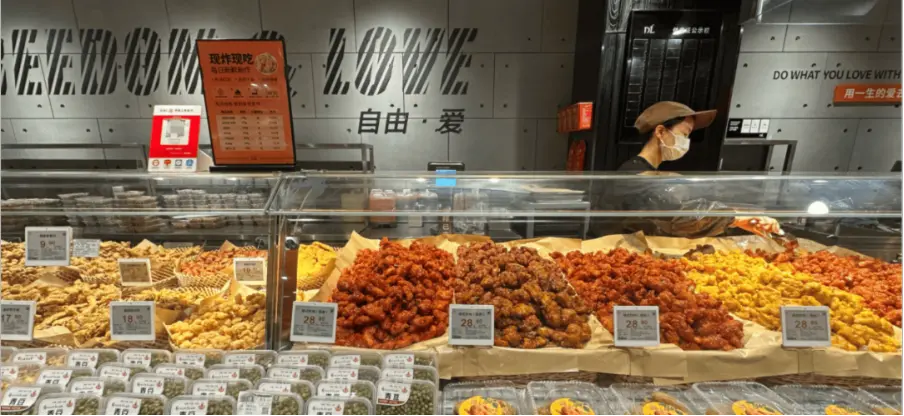
It is precisely against this historical backdrop that “Pang Donglai”, a regional multi-format physical retail outlet, demonstrates another possibility: through rigorous supply chain standards, direct sourcing from producers, own-brand products and the publication of pesticide residue levels, amongst other methods, it exports standards in reverse, holding upstream producers to account and thereby earning the trust of downstream consumers. And in terms of corporate culture and management strategy, although the founder, Yu Donglai, only attended secondary school without graduating, he frequently speaks openly about faith, freedom and love, adopting “promoting good and warning against evil” as the company’s guiding principle, and committing to ensuring that employees live with dignity, that customers consume with decency, and that people are treated as people. Under the dual influence of this management style and organisational culture, the shopping centres and supermarkets of “Pang Donglai” have clearly become an oasis in the business world. But whether such a company – which combines idealism with rigorous quality control and runs counter to the profit-driven nature of capitalism – can survive in the long term amidst society’s general decline and adverse selection, break out of its isolation and truly become an antidote with exemplary value, remains to be seen.