Dushanbe (AsiaNews) – Scholarships and the growing demand for specialists with knowledge of the Chinese language are making Chinese universities an increasingly attractive destination for Tajik applicants.
Just a few years ago, studying in China seemed a distant prospect for most young people in Tajikistan, but today the situation has changed radically: pupils begin learning Chinese from the earliest stages of their education, and gaining admission to universities in that country has become one of the main goals for applicants.
Their interest is not unfounded: knowing the language and obtaining a higher education in China – which has become one of the superpowers of our time – paves the way for young people to a secure future, a decent job and a good income. Experts estimate that more than 200 million foreigners are learning Chinese, and it is included in the educational curricula of more than 80 countries.
The reasons for choosing to learn Chinese have also changed: whilst in previous years it was studied mainly out of cultural interest, today the choice of this language is more often linked to the economy and technology. Knowledge of the Chinese language offers significant opportunities for professional and academic pursuits, particularly in the fields of trade, finance and international projects.
China is the world’s second-largest economy and the main trading partner of Tajikistan, as well as other Central Asian countries. Chinese companies are carrying out major projects in the energy, construction, road-building, communications and industrial sectors.
In all these sectors, there is a strong demand for specialists who have a good understanding not only of the language, but also of the work culture and business practices in China.
Today, knowledge of the Chinese language is a direct route to a good job, both in international companies and in joint projects between Tajikistan and China. This is why young people are starting to learn it even before they enter university.
One such student is Aziz Ašurov, an eleventh-year school leaver who intends to continue his studies in China. Aziz has been studying Chinese for over a year at the Confucius Institute at the National University, and says that “the atmosphere here is just like China itself, and all the teachers really embody that spirit.
This gives us the opportunity to learn not only the language, but also the culture through direct interaction”. The young man says he chose China for his studies on the advice of his family, and also in view of the current situation in China.
In his view, “Chinese could become the world’s leading language in the future. China is a developed country, and you can do business there and build your professional future”, he added. Aziz wants to study finance.
He has not yet decided which university to enrol at, but he is certain of one thing: he has already found his path to studying in China by learning the language and culture. Almost 6,000 Tajik students are studying in China; in recent years, the Chinese higher education system has made significant progress.
Universities are investing heavily in research, infrastructure and international programmes. Consequently, the prestige of Chinese degrees is growing worldwide. Many young Tajiks are among those who hold a Chinese degree.
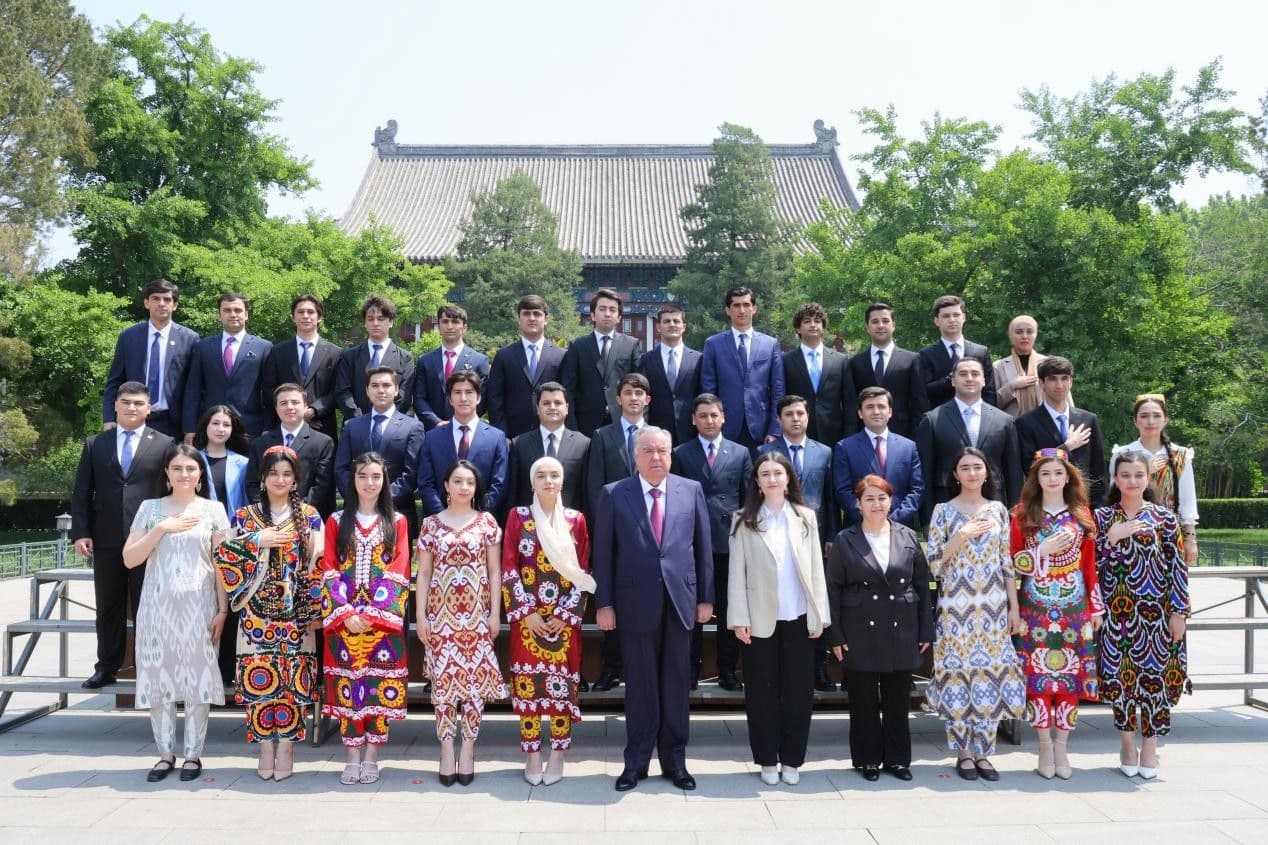
Speaking at Peking University in May this year, the President of Tajikistan, Emomali Rakhmon, stated that nearly 6,000 Tajik students are currently studying at Chinese universities. According to him, in the years following independence, over 10,000 Tajik citizens have graduated from Chinese higher education institutions.
One of the main factors behind the popularity of studying at Chinese universities is affordability: China attracts international students through government and university scholarships, the best known of which is the Chinese Government Scholarship, which covers tuition fees, living expenses and a monthly allowance. Some programmes form part of the Belt and Road Initiative, the so-called ‘New Silk Road’, and are specifically focused on the countries of Central Asia: for most students, this is a reason to choose China over Europe or America.