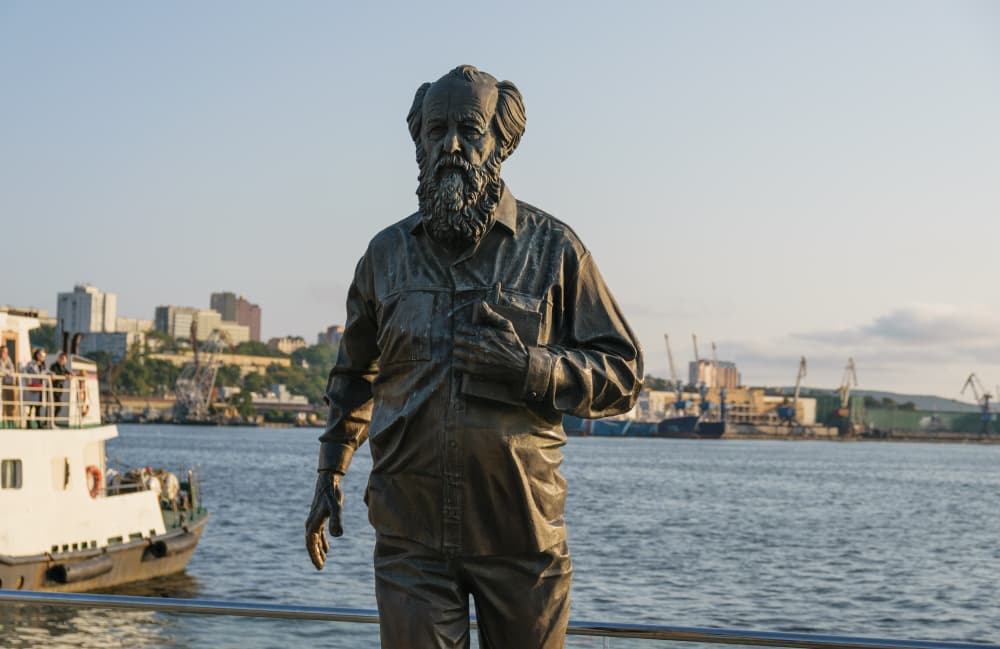
Moscow (AsiaNews) – In Vladivostok, the major Russian city on the shores of the ocean, a monument to Aleksandr Solzhenitsyn is being relocated at the request of local war veterans’ associations and the leadership of the Pacific Fleet.
On 20 October, it was removed from the Korabelnaya riverside promenade, where it had stood since 2015 to commemorate his return to Russia from exile via the Far East, but was subsequently temporarily relocated.
The sculpture was originally intended for the Square of Faith and Hope, but was deemed “too large for the square”. The authorities promise to find a solution, and for the time being it has been decided to leave it at its original location.
The monument has been the subject of controversy in the city ever since it was installed: local Stalinists have long called for its removal, and on one occasion a plaque bearing the word ‘Judas’ was affixed to it. A resident of Vladivostok has filed a lawsuit demanding the removal of Solzhenitsyn from the riverfront because he is a ‘controversial figure’. W
ho, in Putin’s Russia today, does not appreciate the author of *The Gulag Archipelago*? What was his relationship with the Soviet regime really like? Did he perhaps foresee the war with Ukraine? Was he the last great Russian writer? On Radio Svoboda, literary critic Nikolai Aleksandrov and journalist and writer Ivan Tolstoy discuss these issues.
It should be noted that Solzhenitsyn vehemently denied Radio Svoboda’s role in his life, and according to journalist Sergei Medvedev, “he was completely wrong about this”, as Radio Svoboda promoted Solzhenitsyn like few other media outlets.
As early as 1963, it was recounting his life story, reading his ‘Short Pieces’ and broadcasting almost everything he had written; neither the BBC nor Voice of America broadcast his books in full – only Svoboda could afford to do so.
Solzhenitsyn enjoyed the readings of his works, but did not like programmes that talked about him; once in the West, he refused to give direct interviews to Radio Svoboda. The broadcaster continued to record him at press conferences, to report on his speeches and to read out his newspaper articles.
He did not want to be promoted by a broadcaster he did not trust, whilst harbouring great respect for certain people who worked there, such as Father Aleksandr Šmeman, whom he regarded as his spiritual mentor.
The man who exposed the NKVD and fought the KGB, becoming the great leader of anti-Soviet dissent, eventually found himself drawn closer to Vladimir Putin. According to Ivan Tolstoy, ‘this may seem paradoxical, but I do not believe that Aleksandr Isaevich ever experienced any inner conflict: he always fought a known enemy, one he had learnt to love’.
When Solzhenitsyn returned to Russia in 1994 and began appearing on television, he continued to sound the same clarion call against his old enemies, but the country was rebuilding itself and the people wanted something different. He needed the old Russia, one that existed according to its own laws: one recalls his phrase, ‘the old Russia was steeped in Orthodoxy’.
His favourite authors were Dostoevsky, Leskov, Chaadaev and Turgenev, who portrayed ‘ritualism rather than ecclesiastical life’, as Tolstoy observes. Solzhenitsyn believed in only one Russia and saw no others in the world; he had come to the West, where there was a plurality of opinions, but for him this was perhaps the most terrifying aspect: there had to be only one opinion. That is why his speech ‘A World in Shards’ at Harvard came as a shock to many.
Aleksandrov recalls that ‘from his youth, Solzhenitsyn had prepared himself for a public role; he had a strong social conscience, but he only gradually realised his mission’. In his artistic expression, despite his innovative use of language, Solzhenitsyn was very traditionalist, with a style that almost blended with that of the villagers, as in The House of Matryona. Now his legacy evokes highly contradictory impressions, torn between the defence of old Russia and the need to build a new world, and it is unclear where his monument should be placed.