Dushanbe (AsiaNews) – The Rogun hydroelectric power station in Tajikistan, first designed during the Soviet era, has faced decades of uncertainty. Recently, substantial funding appears to have taken the project to a new level; its completion could transform Central Asia’s energy landscape, but also force tens of thousands of Tajiks to leave their homes. This month, international financial institutions have stepped up their support for the power station project.
In early October, Dushanbe ratified an agreement to receive a $300 million loan from the World Bank, and reports subsequently emerged of a possible further $500 million allocation from the Asian Development Bank.
Filippo Menga, an associate professor in the Department of Geography at the University of Bergamo, noted in an interview with Radio Svoboda that the recent news regarding funding does not guarantee the project’s completion, but since the major international financial institutions have staked their reputations on the Rogun hydroelectric power station, “stopping the project, both financially and politically, is now extremely difficult”.
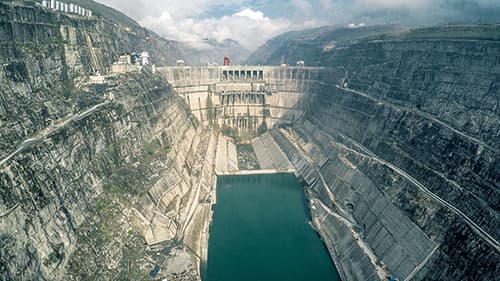
The Rogun dam is expected to reach a height of 335 metres, surpassing even the height of the Eiffel Tower. It will span the narrow gorge of the Vakhsh River, 100 kilometres east of Dushanbe. The hydroelectric power station will double Tajikistan’s generation capacity, potentially putting an end to chronic winter power shortages and creating a surplus for export. The construction of the reservoir will flood the areas upstream, forcing over 50,000 people to leave their homes.
Mukim Khasanov, a resident of a village near Rogun, is one of tens of thousands of people awaiting resettlement. Speaking to Radio Svoboda’s Tajik service, the 75-year-old farmer said that his family had been allocated a plot of land elsewhere, but inflation had eroded the value of the compensation promised for their home many years earlier: “When our homes and property were valued, prices were completely different – even for building materials – whereas now everything is extremely expensive.” For example, a wooden panel used to cost 50 somoni (around $5.40), whereas now it costs 150 (around $16.30). In Rogunion, a village on the outskirts of Dushanbe – whose name refers to the homeland of many displaced people who previously lived in the area now flooded by the reservoir – some complain that the promised agricultural land has never been allocated.
Opponents of the dam project argue that around 32,000 people could avoid displacement if the dam were built just 35 metres lower. Evgenij Simonov, coordinator of the environmental coalition ‘Rivers Without Borders’, stated that the government wants the dam to be the tallest in the world, as ‘an important symbol of national prestige, akin to a sacred pyramid’. The authorities claim that a record-breaking height would guarantee “superior economic and environmental indicators” compared with lower-altitude dam options, an assessment supported by World Bank reports.
Two turbines at the hydroelectric power station are already operational; the third of the six generating units is due to come on stream in 2027. It is estimated that the Tajik government will require around $5.8 billion to complete the Rogun Dam; funding is expected to come mainly from the state budget, and construction is scheduled for completion in 2035.