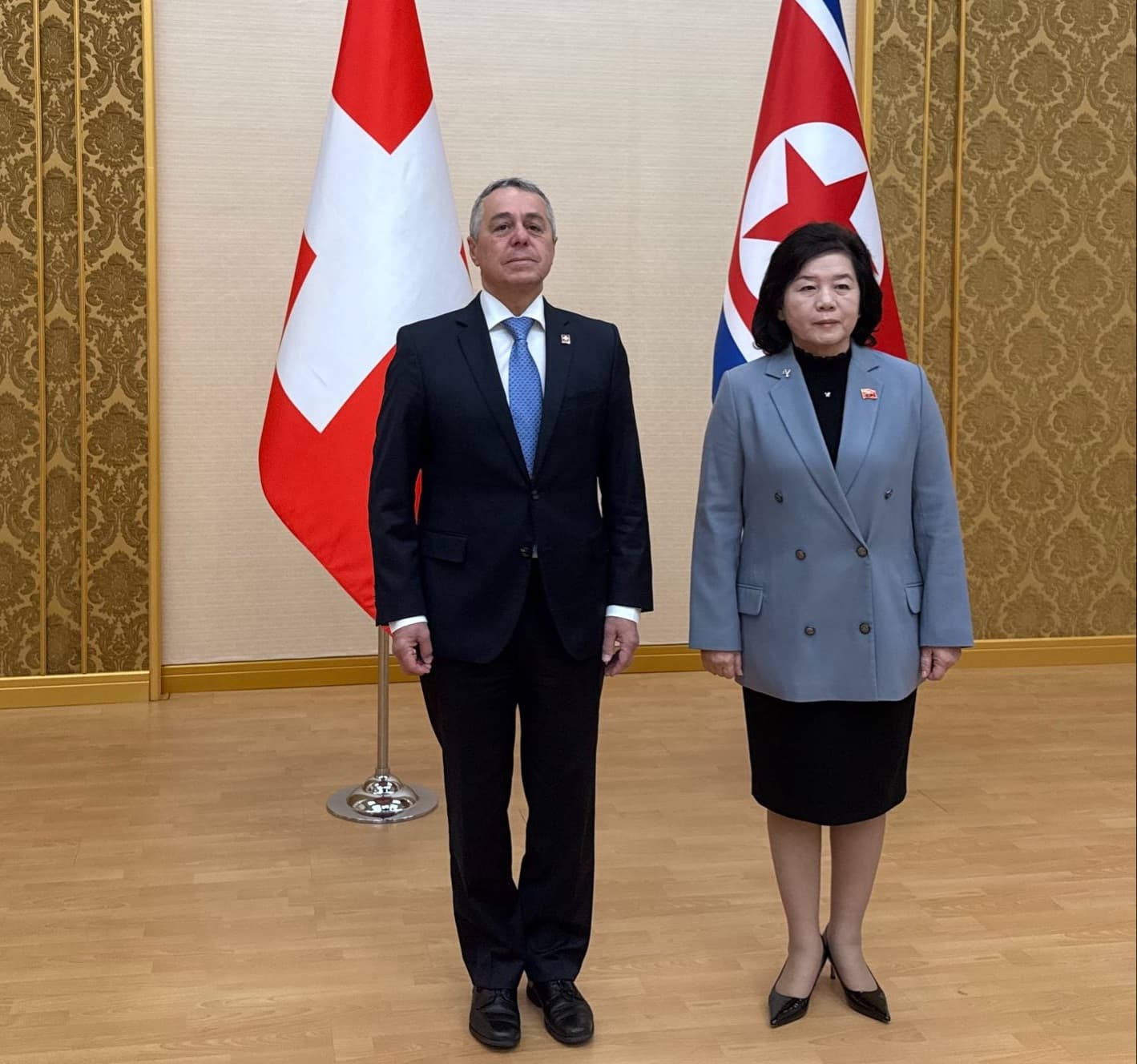
Seoul (AsiaNews/Agencies) – On the one hand, yet another missile launch to flex its muscles. On the other, a significant diplomatic development in relations with Switzerland, with the visit of the Foreign Minister and the reopening of a diplomatic office in Pyongyang. These are the two seemingly contradictory developments emerging from North Korea at this very moment.
The latest missile launch
According to military sources in Seoul, this morning Pyongyang once again launched a dozen short-range ballistic missiles towards the East Sea. The missiles were fired from the Wonsan area, on North Korea’s east coast, at around 12.30 pm, travelling approximately 250 kilometres.
According to initial reports, the launch may have involved the 600-millimetre KN-25 multiple rocket launcher system, which Pyongyang claims can be equipped with tactical nuclear warheads. Furthermore, the possibility of a combined exercise involving other offensive systems – including cruise missiles, drones and artillery – cannot be ruled out.
The launch comes about a week after Seoul proposed holding military talks to resolve differences over the demarcation of the border and reduce tensions. The situation has worsened following a landmine explosion on 21 September, which injured three South Korean soldiers. Pyongyang denies any responsibility and accuses the South of wrongly blaming it, threatening further military measures and the resumption of propaganda broadcasts via loudspeakers along the border.
Cassis’s visit
This scenario of renewed tension is, however, counterbalanced by a signal pointing in the completely opposite direction: as we speak, Pyongyang is hosting Swiss Foreign Minister Ignazio Cassis, who is visiting to mark the reopening of Bern’s diplomatic office in the North Korean capital. Cassis met his counterpart Choe Son Hui today, with whom, he reports, he “discussed security on the Korean Peninsula and the broader security challenges in Eurasia”.
Beyond the rhetoric, the return of a permanent Swiss diplomatic presence in Pyongyang is a significant development. The office – which had been closed in March 2020 due to the Covid-19 pandemic – was reopened on 19 October 2026. The mission, which reports to the Swiss embassy in Beijing, aims to strengthen direct contacts with the North Korean authorities and promote political dialogue, at a time when North Korea is gradually resuming diplomatic relations with other countries.
Switzerland has maintained diplomatic relations with North Korea since 1974. To date, the only member of the Swiss Federal Council to have officially visited the country was Micheline Calmy-Rey, then Foreign Minister, in 2003. In 2014, her North Korean counterpart, Ri Su-yong, travelled to Bern for a courtesy visit.
According to Nicolas Bideau, head of communications at the Federal Department of Foreign Affairs, Switzerland’s diplomatic engagement with Pyongyang is long-standing and substantive. At the same time, the Swiss Confederation continues to enforce the United Nations Security Council sanctions, particularly those relating to North Korea’s nuclear and missile programmes. The stated aim remains to contribute to peace and stability in the region.
Bern’s role in dialogue and humanitarian assistance
It should also be noted that since 1953, Switzerland has been involved in monitoring the armistice that brought an end to hostilities on the Korean Peninsula. Five Swiss officers are currently stationed in Panmunjom, alongside five Swedish officers, as part of the Neutral Nations Supervisory Commission. The commission observes certain military activities, accompanies inspections and verifies compliance with the agreement, which continues to function as a ceasefire.
In addition to this, Swiss humanitarian cooperation has also played an important role: an office of the Swiss Agency for Development and Cooperation was opened in Pyongyang in 1997 to support agricultural and water supply projects. This office was headed for many years by Kathi Zellweger, whose experience in the field is recounted in the book “Miss Kathi. Saving Lives in North Korea’, which we discussed some time ago on AsiaNews in this article. The latest Swiss humanitarian programmes, launched before the pandemic, came to an end in 2024. The reopening of the diplomatic office could also provide an opportunity to restart these forms of cooperation.
The Swedish ambassador, Andreas Bengtsson, had already returned to Pyongyang in November 2024; in addition to the ordinary duties of a diplomat serving his own country, he safeguards the consular interests of the United States and has historically acted as a channel of communication and mediation between the parties in the complex Korean context.