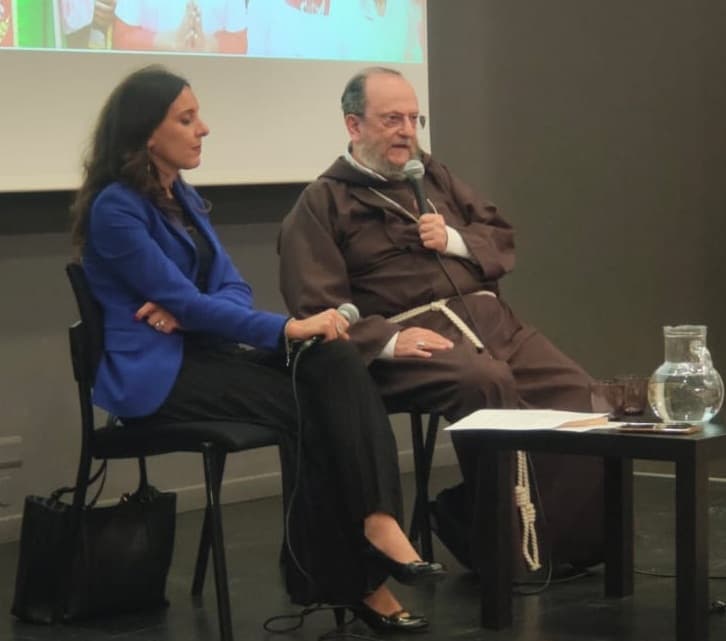
Milan (AsiaNews) – The Missionaries of Charity, who have stayed in Yemen despite the conflict in the Gulf and past persecution, serve as a "sign of hope within a context that remains one of conflict,” said yesterday evening by Bishop Paolo Martinelli, Apostolic Vicar of Southern Arabia,[*] during a conference organised by the Pontifical Institute for Foreign Missions (PIME) in Milan as part of the initiatives for the Missionary Month (October).
The Sisters of Mother Teresa, the prelate explained, are present in Hodeidah and Sana'a, two cities in the north of the country, both of which are under the control of pro-Iranian Houthi rebels, who are fighting against the Saudi-backed government.
“They have been working there since 1973," he noted, "and have paid the price for their mission with their own blood." In fact, over the years, “they have managed to set up care homes," including one in Aden that was targeted by an extremist commando unit on 4 March 2016.
The prelate explained that the attack claimed the lives of "four sisters, as well as Muslim staff members who worked at the facility,” while “an Indian Salesian priest was also seized and held captive by his kidnappers for 18 months before he was released.”
Before that, in 1998, three Missionaries of Charity nuns were killed in an attack in Hodeidah when a lone assailant opened fire outside a church, “killing the religious sisters”.
Still, the Missionaries of Charity “have remained and are very active,” Bishop Martinelli added, thanks in part to the presence of a priest who provides them with spiritual support.
Bishop Martinelli is in regular contact with them and the priest.
Nuns as a symbol of outreach
“The situation,” said the Vicar of Southern Arabia, “was truly difficult for priests and nuns, yet the latter decided to stay. Their serenity and the resolve with which they made their decision are deeply remarkable.”
Currently, the religious sisters are present in the north of the country, under Houthi control, “in a particularly challenging mission environment,” where they “run two shelters with more than a hundred residents, provide medical care and support, and look after the elderly and those who have nowhere else to go. Their work is essential and is valued by the local population.”
The nuns “welcome everyone, even while operating within a context that is still one of war. They are steadfast, sustained by faith, hope, and a profound sense of serenity,” he noted, “which even brings them happiness, despite everything.”
The vicariate strives to support the sisters, their presence, and their work in every way possible, even though “it is very difficult to send basic necessities or other resources.”
Houthi leaders show respect towards them for their “testimony” of care and charity, even though “the atmosphere remains harsh, as they are, after all, fighters.”
The evening, organised by PIME and titled “Christians in the Gulf: A Prophecy of Peace in the Middle East,” was designed to shed light on the lives of Christians in the Persian Gulf, a region currently at the heart of the conflict between the United States and Iran.
During the event, Bishop Martinelli spoke about the daily challenge of fostering fraternity within a Church composed entirely of migrants, situated in countries with an overwhelming Muslim majority.
This reality is further complicated by war, the repercussions of which remain clearly visible, not only in the disruption of trade in the Strait of Hormuz (and the critical situation in the Red Sea) but also in the resurgence of violence between the Houthis and Saudi Arabia.
Over the past week, the Saudi kingdom, long a source of stability and development, has been targeted by drones and ballistic missile strikes from pro-Iranian rebels, resulting in at least 14 dead and hundreds of wounded.
Humanitarian tragedy
The war in Yemen erupted in 2014 as an internal conflict between pro-Saudi government forces and the Houthi Shia rebels, who are aligned with Iran.
The confrontation escalated in March 2015 with the intervention of an Arab coalition led by Saudi Arabia, leading to more than 10,000 dead and 55,000 wounded. Independent organisations estimate the death toll, between January 2016 and the end of July 2018, at approximately 57,000.
According to the United Nations, the conflict has triggered the world’s worst humanitarian crisis, which was further compounded by the COVID-19 pandemic and a food emergency, with “devastating” consequences for the civilian population.
Millions of people are on the brink of starvation, and children, in particular, will suffer repercussions for decades to come.
In an already fragile environment, the intensifying fighting between government forces and the Houthis for control of the Bab el-Mandeb Strait, a gateway to the Red Sea, combined with the spillover of the conflict into Saudi Arabia, threatens to aggravate the humanitarian tragedy and place even greater strain on an already precarious healthcare system.
In Aden, the seat of the internationally recognised government, aid workers, including doctors and nurses, describe the situation as “disastrous,” as the effects of the war are compounded by the severe impact of cuts to international aid by the United States, the United Kingdom, and other donors.
Furthermore, the humanitarian response in 2026 suffered from a severe funding shortfall, receiving less than 20 per cent of the US$ 2.16 billion requested by the United Nations.
The shortfall has forced humanitarian organisations to scale back services, leaving facilities with fewer resources just as the US and Israel, in February of this year, launched a war against Iran, which subsequently escalated into a broader regional conflict.
Continued escalation
Meanwhile, the Houthis are threatening further attacks in Saudi Arabia, just hours after an incursion that reportedly caused extensive damage to the headquarters of the Saudi oil giant Aramco in the eastern city of Dhahran, though no official confirmation has been made.
For the Houthis, the sites attacked, ranging from airports to energy facilities, are “legitimate targets” and are presented as retaliation for Saudi-led bombings in Yemen. This raises the real prospect of more fighting, linked to the broader conflict involving Israel, the United States, and Iran.
Fresh exchanges of fire between government forces and the rebels are also being reported near Taiz, a city currently under a full-scale siege, while government troops try to advance along the coast.
In southern Yemen, an area controlled by the internationally recognised government army, the situation remains “complicated and difficult,” Bishop Martinelli explained, whereas in the north, the Houthis “are better able to maintain control over the territory.”
This also reflects upon the challenges faced by humanitarian workers attempting to deliver relief and aid to the population.
“In the north, it is clear who we need to engage with,” the prelate said, “while in the south, the landscape is more fragmented, making it much harder to establish contact” with the relevant leaders and officials.
“We have points of contact with international agencies operating on the ground,” he noted, “and thanks to their cooperation, we are able to provide further support to the nuns.”
“In the vicariate, we are one single Church, encompassing very different situations; yet, everyone prays for one another, from Oman and the Emirates, all the way to Yemen. There is concrete support, as much as is possible, and we function as one body,” the vicar said.
“I would like to highlight one final, yet equally important, point: I am struck by the high regard in which the nuns working in Yemen are held, a recognition of the objective good they provide for everyone, without distinction.”
[*] The Vicariate of Southern Arabia includes the United Arab Emirates, Oman, and Yemen.