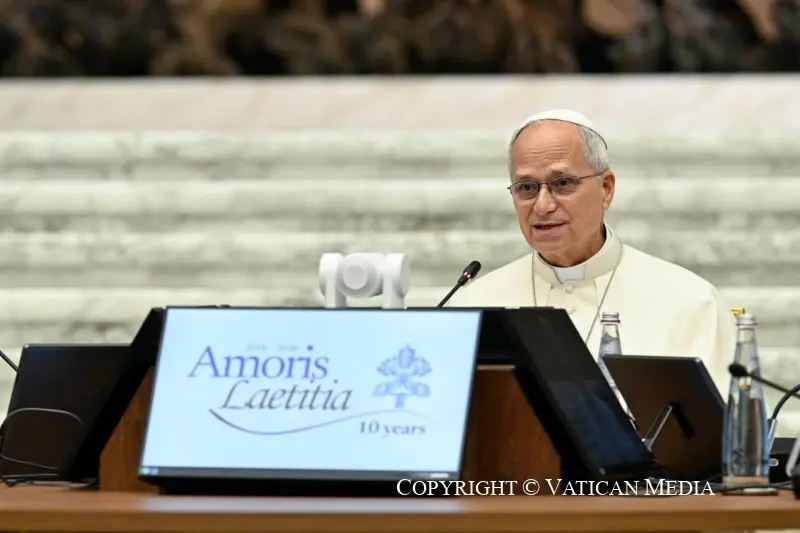
The presidents of bishops' conferences from around the world and heads of Eastern Churches are currently in Rome at the invitation of Pope Leo to reflect, alongside married couples and experts, on the path the Church has travelled in the ten years since the promulgation of the Apostolic Exhortation Amoris Laetitia.
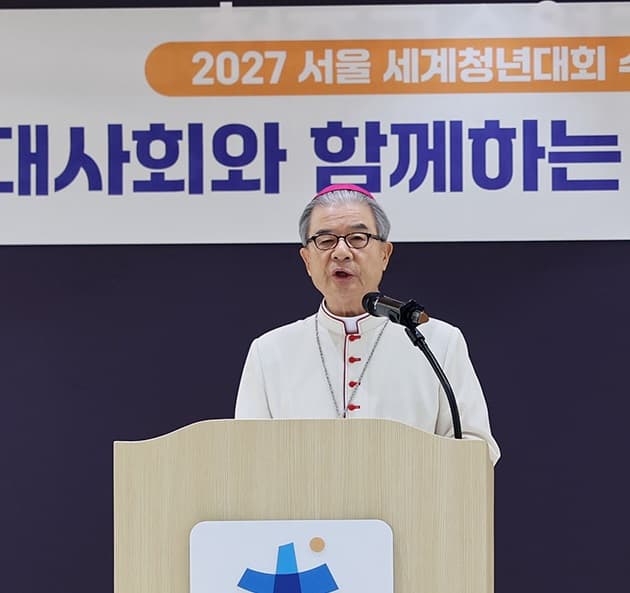
For the Catholic Church in Korea, this moment of synodality is intertwined with the journey towards the coming World Youth Day in Seoul, next August. For this reason, in today's instalment of our Road to Seoul series, we present an interview with Bishop Mathias Ri Iong-Hoon of Suwon, who chairs the Catholic Bishops' Conference of Korea.
The prelate offers his thoughts about the transformations families in his country are currently experiencing, as well as what the Korean Church can truly expect from the upcoming World Youth Day.
As president of the Korean Bishops’ Conference, how would you define the family spirit in Korea and what are the main challenges you think the Korean Church is facing?
I would describe the Korean family spirit as one of strong bonds, mutual responsibility, and solidarity between generations. Traditionally, grandparents, parents, and children cared for one another, especially in times of difficulty. Although family structures are changing through urbanization, individualization, and the rise of single-person households, this spirit of caring for one another remains important.
The Korean Church faces challenges such as declining births, an ageing population, fewer marriages, diverse family structures, and the weakening of intergenerational transmission of faith. We need to see the family not simply as an object of pastoral care, but as a subject of evangelization. I believe Korea can also share with the universal Church our experience of close community life, lay person participation, family-based faith formation, and solidarity in times of social difficulty.
What changes have you seen in family life over the past 15 years in Korea? Are young people still attracted by the family life choice?
The most significant change has been the way young people understand marriage and family life. Marriage is no longer seen simply as a natural stage of life, but as one choice among many. Many young people still desire a loving and stable relationship, but economic uncertainty, housing costs, employment difficulties, and the financial and practical challenges of raising children make marriage and parenthood more difficult.
For this reason, the Church should not simply tell young people to marry and have children. We must first listen to their hopes, fears, and real-life difficulties. We need to accompany them as they discern their vocation and learn the meaning of love and responsibility. Married couples, too, should not feel that they must face every difficulty alone. When the Christian community accompanies families throughout their journey, marriage can be rediscovered not as a social obligation, but as a vocation of love, responsibility, and mutual growth.
You are preparing the WYD, which will be a major event. What are the highlights of the event according to your perspective?
I hope that the 2027 Seoul World Youth Day will be much more than a large Catholic gathering. Its theme, “Take courage; I have overcome the world” (John 16:33), speaks very directly to young people who live with uncertainty and many challenges about the future.
Korea is particularly meaningful as a host country because it is a place where different religions and cultures coexist, and because the Korean Peninsula continues to long for peace and reconciliation. I therefore hope that the WYD will become a place where young people of different cultures, nations, and even religious backgrounds can meet, listen to one another, and experience solidarity and peace.
I also hope that young people will be recognized not simply as recipients of pastoral care, but as active protagonists of the Church. The WYD should not end as an event. It should become a continuing journey that helps young people return to their communities with renewed faith, courage, and hope.
How are Korean Catholic youth getting prepared for it and what are their expectations?
Young Koreans are preparing for the 2027 WYD through prayer, formation, service, and various forms of participation. Young people from the Archdiocese of Seoul, the other dioceses, and different Catholic communities are taking part in volunteer training and in the spiritual preparation for welcoming young people from around the world.
One of the most important aspects of this preparation is helping young people move from asking, “What can the Church do for me?” to asking, “What can I do for the Church and for the world?” We want them to discover that they are not simply participants or volunteers, but members of the Church with gifts, responsibilities, and a mission.
They are also looking forward to meeting young Catholics from different countries and cultures. Through prayer, friendship, and sharing their experiences, they can discover that they are part of a universal Church. Above all, I hope this experience will deepen their relationship with Christ and help them continue their journey of faith after the WYD has ended.
In Korea Catholics are a sizable minority. What kind of impact will this event have on the whole society?
Although Catholics are a minority in Korea, the 2027 Seoul WYD can become a significant meeting point between the Church and Korean society. Young people from many countries will encounter Korean families, communities, culture, history, and daily life. For this reason, the WYD should involve not only Catholics, but also local communities, schools, public institutions, volunteers, and people of other religious traditions.
Korean society today experiences various divisions related to generation, social position, values, and ideology. In this context, the hospitality, dialogue, solidarity, and peace experienced during the WYD can offer a meaningful example of how people from different backgrounds can live and work together.
I believe the most important legacy of the WYD will not be its size or economic impact. It will be the people who return home with a deeper respect for others, a greater concern for those who suffer, and a renewed commitment to dialogue and peace. In that sense, the true legacy of the WYD will be people, not simply an event.
What is the state of ecumenical and interreligious relations in your country?
In Korea, the Catholic Church has continued its ecumenical efforts together with the Orthodox and various Protestant Churches. Through the Christian Council for Faith and Order, we hold annual prayer services for Christian unity and continue theological dialogue, forums, educational programs, and pilgrimages. These encounters help us learn from one another and strengthen our sense of fraternity as Christians.
Interreligious dialogue is also active. Catholicism, Protestantism, Buddhism, Won Buddhism, Confucianism, Cheondogyo, and other religious traditions meet through organizations such as the Korean Conference of Religions for Peace and the Korean Religious Leaders’ Council. We organize cultural exchanges, pilgrimages, academic discussions, and joint activities for the common good.
Of course, dialogue must reach beyond institutional meetings and become part of ordinary people's lives. We need to deepen what I would call “spiritual friendship”: respecting each tradition, learning from one another, and working together for peace, human dignity, and the common good while remaining faithful to our own identity.
Pope Leo is the third pope visiting South Korea. When Pope Francis came in 2014, he concluded the Sixth Asian Youth Day whose topic was 'The Glory of the Martyrs Shines on You' and he presided over the beatification mass of 124 Korean martyrs. How is martyrdom a relevant element in Korean youth identity today?
The Korean martyrs remain an important root of the identity of the Korean Church. They freely embraced the faith and remained faithful to Christ even at the cost of their lives. Their witness reminds young people today that faith is not simply something we inherit, but something we must freely choose and live.
Of course, young people today do not face the same persecution as the martyrs did. Yet they still face important questions: What values will I choose? What kind of person do I want to become? What am I willing to sacrifice for others? In this sense, the spirit of martyrdom can be lived today through everyday choices, remaining faithful to the Gospel, protecting human dignity, forgiving others, caring for those who are poor and marginalized, and putting love before personal interest.
For this reason, the martyrs should not remain figures of the past. Especially as we prepare for the 2027 Seoul WYD, I hope young people will ask themselves: “What does faith mean to me, and what am I willing to live for?” Then the Korean martyr tradition can become a living source of faith, courage, love, and hope for the future.







.jpg&w=3840&q=75)