Hiroshima (AsiaNews) – A memorial ceremony was held today in Hiroshima for the South Korean victims of the US bombing that led to Japan's surrender in World War II.
For the occasion, a registry with the names of 2,826 South Korean victims was dedicated, plus the names of two people whose death was confirmed in the past year, according to Kyodo News.
The deed, which is repeated every August, marks a story that has long been sidelined in Japanese memory, that of the tens of thousands of Koreans caught up by the bombs that razed Hiroshima and Nagasaki on 6 and 9 August 1945.
An international people’s tribunal was established two years in order to obtain official recognition of their suffering.
During World War Two, hundreds of thousands of Koreans were brought to Japan (which had occupied the Korean Peninsula in 1910) because of wartime labour shortages, especially in Hiroshima and Nagasaki, which were important military centres.
Many had come in search of work after losing their livelihoods at home. According to some estimates, around 70,000 Koreans were exposed to the effects of the two A-bombs with some 40,000 dying in the days immediately following their drop, although, as Kyodo News noted, the exact figure remains unknown.
Other sources put the number of Korean deaths at more than 50,000, out of the approximately 215,000 deaths caused by the two atomic bombs at the end of 1945. The uncertainty surrounding the numbers is part of the tragedy.
The city's registry offices were destroyed by the bombing, while the Japanese colonial system forced Koreans to Japanise their names, making it nearly impossible to accurately find out who among the victims was a foreigner.
A 1978 survey by Jeong Gijang (a survivor) among the people of Hapcheon, where most of the Koreans present in Hiroshima came from, identified 5,001 Koreans who had been present at the time of the bombing, 96 per cent in the first city to be bombed.
His research remains one of the few systematic censuses ever conducted on Korean survivors.
Hapcheon, Korea's Hiroshima
About 70 per cent of the Korean victims of Hiroshima came from Hapcheon County, later dubbed Korea's Hiroshima, a mountainous, rural area north of Busan. Thousands of survivors returned there after Korea's liberation in 1945, out of a total of approximately 43,000 Koreans repatriated from Japan after the war.
Today, the Hapcheon Atomic Bomb Victim Welfare Centre caters to survivors of the atomic bombing. Built in the 1990s with a Japanese contribution of 4 billion yen in 1993, it provides humanitarian aid under the management of the Korean Red Cross. Behind the facility, a traditional structure houses 1,172 votive tablets with the names of missing survivors.
According to its director, Jeong Soo-won, approximately 1,600 Korean hibakusha are still alive in South Korea today, 82 as permanent residents of his facility. However, the number of known survivors is likely lower than the actual one since for decades many victims preferred to remain silent.
This was the case, for example, of Bae Kyung-mi, who was five years old when "Little Boy" was dropped on Hiroshima on 6 August 1945. Her house collapsed on her, protecting her from the burns that killed tens of thousands of people, including an aunt and uncle.
Upon returning to Korea, her family never spoke of what happened.
"I never told my husband that I was in Hiroshima and a victim of the bombing," Bae said last year when she was 85, quoted by Agence France Presse. "Back then, people often said you had married the wrong person if he or she was an atomic bombing survivor."
Her two children only learnt of her story when she enrolled at the Hapcheon Centre in 1996. She feared that radiation-related illnesses, which led to the removal of her ovaries and a breast due to the high risk of cancer, could also affect them.
Behind the victims' silence, however, lingers the social shame of having performed menial jobs in the service of Japan, compounded by (unfounded) rumours that radiation exposure was contagious.
Those who remained in Japan faced double discrimination, both as hibakusha and as Koreans, and also had to witness the conflict in the 1950s that led to the division of the two Koreas.
It took decades before their fate received public recognition.
A first monument to the Korean victims was erected in 1970 outside Hiroshima's Peace Memorial Park, at the western end of the Honkawa Bridge, near the site where the body of Prince Yi Wu, an ethnic Korean who served as an officer in the Japanese Imperial Army killed in the bombing of Hiroshima, was found.
Only in 1999, after years of pressure, was the monument moved inside the park, alongside the other memorials.
An international people’s tribunal in Seoul
Today, the issue of recognition is far from settled. Shim Jin-tae, 84, born in Hiroshima to conscript parents and now head of the Hapcheon chapter of the Korean Atomic Bomb Victims Association, summed it up in a speech at the Third Meeting of the States Parties to the UN Treaty on the Prohibition of Nuclear Weapons (TPNW), held in New York in March last year.
“Over 70,000 Koreans were exposed to the atomic bombs dropped by the United States on Hiroshima and Nagasaki. However, even to this day, no proper investigation has been conducted to determine the true extent of the damage, and we still do not know how many Koreans were affected, he said”.
“Even those who survived and returned to their hometowns lived the rest of their lives in pain, suffering from the neglect of the government, social ostracism, crushing poverty, and the aftereffects of the atomic bomb,” he added.
What is more, “Even now, the South Korean government continues to exclude the descendants of atomic bomb victims from special support laws and has completely ignored the voices of the victims.”
A special law passed in South Korea in 2016 provides a monthly subsidy of approximately 100,000 won (about US$ 72) for recognised survivors, but no support for their children and grandchildren, despite the many cases of congenital diseases linked to parental exposure.
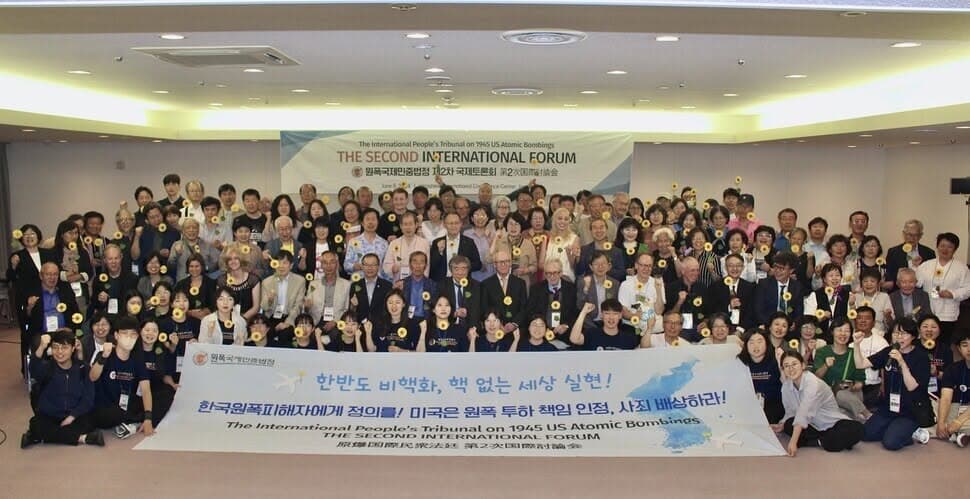
For this reason, the International People's Tribunal on the 1945 U.S. Atomic Bombings was established in 2024, promoted by Solidarity for Peace and Reunification of Korea (SPARK), a South Korean NGO, together with an international committee of jurists, with the aim of holding the United States accountable under international law for the use of the two bombs.
The tribunal (which has no power of enforcement, modelled after other initiatives of symbolic justice such as the Russell Tribunal on Vietnam) focuses specifically on Korean victims, whose plight, according to the organisation, has “not been sufficiently brought to light before the international community," especially as dual victims, of Japanese colonisation and US bombing.
An initial investigation was held in Hiroshima in 2024 and a testimony tour was undertaken in the United States between 20 April and 2 May of this year, which also took the association to New York, coinciding with the Eleventh Review Conference of the Nuclear Non-Proliferation Treaty. The next step will be hearings from 13 to 15 November 2026 in Seoul, at the Graduate School of Theology, Hanshin University.
In June, the organisers sent a formal invitation to the governments of the United States and South Korea to participate in the proceedings, but no official response has yet been received.
Meanwhile, the possibility of keeping the memory alive is dwindling, along with the number of direct witnesses, now in their eighties. Precisely for this reason, according to those who have followed the case for years, the time for international recognition is increasingly short.
As Melissa Parke, executive director of the International Campaign to Abolish Nuclear Weapons (ICAN), put it after a visit to the Hapcheon survivors in August 2025: “The Korean survivors, like their Japanese counterparts, have suffered 80 years of harm. In addition to getting the support and recognition they deserve, their calls for abolition of nuclear weapons must be heeded by all the nuclear-armed countries”.