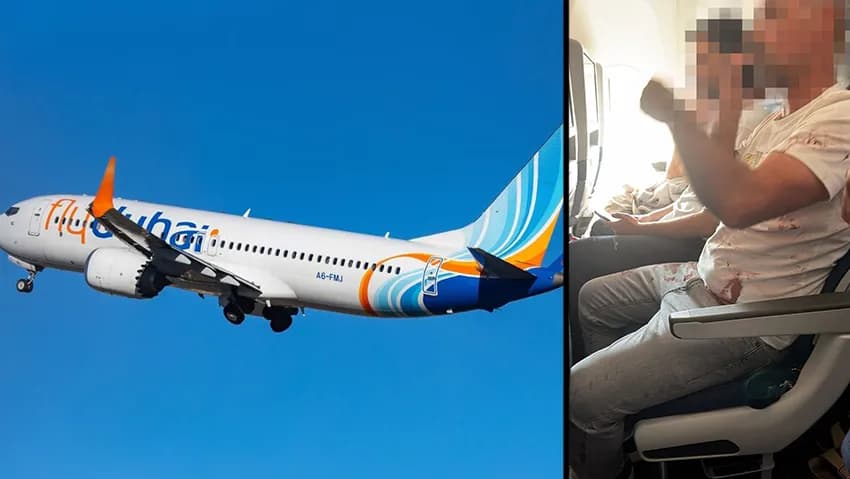
Jerusalem (AsiaNews) – Minutes of terror and confusion unfolded this morning aboard a Flydubai flight connecting Dubai, the UAE’s tourism and commercial hub with Tel Aviv’s Ben Gurion International Airport.
With 174 mostly Israeli passengers on board, including 27 children, Flight FZ 1073, en route from Dubai to Tel Aviv, declared an emergency around 8:30 am and subsequently made an emergency landing in Tabuk, Saudi Arabia.
According to an initial account, one of the two pilots (a native of Oman) intended to crash the aircraft, but the other pilot stopped him with the help of passengers and crew members, thereby averting a tragedy.
The rumour mill regarding the hijacker’s motive is abuzz: whether he intended to hijack the plane, crash it, or steer it toward a target in Israel, like the 9/11 attackers in New York, 25 years ago.
In Israel, the government, Mossad, and Shin Bet have already launched investigations, and will likely question the passengers and crew to piece together the details of an incident that narrowly avoided turning into a tragedy.
Some sources report a lot of blood inside the plane and external damage to the tail, most likely caused by a sudden drop in altitude during a struggle between the attacker and the crew, while another pilot, who was off-duty, reportedly landed the aircraft.
A political controversy immediately ensued, with Finance Minister Bezalel Smotrich calling for another pre-emptive war: the State of Israel "must respond to intent, not results," he wrote on X, commenting on the attempted hijacking.
Growing routes
According to Israeli media, Transport Minister Miri Regev has reportedly called for the suspension of all Flydubai flights to Israel, despite the route's strategic importance.
At the same time, she has instructed the Civil Aviation Authority to investigate whether the UAE violated the agreement with Israel, which “stipulates that only pilots holding passports from countries with diplomatic relations with Israel may land in the country,” given that the Sultanate of Oman is not among such nations.
This is not the first time a flight between Israel and the UAE has landed in Saudi Arabia – a Flydubai flight from Dubai to Tel Aviv made an emergency landing in Riyadh in September 2025 due to a medical emergency, Israeli newspapers reported.
However, such incidents have not halted the development of air links between the two signatories of the Abraham Accords, which marked the normalisation of relations.
On the contrary, data from industry experts show that air links between the UAE and the Jewish state have continued to grow in recent years, even weathering the crisis triggered by the war in Gaza following the Hamas attack on 7 October 2023.
In many instances, these connections proved vital in averting Israel’s isolation caused by the brutal war in Gaza and settler violence in the West Bank, violence often condoned by Prime Minister Binyamin Netanyahu’s far-right government.
The steady expansion of air links, which continues to this day, is confirmed by Etihad Airways' decision last January to launch a new regular route featuring six daily flights to Israel.
Never before had the airline owned by the Abu Dhabi government exceeded five daily flights to a single destination, a testament to the strengthening of ties since the signing of the Accords, bonds that now prevail over political or ethical considerations.
Air traffic between the UAE and Israel has grown rapidly since direct flights began in 2020; the number of flights gradually increased, peaking at 10 per day in 2021 and occasionally reaching as many as 14 daily.
In January 2026, with the addition of six flights by Etihad, the total number of daily direct flights hit a new record, a milestone driven by a significant recovery in 2025.
Last year, in fact, over 300,000 passengers flew from Israel to Abu Dhabi on Etihad flights, with an average occupancy rate approaching 90 per cent. Approximately 30 per cent of these travellers visited Abu Dhabi for leisure, while 70 per cent continued on to more distant destinations in Asia.
Overcoming isolation
This increase in air connectivity has stimulated travel and tourism between the two sides, albeit in a decidedly skewed manner.
For Israelis, the UAE has rapidly become one of the most popular tourist destinations. For instance, data and reports from early 2025 show that Dubai was the preferred winter destination for Israeli travellers, accounting for over 10 per cent of all departures from Ben Gurion International Airport.
In the first ten months of 2022 alone, more than 150,000 Israelis visited the UAE, compared to just 1,600 Emiratis who visited Israel during the same period.
This stark disparity indicates that the economic benefits stemming from the normalisation of tourism flow primarily to the Emirati tourism sector and economy, although the Israeli economy also derives indirect advantages.
As travel volumes rise, so do revenues for Israeli airports and airlines (such as El Al and Israir), and travel agencies on both sides have seen an uptick in business.
According to the Israel Airports Authority, passenger traffic at Ben Gurion Airport increased by 33 per cent in 2025, reaching 18.5 million passengers, up from just 13.9 million in 2024, a year when travel had been heavily impacted by the war.
Flights from the UAE remained among the airport's busiest routes. It is worth noting that the growth of air travel faced a critical test during Israel's war in Gaza, as global airlines such as Delta and Lufthansa suspended or halted operations.
Passenger traffic at Ben Gurion Airport nearly halved compared to the previous year. However, in stark contrast, flights from the UAE continued to help break Israel's isolation and maintain air links with the rest of the world during the most acute phases of the crisis.
Both Flydubai and Etihad Airways maintain regular services between Dubai/Abu Dhabi and Tel Aviv, demonstrating the UAE's determination to separate its normalisation strategy from the human consequences of the war in Gaza.
Notably, statistics show that Flydubai operated over 1,800 flights to and from Israel since the outbreak of the war in Gaza in 2023, cancelling only 77 flights during that period and conducting more than 200 flights in September 2024 alone.
Similarly, Etihad Airways maintained daily connections to Tel Aviv throughout the conflict, operating alongside the Israeli carrier El Al and implementing security monitoring and precautionary protocols where necessary.
The Times of Israel confirmed that flights from the UAE were effectively the only international routes to remain operational during the war, preserving a minimum level of air connectivity with Tel Aviv at the height of the crisis.
Following the ceasefire in October 2025, global airlines cautiously resumed flights to Israel, leading to a significant surge in passenger volume in December (up 59 per cent year-on-year).
Over the course of 2025, Ben Gurion Airport recovered much of its pre-war activity, serving 18.5 million passengers, a 33 per cent increase over 2024, though figures remained below pre-conflict levels from 2023.
These data underscore the severe blow the war dealt to Israel's aviation sector while highlighting the crucial role played by Emirati airlines in mitigating the country's isolation from air travel.
Flights as a pillar of normalisation
Recent years have shown that direct air links have become one of the strongest pillars of normalisation between the UAE and Israel under the Abraham Accords.
Despite regional instability and widespread public discontent across the Arab world regarding the war in Gaza, Abu Dhabi further strengthened its partnership; rather than severing ties, official visits continued, air connections remained uninterrupted, and economic cooperation actually intensified.
Bilateral trade grew even at the height of the war, reaching US$ 3.2 billion in 2024, an 11 per cent increase over the previous year, testifying to a growing convergence of mutual interests, even during the most critical times.
The UAE also maintained its diplomatic presence in Tel Aviv throughout the conflict, despite growing calls at home to suspend the normalisation process.
“The continuation of flights between the two sides during the war symbolizes the UAE’s commitment to its relationship with Israel, no matter what,” said Dina Esfandiary, an advisor at the International Crisis Group.
Bahraini analyst Ahmed Al-Khuzai told The Times of Israel that, “The Abraham Accords have proven more resilient than older peace treaties with Egypt and Jordan. They withstood the October 2023 storm and the economic and popular ties between the UAE and Israel held firm.”
In this context, Etihad’s decision to increase its daily flights to Tel Aviv represents more than just an operational detail. It signals the start of a new phase in which relations between the UAE and Israel are managed as a routine service, driven by criteria such as “demand” and “global connectivity” rather than politics, religion, or public opinion, while the costs of the occupation and the war are relegated to the sidelines.