Milan (AsiaNews) – Hundreds of thousands of displaced people are living in an “emergency” situation that grows worse by the day, exacerbated by a “lack of aid” and a profound “indifference” of the international community, which “offers no answers and seeks no stable solutions” to ensure a future, this according to Father Gabriel Romanelli, parish priest at the Latin-rite Holy Family Church in Gaza.
Reached by phone by AsiaNews, the clergyman describes a critical situation where the effects of the war, and a fragile truce that is broken on a daily basis, are compounded by an emergency caused by severe weather and flooding.
“Life remains miserable for people, who suffer above all because they see no sign of hope,” the priest said. “While the situation has improved slightly since the ceasefire took effect, compared to the most intense phases of the war, that does not mean things are good. On the contrary, things are getting worse, some people have truly lost everything, even the scrap of canvas they called a tent, which provided them with shelter.”
Flood emergency
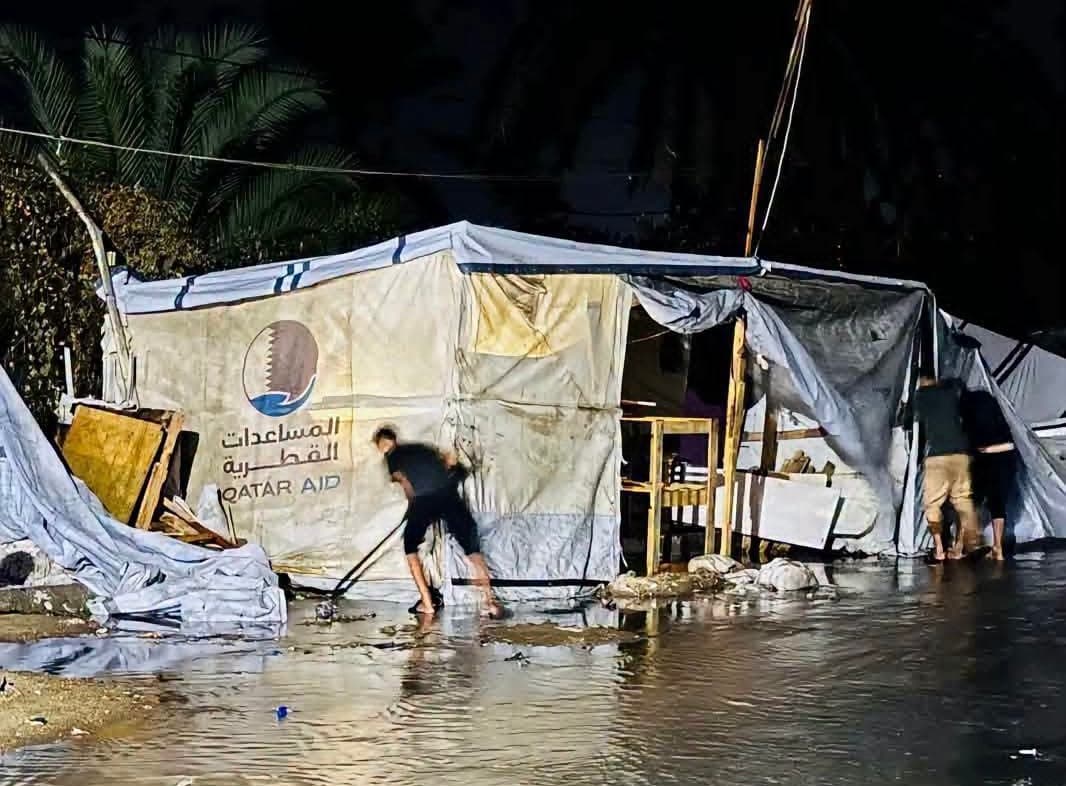
In addition to the war and the daily Israeli attacks that continue to claim lives, Gaza is currently facing a natural emergency: flooding triggered by heavy rains, which brought parts of the territory to its knees.
Cars are submerged, already precarious tents have been flooded and overwhelmed, and adults and children, soaked and shivering, are searching for the few remaining dry spots. Sources from Hamas, the Palestinian extremist movement that controls the enclave, claim that some infants have died from the cold, and at least 70,000 tents have been swept away or rendered unusable.
The situation is most critical in the south, where hundreds of people have gathered their few belongings and headed towards Gaza City or more sheltered areas in the central and northern parts of the Strip.
Exacerbating an already dire situation is a lack, or a cut, in emergency funding and humanitarian aid; the World Food Programme (WFP), for instance, has cut the number of people it assists by one third, from 1.5 million to 1 million.
Weighing on budgets and resources are the significant reductions imposed by the US administration under President Donald Trump, who recently renewed pressure to revive his highly criticised “plan” for the reconstruction of the Strip.
Currently, most Gazans are sheltering in an estimated 270,000 tents, but meeting the actual needs would require providing shelter for another 400,000 displaced people who have been living outdoors or in makeshift shelters for years.
According to the United Nations, an additional 900,000 people are at risk of being flooded and left without assistance should the rains and flooding continue.
In the background, the negotiations remain at a standstill, awaiting an agreement, still a long way off, for the withdrawal of Israeli troops and the complete disarmament of Hamas. Also pending is a more effective role for the Trump’s “Board of Peace” for Gaza, which has so far failed to deliver any results.
Before the conflict, the al-Zeitun neighbourhood, in the southern part of Gaza City, where the Holy Family parish is located, was home to “roughly 2,500 families,” says Father Romanelli. “Now, there are twice as many, many of them desperate, camped out on the streets, everywhere, waiting for the chance to return to their home areas,” which in many cases lie “beyond the yellow line controlled by Israel.”
“They want to return to their land because they inherited it from their parents and grandparents,” the priest adds.
There are heart-wrenching sights of children rummaging through trash in search of anything useful, or adults gathering plastic and cardboard to light a fire to keep warm; the meagre supply of gas that gets in is not enough, so people burn whatever they can find to generate a little heat and to cook.”
Unresolved conflict
In the Palestinian enclave, often described as an "open-air prison", up to two million people lived before the war. Today, at least 950,000 of them are displaced, forced to survive in tents or emergency shelters that, according to United Nations data, are exposed to "moderate to high" risks of flooding.
Compounding the tragedy of the floods is a conflict that, despite the truce, continues to claim lives, as evinced this past weekend, when two people, including a woman, were killed while 12 others were wounded in an Israeli attack early yesterday, in the latest incident in a long, bloody trail, proof of the repeated violations of the fragile ceasefire that has been in place in the Gaza Strip since 25 October 2025.
According to the Gaza Ministry of Health, at least 1,610 Palestinians have been killed and another 5,819 wounded by fire from Israeli military forces since the truce began just over a year ago.
The agreement was reached following two years of war waged by Israel in response to the attack by Hamas on 7 October 2023, which resulted in the deaths of more than 74,000 Palestinians, left more than 175,000 people wounded, and devastated 90 per cent of Gaza’s civilian infrastructure.
Father Romanelli, an Argentinian priest from the Institute of the Incarnate Word, said that the floods have destroyed even the few resources some people had left, such as the “cardboard and boxes used for shelter.” They lost the mattresses they slept on, and this is the primary emergency that must be addressed, as living conditions continue to deteriorate.
“People continue to suffer,” he stressed, “yet from the outside, we hear no words of respect or concern for their plight. The dignity of human life seems to have been lost,” while the inhabitants of the Strip “struggle and toil just to find a bit of food or water; and those who still have a job are the privileged ones.”
“Everyone is in need of humanitarian aid,” he said. “Most have lost their homes, and even those who own a small plot of land cannot access it because it lies beyond the Yellow Line.”
The Strip: darkness and gloom
Faced with this emergency, indifference, and profound sense of abandonment, the people of Gaza are forced to find their own ways to meet their daily needs. One example is a former engineering student who uses scrap metal and salvaged parts to generate electricity.
He created rudimentary solar panels capable of providing just enough power to charge phones, run lights, and operate fans for families still living in tents.
“People,” the parish priest added, “possess an incredible ingenuity, which they use to seek out alternative ways to produce energy. For instance, they use plastic to make a crude form of diesel, which, in some cases, even risks damaging their machinery, yet it remains the only way to generate even a minimal amount of energy.”
“Then there are solar panels; most have been destroyed, but people still make use of what is left. Other components can be found for sale in the markets, even though their energy-generating capacity has dropped to as low as 30 per cent.”
Ultimately, the Strip today “lives in darkness”. And for the clergyman, “darkness, a lack of energy, obscurity is a metaphor for Gaza today… a strip of darkness enveloping 2.3 million people.”
The world is currently focused on the US midterm elections, which saw a rejection of President Trump and the Republican Party, and on developments in Israel, where Gadi Eisenkot has been tasked with forming a new government.
These events feel distant to people in the Gaza Strip, where the daily, urgent struggle is simply “to live, to eat, to find water, medical care, and medicine, most of which are impossible to come by,” Father Romanelli points out.
“Many promises have been made, many speeches delivered, yet what people want today are answers, concrete actions,” and this includes Christians, members of the Holy Family community, who share the same needs and hardships as the rest of the population.
“Christians suffer from the same difficulties endured by their Muslim neighbours,” the parish priest noted, while the local Church “strives to help everyone” by making available, and sharing, whatever limited resources arrive through the Latin Patriarchate of Jerusalem. “We provide drinking water to hundreds of families, but the needs are enormous, far greater than what we can meet.”
“Some Christian families have returned following the ceasefire,” the priest noted. “Those who still had a home standing, even if in poor condition, have returned; others have rented a small plot of land and are working on reconstruction; still others are sharing space in tents.”
What is certain is that Christians “suffer just like the rest of the population, struggling to secure the means to survive today, while worrying about their children’s tomorrow.”
Among the priorities is education. Regarding the school run by the Latin Patriarchate, he said, “we strive to keep it running as effectively as possible, albeit in an improvised manner. It serves over a thousand students, most of whom are Muslim, along with Catholics and Orthodox Christians.”
“Classes are held five days a week, in the morning. It is one of the few schools that manages to operate efficiently and consistently,” Father Romanelli explained, “whereas most other functioning schools only offer three days of classes, for a maximum of an hour and a half each day.”
“Space is so limited,” he added, “that three students have to sit at a single desk; there is a shortage of ink, and books are scarce. Yet, we still manage to provide an education, at a time when, for many others, this marks the fourth year without the possibility of attending school.”
(Photo credit: Father Romanelli’s Facebook page)