Beirut (AsiaNews) – Tomorrow, 20 August, Pope Leo XIV will receive Lebanese President Joseph Aoun, who is seeking international support amidst difficult negotiations between Israel and Lebanon. The head of state’s main concern – he will also meet Italian Prime Minister Georgia Meloni in Rome – is, in particular, to find an alternative to the UNIFIL mission, whose mandate is due to expire. Italy, the main contributor of troops, plays a central role in the negotiations and in preparations for the post-UN mission period, whose mandate expires on 31 December 2026.
It is conducting intensive diplomatic discussions with France – which Israel and the United States wish to keep out of the picture – to build a multinational coalition of support in order to avoid a security vacuum in southern Lebanon. According to institutional sources cited by AsiaNews, five states are currently being considered for this mission: the United Kingdom, Switzerland, Italy itself, Canada and Azerbaijan.
This is the Lebanese president’s third visit to the Vatican. Having come to power in January 2025, Joseph Aoun met US President Donald Trump on 21 July at the White House, securing a promise of support from Washington for Lebanese sovereignty.
His opponents criticise him for “putting all his eggs in one basket” and for having gained nothing in return. But what other choice could a Lebanon doubly occupied by Israel and Iran have had?
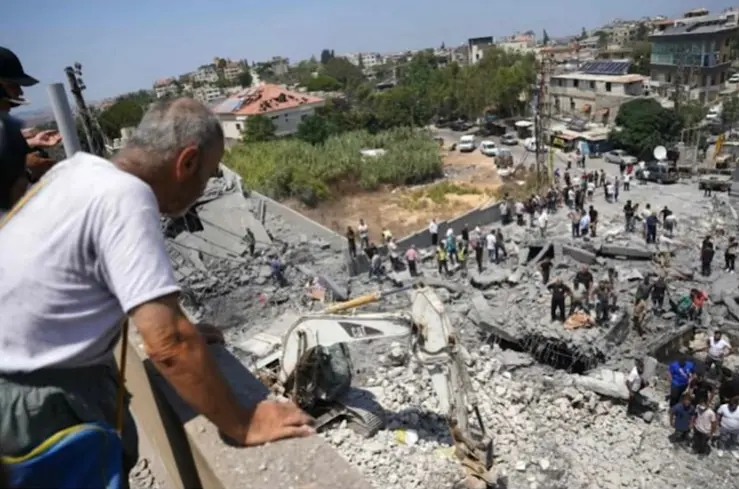
President Aoun remains, in fact, in a difficult position domestically in the face of the war – at times open, at times latent – that continues between Israel and Hezbollah, with the prospect of general elections in the Jewish state scheduled for the end of October. On 15 August, Israeli air strikes on two villages in southern Lebanon caused at least 11 deaths, including the massacre of an entire family in Ansar.
Last spring, direct negotiations began between Israel and Lebanon, which were subsequently formalised in a framework agreement concluded with US mediation on 26 June. This agreement provides for the gradual disarmament of Hezbollah, the deployment of the Lebanese army in the south and, in parallel, a gradual Israeli withdrawal from that area.
However, this agreement has stalled, in particular due to the absence of an international force tasked with verifying the disarmament of the pro-Iranian Shia militant group, as Israel has called for the abolition of UNIFIL without proposing any viable alternative on the ground.
“Our first choice is the extension of UNIFIL’s mandate,” President Aoun stated on 17 August during a meeting with MPs. His visit to the Vatican, and subsequently to Rome, therefore forms part of the diplomatic negotiations launched to preserve the territorial integrity of Lebanon, whilst the south appears to be increasingly on the brink of a full-scale conflict that would entail a further loss of territory and even greater destruction.
“President Aoun,” explains MP Melhem Khalaf to AsiaNews, “has given assurances that the new force which could replace the Blue Helmets will remain under the auspices of the United Nations.”
Amnesty and abolition of the death penalty
On the parliamentary front, a milestone considered significant for human rights has been reached, with Lebanon’s abolition of the death penalty on 12 August – a first in the Middle East and the Arab world.
The decision was described as “historic” by the Lebanese Minister of Justice, Adel Nassar. In this regard, the French Minister for Foreign Affairs, Jean-Noël Barrot, yesterday welcomed the parliamentary vote, describing it as “historic and courageous”.
“This vote,” the head of the Quai d’Orsay stated in a note on X, “demonstrates that Lebanon, despite the difficulties it is facing, retains a unique voice in the region and remains an example for its ability to uphold the democratic values and freedoms that underpin its very existence”.
The minister finally emphasised that the Land of the Cedars is thus honouring a “commitment made in Paris a month ago at the 9th World Congress against the Death Penalty”.
The only party to vote against this abolition was Hezbollah, out of loyalty to Sharia, Islamic law. One of the advantages of this vote is that it highlights the difference between the Party of God and the Amal movement, which professes a much more secular form of Shia Islam. Furthermore, on 12 August, Parliament approved a law granting amnesty – with numerous exceptions – and reducing prison sentences for the benefit of thousands of prisoners and individuals wanted by the authorities.
The authorities did not immediately specify how many people were affected, but Bilal Abdallah, chairman of the parliamentary committee on Labour and Social Affairs, told AsiaNews that the measure benefits 7,200 prisoners and individuals wanted by the authorities.
The Speaker of the Assembly announced “the adoption of the bill granting a general amnesty and, on an exceptional basis […], reducing the duration of certain sentences”. This measure had been at the centre of a polarised debate for years, as dozens of prison sentences had been handed down at a time when Hezbollah was exerting influence over the Military Court.
Prison overcrowding
Lebanese prisons had reached a total of around 9,000 inmates, more than four times their actual capacity (330 per cent of the places normally available), explained Bilal Abdallah, a member of the Druze parliamentary bloc.
Almost 80 per cent of those incarcerated were awaiting trial, whilst only 20 per cent (1,700) were actually serving a sentence. Furthermore, the MP continued, prison conditions had deteriorated significantly over the years, particularly following the banking collapse of 2019, with shortages of medicines, food, drinking water and healthcare.
Consequently, at least 48 prisoners had died in 2025, followed by a further 11 in the first four months of the current year alone.
However, whilst many justified the law on the grounds of prison overcrowding, for Bilal Abdallah it was above all a matter of ‘justice’. Indeed, the amnesty marks the end of Hezbollah’s dominance over the military court, which was responsible for dozens of arbitrary arrests.
The slow pace of proceedings – not to mention the reluctance of some judges – had led to a veritable catastrophe, with prisoners held for twelve years without trial. The member of the Druze parliamentary bloc pointed out that, just recently, the courts had acquitted a man who had been imprisoned for five years and was still awaiting trial.
According to the NGO Legal Agenda, the detainees include 86 Islamists linked to the organisation Hayat Tahrir al-Sham (HTS), which has been in power in Syria since the fall of Bashar al-Assad at the end of 2024.
In this instance, the passing of the law sparked exuberant celebrations in the streets of Tripoli, where most of them hail from. It is worth noting that, under the law, the Salafist sheikh Ahmad el-Assir is due to be released in April 2028.
Thousands of prisoners released
Meanwhile, the families of thousands of prisoners and fugitives from Baalbek and Hermel – regions under Hezbollah’s influence – have mobilised in the hope that the law would cover offences related to drug trafficking and vehicle theft.
These activities are ‘legitimised’ by their communities due to the absence of any alternative development projects capable of creating jobs. It should also be noted that, in April 2020, the Lebanese Parliament legalised the cultivation of cannabis for medical purposes, but the law is still awaiting the establishment of the medical-legal authority responsible for supervising such cultivation.
Finally, around 4,000 Lebanese from the border area formerly controlled by the South Lebanon Army (SLA), who fled to Israel in 2000 following the withdrawal of the Israeli army, will benefit from the amnesty.
They will be able to return to their homeland on condition, of course, that they renounce their Israeli identity if necessary. Under pressure from Hezbollah, these Lebanese had hitherto been regarded as ‘collaborators’ whose return to Lebanon was unwelcome, and they were not even able to register their children on the Lebanese civil register.
Effectively stripped of their Lebanese nationality under pressure from the Tehran-aligned movement, they could neither inherit their parents’ assets nor pass them on to their children. Nevertheless, it is clear that this return will not take place on a mass scale, given the current state of war.







.jpeg&w=3840&q=75)