Milan (AsiaNews) – Some 3,171 people have been evicted from their homes, 488 families, from the Ein Bahha and Al-Jaladeh neighbourhoods, including 209 children, 258 seniors, pregnant women, and the sick. All of this for an operation that, according to the Israeli broadcaster Kan News, the Chief of the General Staff, General Eyal Zamir, considers entirely devoid of any utility.
This is the current toll of the operation launched by the Netanyahu government in Hebron, following an attack by two Palestinian militants on Friday that killed two Israeli soldiers stationed at a checkpoint leading into the major city, home to 250,000 Palestinians and approximately 700 Israeli settlers.
While the world’s attention is set on Israel’s highly sensitive elections, a campaign of collective punishment has been unfolding in Hebron for the past three days, an action that has nothing to do with security. Instead, it increasingly resembles a "fact on the ground" intended to serve as a lasting legacy, regardless of the outcome of tomorrow’s elections.
The first acquisition in Eretz Yisrael (and the settlements)
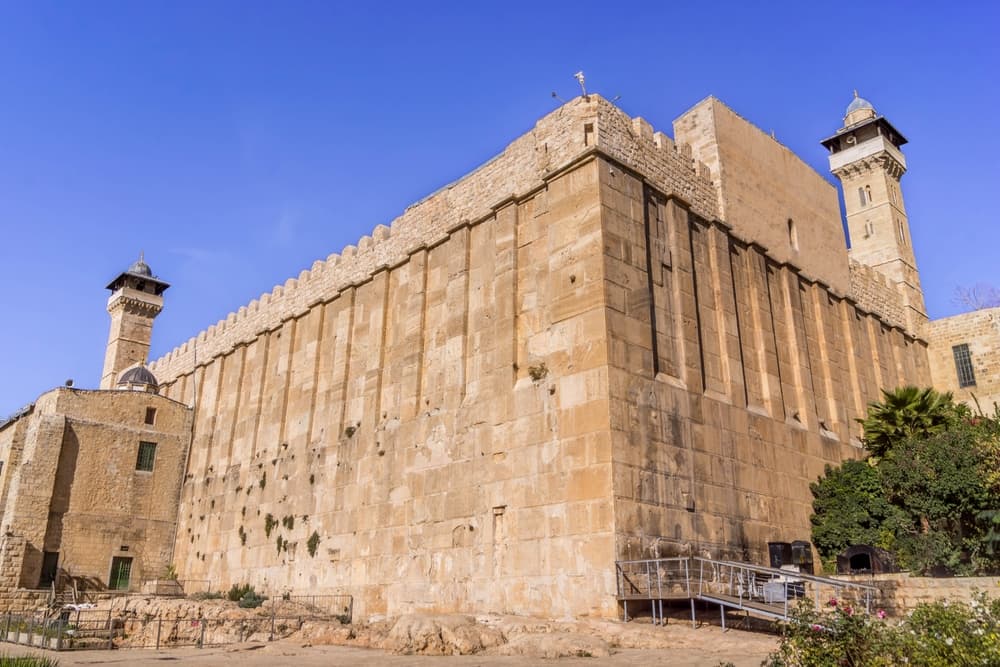
Hebron is not like other cities in the West Bank. It represents the most volatile fault line in the clash of identities in the Holy Land, with its epicentre located at the very site that ought to serve as a point of unity: the Tomb of Abraham, a figure revered by both Jews and Muslims as their common patriarch.
It is no coincidence that in Arabic the city is called al-Khalil, "the Friend of God", the epithet used in the Quran to refer to the (common) father of Isaac and Ishmael.
Hebron is the place where Abraham purchased the Cave of Machpelah to bury his wife, Sarah, an act regarded in Jewish tradition as the "first acquisition" in Eretz Yisrael, the Promised Land.
Throughout the diaspora, even under Arab rule, the connection to the tombs of Abraham and Sarah (now enclosed within an imposing Crusader-era structure, converted into a mosque in the 13th century) remained unbroken, as a small Jewish community continued to reside in the city.
Muslims and Jews coexisted for centuries, until the great trauma of 23 August 1929, when, amid the first Arab uprising against Zionist pioneers, the city became the scene of the first major massacre in what would evolve into the Arab-Israeli conflict.
That day, an Arab mob attacked the homes of the approximately 700 Jews living in the city, killing 67 of them. Jewish sources note that hundreds of other Jews survived that day because local Muslims hid them in their own homes. Yet, that date would come to define the history of Hebron in the decades that followed, far more than the preceding centuries of coexistence.
This was compounded by the response of the British, the mandatory power at the time, who removed all Jews from Hebron. This only deepened the trauma, failing to resolve the very problem the British had helped create by playing a double game during the First World War: fostering both Jewish and Arab nationalism as tools against the Ottoman Empire.
In a region like the Middle East, where history is an eternal recurrence of the same, it was only natural that Hebron would be the first place in the West Bank to which Jews sought to return following the 1967 war.
In 1968, a group of religious Zionists, led by Rabbi Moshe Levinger, arrived to celebrate Passover. They have remained ever since, demanding the “restitution” of the homes that had belonged to the community, a community that had, in effect, been expelled 40 years earlier.
Israeli settlement in the West Bank was born on that day; the outposts in the Jordan Valley, and later, those deep within the Palestinian-inhabited territories in the regions Jews refer to as Judea and Samaria, would come only afterward.
The 1994 Mosque massacre
From that very first nucleus of settlers in the spring of 1968, Kiryat Arba was born, a settlement on a nearby hill where Itamar Ben-Gvir, the Minister of National Security in the current Netanyahu government, still resides today. In recent years, he has become widely known for his fanatical extremism, directed indiscriminately against all Palestinians.
Kiryat Arba was also home to Baruch Goldstein, a doctor born in Brooklyn. On 25 February 1994, during the years of the peace process, he carried out an atrocious act of "revenge" for the events of 1929. On the day of the Jewish holiday of Purim, at the Cave of the Patriarchs (the Cave of Machpelah), he opened fire on Muslims at prayer, killing 29 people and wounding 125 others, before being killed himself.
That day, the then-Prime Minister of Israel, Yitzhak Rabin, a former general from the 1967 Six-Day War, but also the man behind the 1993 Oslo Accords, spoke in the harshest terms about Goldstein and the world he already represented at that time:
“You are not part of the community of Israel. You are not part of the national-democratic camp [. . .] and many of the people despise you. You are not partners to the Zionist enterprise. You are a foreign implant. You are an errant weed. Sensible Judaism spits you out. We say to this horrible man and those like him: you are a shame on Zionism and an embarrassment to Judaism.”
A year and a half later, on 4 November 1995, Yitzhak Rabin was killed by that very same world. Meanwhile, in Hebron, a bulletproof barrier was installed to divide the space between the synagogue and the mosque within the Cave of the Patriarchs, a precursor, in this instance, to a “separation wall.”
In 1997, a protocol signed by Binyamin Netanyahu and Yasser Arafat divided the city into zones H1 and H2: the former (theoretically) under the control of the Palestinian Authority, and the latter, where the settlers live, under total Israeli control.
Later, however, with the onset of the Second Intifada, restrictions increased exponentially, ostensibly to “protect” the settlers, even as their behaviour grew increasingly provocative by the day (such as the now-infamous practice of throwing trash from above onto the homes of the Arabs living below).
This culminated in the 2022 elections, when Benjamin Netanyahu cynically handed the reins of the Ministry of Internal Security to a man like Itamar Ben-Gvir, a figure who has honoured Goldstein’s grave as if it were the resting place of a hero. It does not take much to understand what has unfolded in Hebron over these past four years.
The illusion of being able to ignore the other
The recent attack carried out a few days ago by two Palestinian militants feels like the closing of a circle. In Hebron, on the backs of women and children, and on the eve of elections, the homes of people who had nothing to do with that attack are being destroyed.
An entire neighbourhood is being cleared, music to the ears of the settlers, whose votes are more crucial than ever for Netanyahu today.
In Israel and across the globe, everyone is waiting anxiously for the outcome of the 27 October vote. We will know the results in a few hours.
But tomorrow, will anyone have the courage to look into the deep rift in Hebron? Or confront the madness of those, both in Israel and Palestine, who persist in the delusion that two peoples sharing the same land can remain prisoners of the past, imagining they can go on living indefinitely while pretending that those on the other side do not exist?