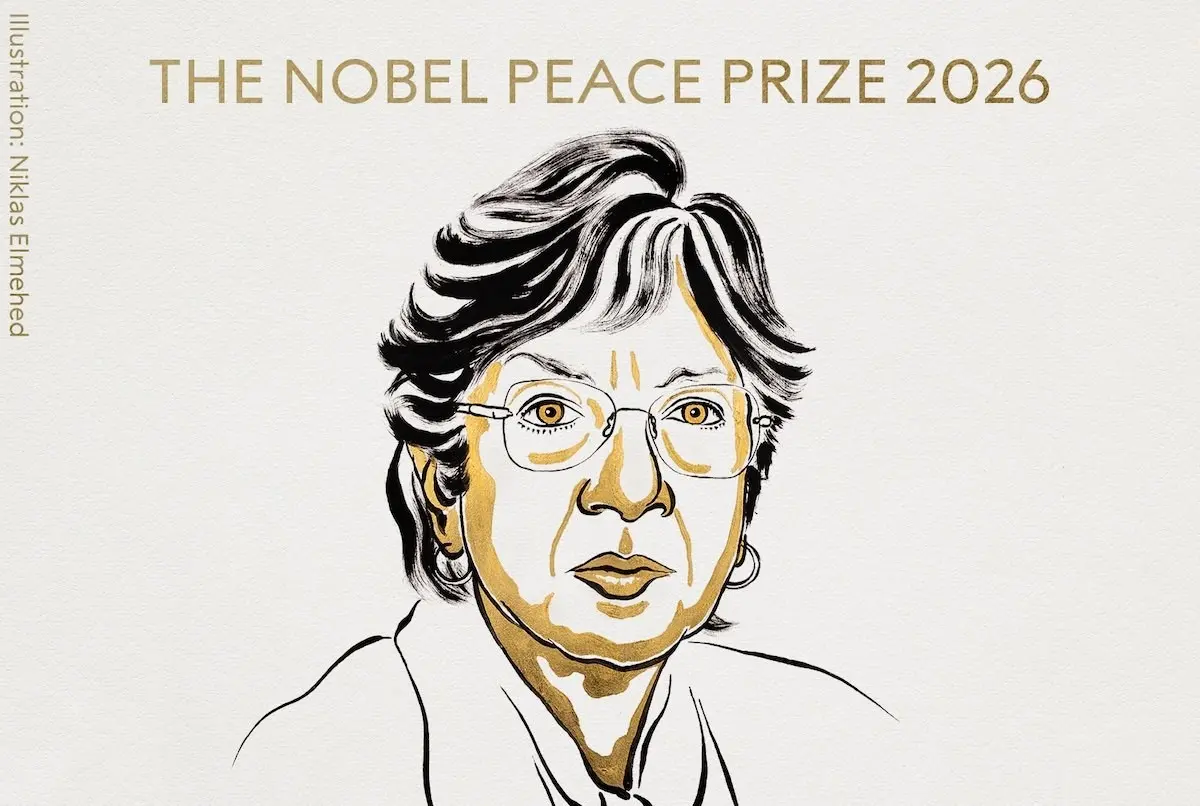
Oslo (AsiaNews) – The 2026 Nobel Peace Prize has been awarded to Navanethem “Navi” Pillay, an 85-year-old South African jurist, for her commitment to international justice, recognising the place of international law at a time when its institutions are facing mounting political pressure.
In announcing the award, the Norwegian Committee spoke out against the growing tendency to prioritise power politics over legal norms.
“Whenever might overtakes right, it undermines stability, trust and peaceful coexistence," said Norwegian Nobel Committee chair Jorgen Watne Frydnes, highlighting the role of international institutions in prosecuting those responsible for war crimes and ensuring justice for victims.
Born in Durban on 23 September 1941 into a family of Indian Tamil descent, Pillay grew up in apartheid-era South Africa amidst poverty and discrimination.
Her grandfather had been brought to South Africa to work on sugar cane plantations during the British colonial period and suffered arm injuries that left him maimed following a workplace accident. Her father worked as a bus driver.
In various interviews, Pillay spoke about how her childhood under apartheid led her to pursue a career in international law. When she was six, her parents explained that she could not play in certain parks or on certain beaches because they were reserved for white people.
“I thought what kind of law is this? It’s not fair!” she noted. “I was a lawyer. I had four degrees, but I was treated like dirt just because of my skin colour,” she said last year.
In 1967, she became the first woman to open a law practice in the province of Natal. As a lawyer, she defended opponents of apartheid and various political prisoners, helping to expose torture and violations of fundamental human rights.
In 1995, following the end of the segregationist regime, she became the first non-white woman to serve as a judge on the High Court of South Africa.
Her personal experience helped solidify a conviction that would stay with her throughout her career: that justice cannot depend on the identity of the victims or the might of those in power.
“I never thought apartheid would end in my lifetime,” she noted, citing the role of international solidarity at the time. “We had the collective support of civil society the world over,” she remembers.
In 1995, upon the nomination of Nelson Mandela, Pillay was appointed a judge at the International Criminal Tribunal for Rwanda, set up to prosecute those responsible for the 1994 genocide. She became its president in 1999, a position she held until 2003.
Among her most significant contributions was her work on the Akayesu case, which led an international tribunal to recognise for the first time that rape can constitute an act of genocide.
Pillay had already helped found Equality Now in 1992, an international organisation dedicated to defending women's rights.
After her time in Rwanda, Pillay joined the International Criminal Court, where she served until 2008. That same year, she was appointed United Nations High Commissioner for Human Rights, a role she held until 2014.
In recent years, her name has been linked to the work of the UN Independent Commission of Inquiry on the Occupied Palestinian Territory and Israel, which she chaired.
In September 2025, the Commission, established in 2021, determined that Israel had committed genocide in the Gaza Strip, identifying a specific intent to destroy the people of Gaza, in whole or in part, as a group. The report also assigned responsibility to Israel’s leaders and accused several political figures of incitement to genocide.
Throughout her mandate, Pillay also reiterated the need to prosecute crimes committed by Hamas and other Palestinian armed groups, including attacks on Israeli civilians and the taking of hostages.
Israel strongly rejected the findings, but Pillay defended the Commission’s work, stressing that the investigations had spanned more than two years.
In a November 2025 interview, she noted that “the prohibition of genocide is absolute,” regardless of whether or not the Genocide Convention has been ratified.
What is more, “When clear signs and evidence of genocide emerge, the absence of action to stop it amounts to complicity,” the jurist added.
For Pillay, the international community’s failure to intervene raises an issue of accountability that cannot be resolved through mere political statements.
Drawing on her experience, Pillay was also selected by The Gambia to serve as an ad hoc judge at the International Court of Justice in the proceedings against Myanmar in the case of genocide against the Rohingya, a predominantly Muslim ethnic minority forced to flee the country en masse in 2017.
Hearings on the matter ended in January 2026, and the case is now awaiting the Court’s decision.