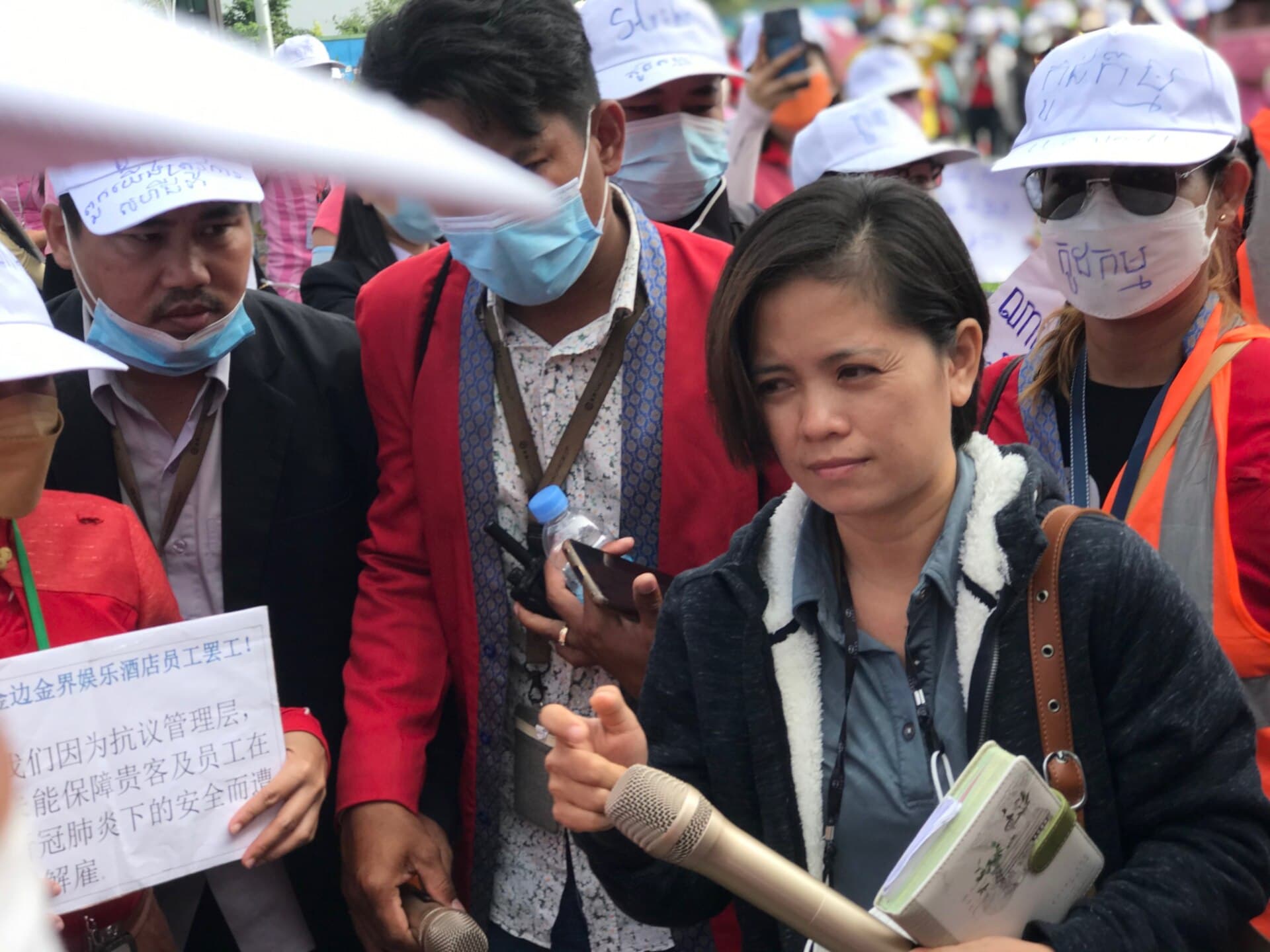
Phnom Penh (AsiaNews) – Chhim Sithar turns 39 on 25 December. However, this year, for the Cambodian trade union leader, the occasion comes amid a legal battle that has lasted nearly five years and has become the longest-running labour dispute in the country's history.
Since December 2021, Chhim has led the protests of workers from NagaWorld, a major Phnom Penh casino controlled by the NagaCorp group.
This July, around 50 members of the Labour Rights Supported Union of Khmer Employees of NagaWorld (LRSU) resumed demonstrations, demanding the reinstatement of the more than 1,300 laid off workers and the resumption of negotiations between the company and the union.
During that same period, the Phnom Penh Municipal Court summoned several union members to answer charges of "aggravated intentional damage” to property, an accusation stemming from the protests that began in 2021.
The company maintains that the layoffs were part of a restructuring plan necessitated by the COVID-19 pandemic. The workers, conversely, view the move as an attempt to weaken the independent union led by Chhim, who has been advocating labour rights for 14 years.
Over time, some employees have accepted the severance packages offered by the company or found other employment, often at lower wages.
Yet, although the protests have become less frequent, hundreds of workers continue to demand the reinstatement of those who were fired, full recognition of the union, and the dropping of criminal charges.
Every month, dozens of them protesters to rally outside the casino. “It isn’t easy, but we have no other choice because, if we don’t fight back, we’ll lose our union,” Chhim said. “The authorities try to scare us,” but “I am not scared to be rearrested,” she added.
According to the union leader, the dispute concerns not only the NagaWorld workers but all Cambodian workers who fear organising and engaging in collective bargaining with their employers.
The labour protest has not been without consequences for the LRSU leader. In early 2022, she was arrested and detained for three months on charges of incitement to commit crimes and cause social unrest.
After her release on bail, she was arrested again in November of the same year upon her return from Australia, accused of violating the conditions of her release by leaving the country. She remained in prison until the end of 2024.
Several other union leaders received similar sentences.
Chhim notes that she is still under surveillance and faces intimidation, including online harassment via fake Facebook accounts.
The NagaWorld case has become one of the clearest examples of the gap between the guarantees provided by Cambodian law and actual implementation.
Although workers' rights are protected by the country’s constitution and laws, in reality, the population faces a progressive shrinking of space for independent unions and other forms of activism.
This issue has recently come before the United Nations as well. Last Friday, while presenting the report on his visit to Cambodia to the UN Human Rights Council in Geneva, the Special Rapporteur on the situation of human rights in the country, Thomas Andrews, spoke of “two Cambodias”.
On one hand, he explained, there is the country that has ratified eight of the nine major international human rights treaties, backed 84 per cent of the recommendations made during the most recent periodic review, and continues to cooperate with United Nations special procedures.
On the other hand, as Andrews noted, there is a Cambodia that is “severely restricting freedom of expression and civic space” by applying its laws repressively against political opponents and detaining human rights defenders, political activists, and journalists.
The case of Chhim Sithar clearly illustrates this contradiction. Her union has received support and funding from Cambodian civil society groups, international human rights groups, and certain foreign government agencies.
However, NagaWorld, which holds a government-guaranteed monopoly until 2065 and faces no competition within a 20-kilometre radius, has not commented publicly on the dispute since shortly after the strike began, nor has it issued statements to the media regarding the controversy.
The sector in which Chhim and her colleagues continue to mobilise is central to the Cambodian economy. Tourism is considered one of the four pillars of the national economy, alongside textiles, agriculture, and the construction and real estate sectors.
For the union leader, the fight is also essential to ensure a living wage for workers in the industry. “I live my life with the aim of contributing to something important for my community,” Chhim said, who added that she is proud to have dedicated many years of that life to defending workers.
How much longer can the protest last? Chhim’s answer is unequivocal: “Until we win.”