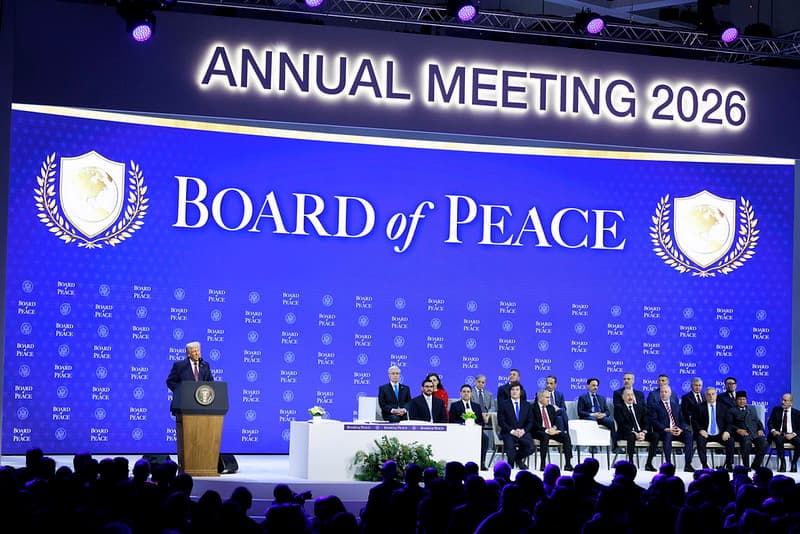
Milan (AsiaNews/Agencies) – On the one hand, we have the agreement on the "complete disarmament" of Hamas, announced last night by Donald Trump as a ‘historic deal’ for Gaza; on the other, conflicting signals confirm that the path the Peace Board is attempting to follow for the Palestinian territory is fraught with pitfalls.
The team led by Bulgarian diplomat Nickolay Mladenov, the high representative of the body created by Trump, will have to find a way around these two opposites, "within 14 days”, according to the document, to turn words into concrete action.
This morning, as often happens between the announcement of agreements and their entry into force, the Israeli air force carried out fresh air strikes on Gaza, killing several Hamas militants, including one of those responsible for the kidnappings of 7 October 2023.
The Islamist movement responded by maintaining that the first condition for its consent was a halt to Israeli raids and that the entire process for its support and disarmament, under the supervision of the National Committee for the Administration of Gaza[*] (NCAG), would begin only after the Israeli withdrawal.
For this reason, one of the extremely unclear aspects of Trump's peace plan, upon which the entire operation depends, is once again front page news, namely the establishment of the International Stabilisation Force (ISF), to replace Israeli forces in Gaza within a short period of time.
Point 15 of the October 2025 plan says that the United States would work "with Arab and international partners" to set up a temporary military contingent “to immediately deploy in Gaza.”
Its mandate would be to support "Palestinian police forces in Gaza” who have passed a vetting process and delegate internal security to them in the long term.
“The ISF will work with Israel and Egypt to help secure border areas, along with newly trained Palestinian police forces,” reads the plan.
Now, more than nine months later, the outlines of this force with such a crucial mission remain extremely vague.
Last Monday, on the eve of Prime Minister Binyamin Netanyahu's trip to Washington, the Israeli cabinet approved the entry of limited ISF troops into Gaza, with the usual dissenting vote from National Security Minister Itamar Ben Gvir.
According to leaks from the Israeli government, the green light was given only to a contingent of approximately 200 soldiers from countries considered friendly to Israel, including Uganda and Morocco.
Their first task, Israeli government sources claim, would be to ensure the security of a pilot humanitarian zone in the Rafah area, where Israeli troops would withdraw to make way for the international contingent.
But Israel still insists on maintaining control of the so-called Yellow Line, which currently separates the centre of the Gaza Strip from the buffer zone that effectively covers more than 50 per cent of its territory.
The deal reached yesterday, instead, explicitly provides for the ISF to be deployed in the Gaza Strip to separate Israeli forces from Palestinian-controlled areas.
In fact, the “ISF shall not perform any police mission or missions related to the Palestinian society. Furthermore, it shall monitor compliance by all parties with the ceasefire, train the Palestinian police, secure the protection and delivery of humanitarian assistance and essential supplies into Gaza Strip, and support the NCAG, at its request, in any other non-policing mission.”
Only the presence of a large international contingent, accepted by both sides and responsible for crisis management, could truly resolve this issue.
Asked about it yesterday, a US official stated that the Peace Board had obtained commitments from various countries for the participation of 5,000 soldiers.
So far, however, only a small number of soldiers from Morocco, Kosovo, Albania, and Kazakhstan have actually arrived in Israel for possible deployment.
The position of Indonesia, which initially expressed willingness to send a contingent of 8,000 men to the ISF in Gaza, will need to be vetted since Indonesian President Prabowo backtracked after Israel and the United States opened a war front with Iran at the end of February.
The Netanyahu government's stressed that the troops must be from countries that are “fair to Israel”, which would appear to close the door on Indonesia, as well as Erdoğan’s Turkey.
Another Muslim-majority country Trump himself had mentioned was Azerbaijan, which has well-established diplomatic relations with Israel (as well as defence cooperation). But in this case, Azeri President Aliyev himself ruled out the possibility of deploying his troops to Gaza back in November, reiterating his opposition in January.
What still needs to be seen is the role Gulf states will play. The United Arab Emirates and Bahrain, in particular, have diplomatic relations with Israel, and a place on the Peace Council established by Trump, while the Gaza issue is increasingly caught up with the anti-Houthi coalition that Saudi Arabia is building in the Red Sea.
[*] The NCAG is the group of Palestinian technocrats to who are slated to run Gaza under the supervision of the Board of Peace, in accordance with the October peace plan.