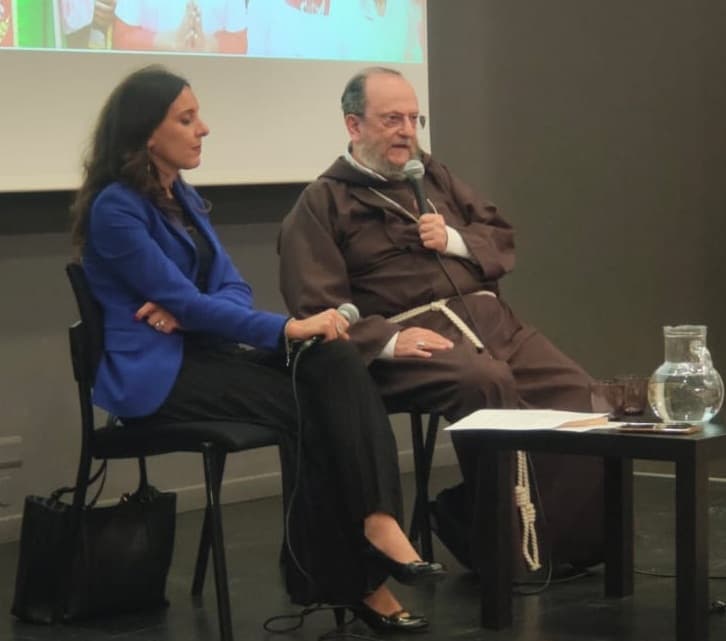
Aleppo (AsiaNews) - Women who are asked to wear the veil or drivers who are ordered to remove symbols such as the cross, alternating with gestures of solidarity such as flowers or messages stating that Christians and Muslims ‘together’ can ‘rebuild’ the country. It is a Syria characterised by a profound phase of uncertainty, a mixture of fears and hopes, that which emerges from the account entrusted to AsiaNews by Fr Bahjat Karakach, parish priest of the Church of St Francis of Assisi in Aleppo. A community that approaches Christmas with the desire to celebrate, and celebrate, in a perspective of peace after more than 13 years of bloody war. And that looks to the future, beyond 1 March when the mandate of the current executive expires, in view of democratic elections and a new Constitution in which ‘all citizens have the same rights and duties’.
In less than two weeks, the militias of Hay'at Tahrir al-Sham (Hts), once affiliated with the al-Nusra Front (formerly al-Qaeda), have overthrown the regime of Bashar al-Assad, who had managed - with the support of Russia and Iran - to remain in power despite 14 years of civil war. Yesterday, Hts leader Abu Mohammed al-Jolani relaunched ‘reassuring’ messages to the international community on the country's new course, showing a conciliatory face towards neighbouring countries including Israel, which continues to occupy the Golan Heights. Nonetheless, on the domestic front there is talk of ‘limits’ to women's participation in public institutions and administrations, hypothesising ‘functions’ more ‘in harmony with their nature’. Meanwhile, in the north-east, the Kurds report artillery bombardments towards Kobane, while more and more evidence is emerging of a ‘death machine’ set up by the Assad regime to repress dissent and punish opponents. At least 100,000 people have been tortured and killed since 2013.
Below is the testimony of the parish priest of Aleppo:
At this stage, as you can imagine, events do not have the same speed as we observed a fortnight ago. In any case, it can be said that the feeling we have is one of temporariness mixed with anticipation of the coming First of March. A date on which the mandate of the current interim government tinged with one colour, of a clear Islamist matrix, expires to form a transitional executive that will have the task of leading Syria to democratic elections after the formation of a new constitution.
In view of this crucial event, Syrians have moved to make their contribution, according to the political vision that guides them. We Christians have also been active with study meetings and proposals that will be presented to the three patriarchs present in Damascus (Melkite Greek, Greek Orthodox and Syriac Orthodox), who will then have the task of drafting a text to present to the constitutional commission.
The main point of the proposal is summed up in the demand for a democratic and civilised state, in which all citizens have the same rights and duties. We are aware that it will not be easy to find a formula that satisfies everyone, given that Syria is a very diverse country, and the fear of a one-party Islamist government, which ends up excluding all others, remains real. Such a possibility would be a strong risk of either a new dictatorship or a highly unstable country. However, it is equally obvious that we do not give up and we count first and foremost on the many enlightened Syrians who want a civilised and democratic nation, hoping that the international community will help these currents to have a voice.
As far as daily life is concerned, it is not easy to paint a single picture of the country, because everything depends, at the moment, on the presence of the forces of law and order, which is not homogeneous. The current government is mainly based on forces from Idlib, which are not sufficient to govern a vast area. Some services are suspended, while others are doing quite well. Aleppo has suffered thirst for more than eight days due to an attack on the water station, carried out by the forces of the Kurdish party Syrian Democratic Forces (SDF), which are negotiating with Damascus for the full inclusion of the Kurds in the political process that will lead to the birth of the new state.
Christians remain perplexed by everything that is happening: various signs of the country's Islamisation are beginning to become evident, for example, a public prayer with a large number of participants was held in the classrooms of the Faculty of Engineering at Damascus University; various checkpoints expressly ask Christian women to wear the veil, and drivers to remove all Christian religious signs; various voices are raised for the separation of gender in public spaces, etc. On the other hand, we find gestures of hope such as, for example, a group of young Muslims who stand in front of churches to distribute flowers to Christians entering them, on the flower is a note that says: ‘together we can rebuild our country’.
It is a time of great change and turmoil [which also brings us closer to the Christmas celebrations]: let us pray that it will lead us to better times!
* parish priest of the Church of St Francis of Assisi in Aleppo