Istanbul (AsiaNews) – Turkey is marking the tenth anniversary of an attempted coup that, on the night between 15 and 16 July, shook the power of President Recep Tayyip Erdoğan for a few fateful hours.
The attack against the core of Turkey’s system of government ended up boosting the president’s power, allowing him to purse a series of reforms that strengthen his grip on the country through, among other things, a presidential form of government.
His strong leadership is evidenced by the presence of US President leader Donald Trump at the recent NATO summit “only because invited by Erdoğan” as the White House explained.
For his part, Erdoğan has invested in the defence sector with record numbers (and contracts), while extending Turkey’s influence in the Middle East, from Syria to the Gulf.
At home, however, he has been criticised over human rights and freedoms, including in religion, despite a recent meeting with Christian leaders, not to mention the ever-present Kurdish question.
Erdoğan: stronger country
In a recent article, the president wrote about the tragic coup, praising a nation that is "stronger" than in the past, thanks to the spirit of resistance shown that night, which must be kept alive.
He describes 15 July as “a great victory”, in which the people defended their will, democracy and independence.
“Ten full years have passed since that ominous night, when a great nation fought at the cost of its life for its independence and future,” Erdoğan wrote.
He mentioned his call at the time to fellow Turks to pour into to the streets and airports; occupying them on that confusing night reflected their “trust” in the country’s democratic character, foresight, and courage.
“Our nation did not betray this trust. It once again defended its independence and future itself,” he wrote.
The president noted that 253 people were killed during the coup attempt, plus more than 2,000 wounded.
“Each of these figures is a separate sign of the sacrifice, courage and heroism shown to protect the homeland, the flag and the national will,” Erdoğan said.
He insisted that Turkey will continue the fight at home and abroad of the past decade against what the government calls the Gülenist Terror Organisation (Fethullahçı Terör Örgütü, FETÖ), which it blames for the coup attempt.
“We rooted out FETÖ in every field, from the bureaucracy to the army, from the judiciary to the business world,” he wrote.
A diplomatic source in Ankara spoke to AsiaNews, anonymously for security reasons, noting that Turkey is using the 10th anniversary of the coup attempt to whip up Islamist-oriented nationalist fervour. For the past few days, “marches, concerts, special television broadcasts with epic reconstructions of the events” have filled the TV screens, including a reference to Turkey’s Mawlid (Muhammad’s birthday) poetic tradition, with “a funeral vigil with the recitation of the poem, as on the day of the prophet’s birth”.
Witch hunt
During the failed coup, up to 270 people died, while thousands more wounded. Soon after, the government and President Erdoğan launched a purge against intellectuals, political leaders, military officers, and civil servants considered close to Fethullah Gülen, who passed away in October 2024. always claiming that his movement was not involved in the coup.
Once an Erdoğan supporter, Gülen eventually became his number one enemy in exile in the United States. Turkey considered him the main leader of a terror network.
Despite having consistently denied any involvement, Gülen and his movement have been the object of a virtual witch hunt.
In addition, the post-coup crackdown also fell on journalists and media close to Turkey’s opposition parties, as well as teachers and public servants.
Turkey’s police and intelligence services vetted all levels of government, an unprecedented move that sparked strong criticism in the West, driving Ankara and Washington apart.
Tens of thousands of people were arrested and hundreds of thousands lost their jobs because of Erdoğan’s hardline stance, overturning the secular foundations of modern Turkish society laid down by its founder, Mustafa Kemal Atatürk, and guaranteed by the military.
The president's Justice and Development Party (AKP) embodies this nationalist-Islamist reorientation.
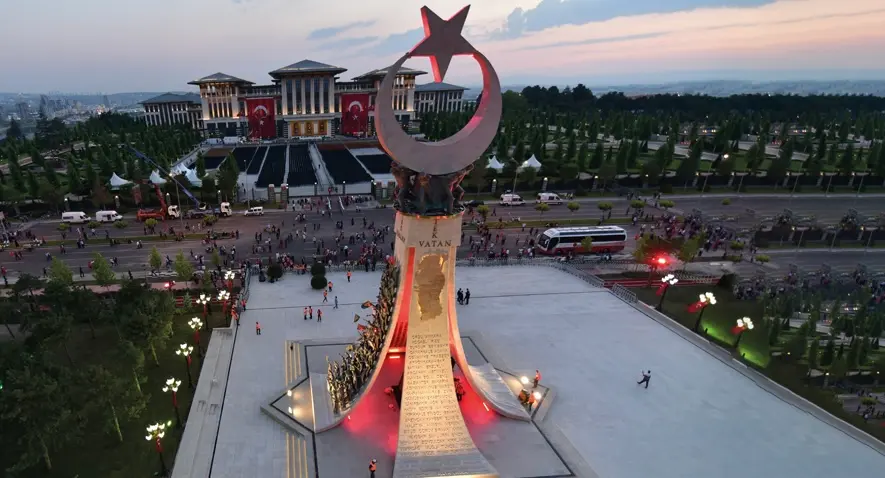
Two memorials now stand at Turkey’s parliament, the Grand Turkish National Assembly (TBMM), witnesses to the events of the tragic night on 15-16 July.
One, shaped liked an obelisk, is located near the Dikmen Gate, where the first bomb struck the parliament complex. The impact site, inside a glass structure, is known as the TBMM 15 July Martyrs Memorial.
According to the official version, the attempted coup was not the result of an improvised overnight plan, but the culmination of months of preparation by FETÖ that accelerated after the general elections of 1 November 2015.
Today, 15 July has become a national holiday with the former Bosphorus Bridge renamed 15 July Martyrs Bridge in memory of those who lost their lives that night.
Repression’s long reach
According to official data, about 390,000 people were detained between 2016 and 2025 for alleged links to the Gülenist movement with 113,000 placed in pretrial detention.
Some 2,761 institutions – schools, associations, foundations, media – were shut down. A total of 4.130 people were sentenced to life imprisonment or life imprisonment with aggravated conditions.
However, the anniversary is more than a simple commemoration of the victims because it also marks the country's major political turn as the government expanding its power over time, dismantling the Gülen movement, and carrying out large-scale arrests and expulsions.
Six days after the coup attempt, the TBMM declared a state of emergency that ended, in theory, on 19 July 2018, but whose effects are still felt today.
During those two years, President Erdoğan ruled largely through 32 emergency decrees. Since then, his leadership style has remained unchanged.
Indeed, for political scientist Ersin Kalaycıoğlu, the impact of the state of emergency is still being felt to this day. Although formally repealed in 2018, the practices from that period have “become institutionalized to a certain extent”.
The Turkish state has undergone a permanent transformation and the frequent recourse to decrees has led to an “extremely centralized structure,” he notes.
The public service has also undergone fundamental changes, evolving from an apparatus with its own professional standards and scientific expertise into an administration that implements mainly political directives.
For their part, opposition parties accuse the government of carrying out purges well beyond the Gülen movement, because, in addition to suspected Gülen supporters, it has also persecuted and fired other activists and critics.
Finally, regarding media and press freedom, independent information in Turkey has been gradually dismantled since that momentous night 10 years ago through a combination of mass incarceration, closures, regulatory punishments, Internet censorship, and the consolidation of media ownership in the hands of pro-government groups.
The crackdown, initially centred on journalists and media accused of links to the Gülen movement, has expanded to sweep up anyone who dared criticise those in power.