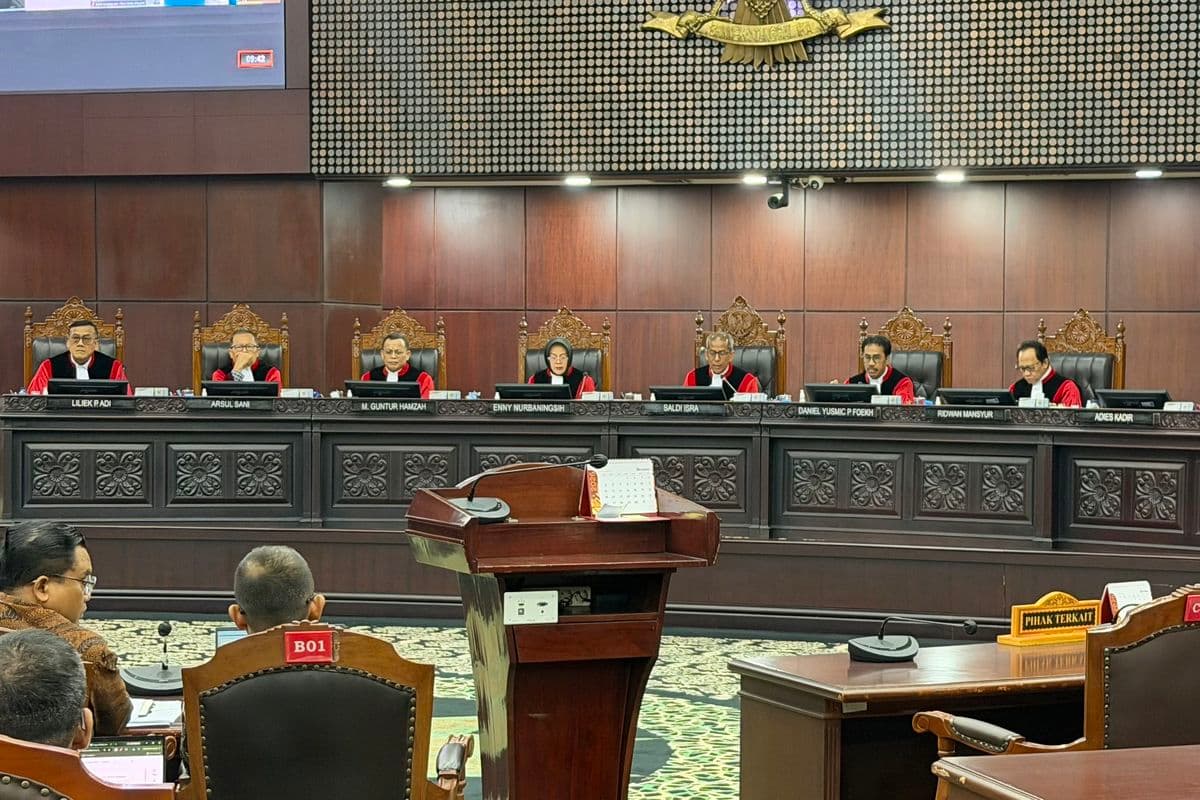
Jakarta (AsiaNews) – In a controversial ruling issued yesterday evening, the Constitutional Court of Indonesia officially rejected a legal case against the eligibility of Vice President Gibran Rakabuming Raka in the 2024 presidential election.
The Court ruled that the petitioners challenging the eldest son of former President Joko "Jokowi" Widodo, who entered politics following his father's years of leadership, lacked legal standing in bringing the case.
While the ruling neither disqualifies Gibran nor affects the office he currently holds, the Court's reasoning raised doubts about the educational credentials he submitted at the time of his registration as a vice-presidential candidate. In fact, the justices found no convincing evidence that President Prabowo Subianto’s VP had obtained a diploma.
No documents, such as a certificate or other document issued by a foreign institution, exist attesting to Gibran completing any educational programme equivalent to upper secondary school, as required by Indonesian electoral law.
Justice Arsul Sani stated that the certificate of attendance and other documents submitted during the candidacy process did not constitute proof of educational qualification or completing secondary education. The documents submitted by the vice-president, in fact, attest only to participation in an educational programme.
At the same time, the Court ruled that Gibran could not be disqualified within the scope of these proceedings. For Justice Adies Kadier Gibran’s status as a candidate ceased the moment he was elected, took office, and was sworn in as vice-president on 20 October 2024.
The Court therefore referred the matter regarding the educational credentials to other institutions with constitutional authority. The ruling, while acknowledging the issue of the missing qualifications, does not intervene directly and leaves the actual decision to others.
The case, registered under number 01/PHPU.PRES-XXIV/2026, was initially brought by former Deputy Minister of Justice and Human Rights Denny Indrayana, the Independent Election Monitoring Committee, the Ummat Party, and several citizens.
The petitioners had asked the Court to disqualify Gibran, annul various decisions by the General Elections Commission regarding his candidacy, and invalidate his inauguration as vice-president.
The Court instead reiterated its jurisdiction to hear the case but ruled that the petitioners lacked the necessary legal standing to bring the action.
Still, the ruling has sparked a broader debate regarding candidates' qualifications and the legal mechanisms available to verify them and address doubts about their documents that might arise after the vote and the deadline for filing appeals have passed.
For the Institute for Development and Democracy Advocacy (LAPD), this case should be an opportunity to improve Indonesia's electoral verification system. LAPD Executive Director Kaka Suminta asserted that democracy “should learn” from this, rather than view the ruling "merely in terms of victory or defeat”.
The institute calls for the implementation of a verification system based on evidence, particularly regarding documents issued by foreign educational institutions, which should ensure full traceability, as well as cover original documents, the issuing institution, the status of the qualification obtained, the equivalency assessment, and the documentation submitted to the General Elections Commission.
Furthermore, the LAPD proposes a post-election review, to be conducted after every election cycle, to identify critical issues in verification procedures and corrective mechanisms, without, however, allowing election results to be challenged indefinitely.
According to the advocacy group, electoral reform should clearly define which institutions can vet candidates' qualifications, the applicable procedures and evidentiary standards, and the legal consequences should serious irregularities be discovered after the deadline for election appeals has passed.
Beyond the issue of educational qualifications, the candidacy of former President Widodo’s eldest son had already sparked controversy prior to the vote because Gibran, a former mayor of Surakarta, was only 36 years old, well below the 40-year minimum required to seek the office.
In early February 2024, the Indonesian Election Ethics Council ruled that the candidacy remained legitimate after the Constitutional Court’s last-minute change to regulations allowing under-40s to run, even though rules had been violated.
The decision sparked a wave of protests, that spread to the academic community in Java and the Association of Indonesian Catholic Universities.