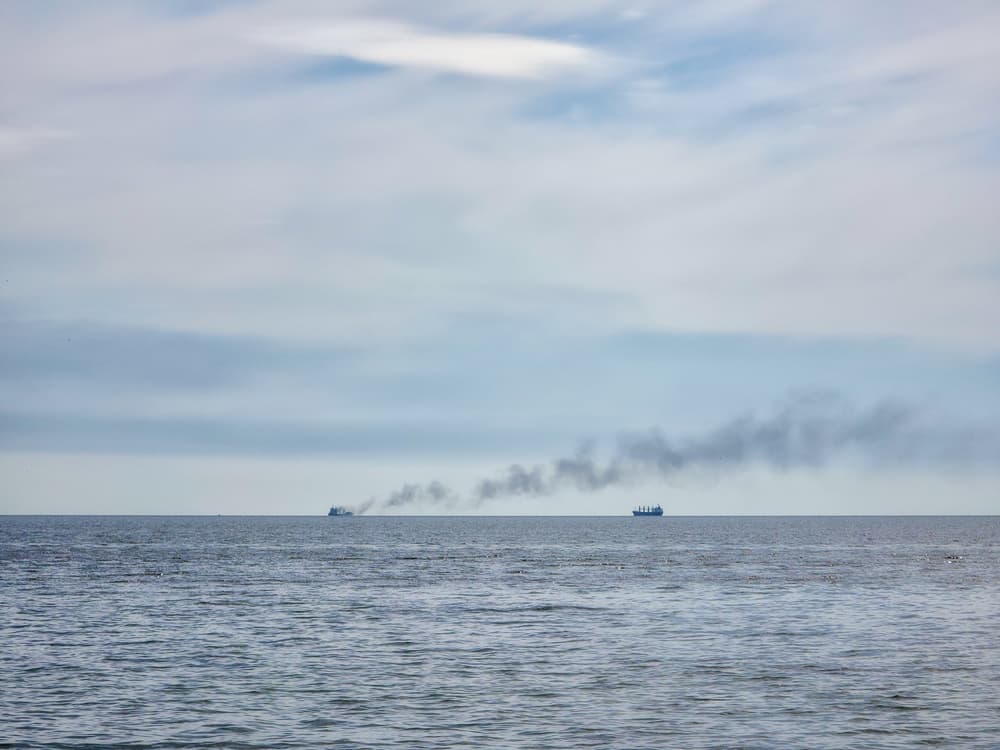
Moscow (AsiaNews) – A major escalation of conflict in the Black Sea continues to unfold, with both vessels linked to Russia and civilian ships carrying Ukrainian goods coming under attack. An oil tanker subject to Ukrainian sanctions caught fire off the coast of Sochi, and the day before, Russia had attacked a Turkish ship en route from Izmail to Italy, off the coast of Romania. On Radio Crimea. On the programme Realities, presenter Alena Badyuk discussed the situation with Pavel Lakijčuk, a military expert and head of security programmes at the Strategy XXI Centre for Global Studies, and Oleg Lisny, a political scientist and director of the Politika think tank.
By the end of September, Ukrainian forces had already attacked more than 160 ships in the Black Sea, according to Robert Brovdi, known as Madyar, commander of Ukraine’s unmanned systems forces. Meanwhile, Russia has used drones to attack a Turkish civilian vessel in neutral waters off the Romanian coast: the captain died, according to Ukrainian President Volodymyr Zelenskyj, who stated that the vessel was carrying maize. Citizens of Azerbaijan and India were on board.
Zelenskyj pointed out that Ukraine and third countries have repeatedly proposed concrete measures to ease tensions and ensure security in the Black Sea, but Russia continues to “choose terror and the sinking of civilian ships rather than normal navigation”. Whilst in the past Russia targeted Ukrainian port infrastructure and ships sailing in Ukrainian territorial waters and on the high seas, it is now also attacking ships in the territorial waters of other Black Sea countries, the military expert notes. A few days ago, another significant incident occurred: two dry cargo ships, both bulk carriers, were attacked in Bulgaria’s exclusive economic zone in the southern Black Sea.
According to Pavel Lakijčuk, “terrorist attacks have begun against ships flying different flags but located within Romania’s exclusive economic zone, and this is, to all intents and purposes, an indirect attack on Romania”. All three ships, operated by Turkish companies, were struck by “unknown drones” in the Black Sea. The expert is also convinced that Russia is deliberately attacking Turkish ships to force Turkey to accept separate agreements, whilst Turkey is seeking to position itself as a guarantor of stability in the Black Sea. At the same time, Lakijčuk states, it is trying to ‘sit on two chairs’, purchasing Ukrainian oil and wheat stolen by Russia.
Ukraine has repeatedly proposed a maritime truce and is now open to various forms of ceasefire, but Russia’s consent is required. Several options have been put forward, involving India, Egypt and Turkey, given that Russia’s blockade of Ukrainian grain shipments is a concern not only for its Turkish neighbours but also for external actors. According to Oleg Lisny, “India is an influential country in its relations with Russia: it buys resources, so it has its own bargaining power. Turkey has its advantages, and Egypt also has its own perspective, but without a comprehensive approach there will be no results, as the problem is essentially the same for everyone: the war is being fought in Ukraine and the consequences are being felt far beyond its borders”.
At the same time, according to Lisny, isolated initiatives are not enough: pressure on Russia must be stepped up, and not just at a diplomatic level; “we must continue to apply ‘kinetic sanctions’, as they continue to do the same to us, and the ideal option would be to involve the United States in this process”. The US has acted as a mediator and has stated this openly, and the Republican Party – and Trump in particular – must demonstrate that they have achieved some success before the elections. At the same time, the expert remains optimistic about the possibility of securing a maritime truce: he is convinced that not only could the mechanisms for putting pressure on Russia play a role in this regard, but also the fact that Russia has an interest in the unhindered transport of grain.