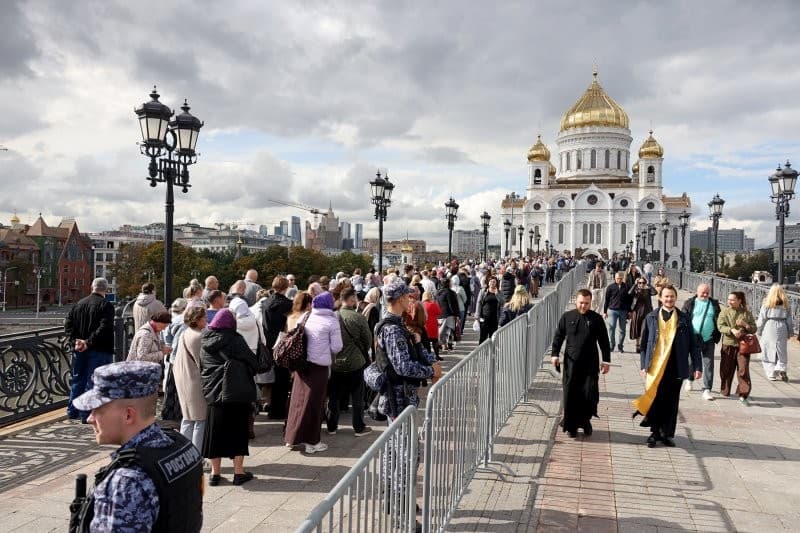
In July, the Russian government announced the "miraculous discovery" of the relics of the great commander Saint Dmitry Donskoy, victor over the Tatars on the banks of the Don in the late 14th century, and sent them to the front lines to support the war effort and to polling stations to glorify the regime.
Modern propaganda portrays Dmitry as a warrior-saint fighting against a “Western” coalition and as a defender of Orthodoxy, part of a new version of the "alternative" history surrounding the figure, who began to take on mythic status shortly after the prince's death.
During his lifetime and for several centuries after his death, Dmitry was neither "Donskoy" nor a saint (he was in deep conflict with many Church hierarchs), and describing him as a fighter against the West is simply absurd. At the time, there was no united West, and everyone was at war with everyone else.
Two months ago, his long-known tomb in the Kremlin's Cathedral of the Archangel was opened, and the prince's remains were venerated as miraculous relics, not least due to their "astonishing" state of preservation.
Just a few weeks later, Vladimir Putin called the discovery "a true miracle”, and the State Duma proposed sending fragments of the saint's remains to Russian troops in Ukraine.
Russian authorities then decided to use the figure of the prince in a contemporary context. Propagandists from the Russia-1 channel portrayed the Tatar Khan Mamai and the Golden Horde, whom the then-Prince of Moscow had fought, as “representatives of the West”.
The image of Donskoy thus became yet another example of how a real historical figure – another striking instance being the saintly Prince Alexander Nevsky who defeated the Teutonic Knights in the early 13th century – was turned into something completely different for ideological purposes.
In reality, the medieval prince was a highly controversial figure. He warred with his Slavic neighbours, oppressed the Orthodox Metropolitan who had found common ground with the Tatars, and offered only marginal opposition to the West, unless one considers Lithuania (at the time still a pagan state also at war with the Catholic Teutonic Knights) to be a representative of a world hostile to Russia.
Moreover, among the troops deployed in 1380 at Kulikovo, the "Woodcock Wood" of the battle, Tatars and Lithuanians were found in the ranks of the armies on both sides.
Dmitry’s actual reign was marked by numerous episodes that sit uneasily with the image of an impeccable Orthodox ruler.
One of the most notorious occurred in 1368, at a time when the city of Tver remained Moscow's chief rival in northeastern Rus’ and its prince, Mikhail Aleksandrovich, relied on an alliance with Lithuania.
Dmitry and Metropolitan Aleksii invited Mikhail to Moscow to settle a dispute regarding his inheritance, guaranteeing his safety by kissing the cross, a solemn religious oath; yet, Mikhail and his boyars were arrested, and a portion of the contested lands was seized.
Dmitry’s policies were equally harsh toward his own subjects and neighbouring Russian lands: in 1371, he was forced to raise vast sums to secure a yarlyk, a patent of authority, from the Horde.
Chronicles recorded the "heavy burden imposed on the people" following his return, and sources describe the devastation wrought upon the lands of Tver. In 1375, during a renewed conflict with Tver, the Muscovite army burnt down the trading post, the churches, and the surrounding villages.
Following the invasion by the new Tatar Khan Tokhtamysh in 1382, Dmitry dispatched an army against the city of Ryazan, whose prince was accused of having aided the khan. The chronicler wrote that the land of Ryazan was devastated and burnt "even more than by the Tatar armies.”
Thus, the prince, who went down in history primarily as the defender of Rus' against the Horde, consistently employed the methods of warfare common to his era: laying waste to lands, coercion, and the confiscation of property.
It is also particularly difficult to reconcile the later image of the pious prince with his conflict with the Bulgarian Metropolitan Cyprian. At the time, the Russian Church was subordinate to the Patriarchate of Constantinople, which, following the death of Metropolitan Aleksii, regarded Cyprian as the legitimate head of the Kyiv-Moscow metropolitanate.
Dmitry refused to recognise him and attempted to install his trusted associate Mityay as metropolitan instead. When Cyprian travelled to Moscow in 1378, he was arrested, humiliated, and exiled. The metropolitan himself wrote of beatings, looting, and famine, and in response, he excommunicated and cursed those responsible.
In 1380, Dmitry was forced to reconcile with Cyprian, but after the sacking of Moscow by Tokhtamysh, he exiled him once more; the metropolitan returned to the capital only after the prince's death.
Claims portraying the Tatar Khan Mamai as the "representative of a united West”, and Dmitry Donskoy as the unifier of Rus’ in opposition to it, do not withstand even the most basic scrutiny: in 14th-century Europe, there simply was no such thing as a unified “West”.
England and France were engaged in the Hundred Years’ War, and from 1378 the Roman Catholic Church itself was divided between the Roman pope and the Avignon pope. Furthermore, the Italian principalities were constantly at war with one another.
The legacy of Dmitry Ivanovich evolved gradually. Initially, it was preserved only within the family circle of the princes of Moscow. While his contemporaries knew him as the Grand Prince Dmitry Ivanovich of Moscow and Vladimir, the epithet “Donskoy” (of the Don) only gained currency in the 16th century, when the Battle of Kulikovo began to be reinterpreted as the start of Moscow's struggle against the Horde.
Ivan the Terrible made particularly active use of Dmitry Donskoy’s image, symbolically linking his 1552 campaign against the Kazan Tatars to the victory at Kulikovo, thereby establishing Dmitry as a historical precursor to the expansion of the Muscovite state.
In the Russian Empire, Donskoy eventually entered the national pantheon. Interest in him intensified during the Napoleonic Wars, and the 19th century saw the appearance of monuments, paintings, and literary works that cemented his image as a defender of the homeland and a great military leader.
After the 1917 Revolution, the religious aspect faded, but, Donskoy regained favour within the Soviet patriotic-military tradition from the late 1930s onwards.
In a speech at the parade of 7 November 1941, Stalin counted him among the "great ancestors”, and during the Great Patriotic War, a tank column named "Dmitry Donskoy" was established, funded, reportedly, by donations from the faithful of the Russian Orthodox Church.
The next major anniversary in Dmitry’s commemoration was the 600th anniversary of the Battle of Kulikovo, widely celebrated by the Brezhnev-led regime in 1980, which also marked an opportunity to return to a religious interpretation of the prince’s figure.
The canonisation of Donskoy by the Russian Church Council in 1988, the year marking the millennium of Rus’ and the onset of the “religious revival” under Gorbachev, was the culmination of a long process rather than a surprise decision.
At that time, the Russian Orthodox Church selected figures who were historically and politically safe for the first major wave of post-Soviet canonisations. The list included, among others, Andrei Rublev, Maximus the Greek, Paisius Velichkovsky, Ambrose of Optina, and Theophan the Recluse.
These monks, theologians, and ascetics were medieval heroes, whose glorification allowed the Church to restore its historical tradition without raising the issue most controversial to the Soviet regime: the persecution of the Church after 1917.
Following the outbreak of the war between Russia and Ukraine in 2022, the sacred dimension took on even greater importance.
In 2024, the television channel Spas organised a procession featuring the relics of Saint Demetrius of Thessaloniki, Saint Alexander Nevsky, and Saint George the Victorious, which were delivered to military units and churches near the front line.
Today, the focus is not so much on the 14th-century ruler himself as on the image of a victor and defender of the state constructed around him; his inclusion in current military rituals demonstrates how the Russian government is seeking further symbolic resources to justify its prolonged aggression.
The modern war is likened to past "fateful" battles, and military and political failures are imbued with a higher significance. This means that Russians should be imbued with a sense of historical and spiritual continuity.
Amidst a deepening economic crisis and a period of unparalleled uncertainty in Russia in the last 20 years, ordinary Russians are yearning for a miracle. And the Kremlin is attempting to satisfy this desire by, among other things, “discovering relics”.