Moscow (AsiaNews) – After a journey of almost a month through Russian cities, the right hand of Saint Spyridon of Trimiton, a 4th-century Greek martyr, was brought to Moscow and remained in the capital’s Cathedral of Christ the Saviour for a week, until 20 September, the ‘sacred day’ of the State Duma elections.
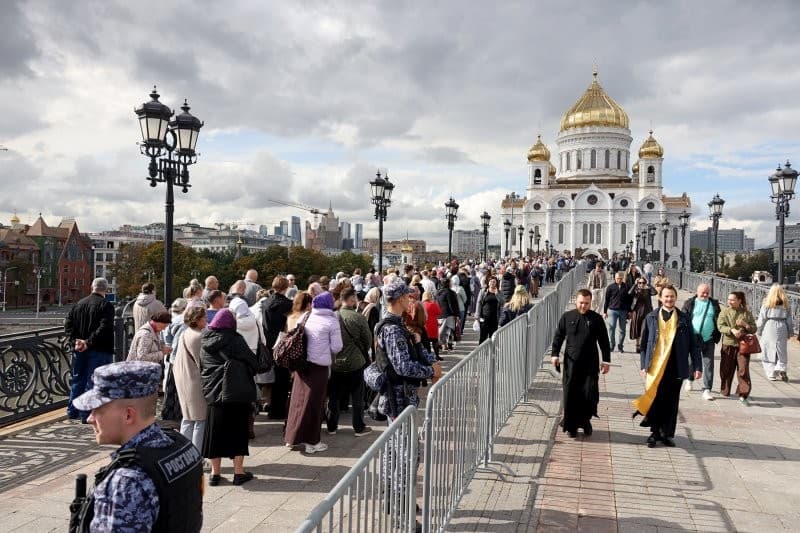
The recently discovered relics of Saint Dmitry Donskoy are also currently on display for veneration, and queues lasting several hours formed outside the cathedral before people headed to the polling stations for the parliamentary elections which – as expected – resulted in victory for Putin’s party.
The organising committee for the feast of the relics of Saint Spyridon of Trimiton has been posting updates on the state of the queue at the cathedral several times a day on social media: ‘the end of the queue is beyond the Crimean Bridge, near Gorky Park; the entrance to view the relic is under the bridge; the estimated waiting time is seven hours’, it was reported in recent days. The relic was placed in the cathedral on 14 September, after having been transported throughout Russia since 17 August.
The Orthodox Church states that over 800,000 worshippers have venerated the relics of Saint Spyridon, a Christian saint and miracle-worker who lived between the 3rd and 4th centuries on the island of Cyprus. He came from a family of peasants and spent his life as a shepherd and farmer. Because of his virtuous and pious life, the inhabitants of the town of Trimythous (now Tremetoussia, Cyprus) elected Spyridon as their bishop, and according to tradition, it was he who denounced the heresy of Arius at the First Ecumenical Council of Nicaea in the year 325.
To demonstrate the unity of the Holy Trinity, he took a brick in his hand, and immediately fire burst forth from it, water gushed out, and clay remained in his hand, symbolising the three elements in a single object.
It is also believed that the saint possesses the gift of healing the terminally ill, casting out demons and raising the dead. The faithful also turn to Spyridon with prayers to resolve housing problems, purchase property, repay mortgages, find work and achieve financial well-being – matters that appear particularly urgent against the backdrop of the economic crisis caused by military expenditure in the endless war against Ukraine.
Currently, another relic is on display in the Cathedral of Christ the Saviour: a reliquary containing several fragments of the saint and faithful Prince Dmitry Donskoy, discovered in July during restoration work on the Cathedral of the Archangel in the Kremlin. Many senior officials, including leaders of the Russian Orthodox Church, starting with Patriarch Kirill (Gundjaev), and President Vladimir Putin himself, have described the discovery as miraculous.
The fragments have been placed in several reliquaries, one of which has been on display in the Cathedral of Christ the Saviour, also until 20 September. Shortly before the election, the Russian Orthodox Church had advised the faithful who were going to venerate the relics to pray to the holy prince for the ‘reunification of Holy Rus’ and ‘victory over the enemy’.
Prince Dmitry Ivanovich (1350–1389) had been canonised in 1988, on the millennium of the Baptism of Rus’; his victory over Mamai’s Tatar-Mongol horde had contributed to the unification of the Russian lands around Moscow. Both reliquaries, containing the relics of Saint Dmitry and Saint Spyridon, were displayed in the central part of Christ the Saviour Cathedral, and the queue to venerate the relics was shared.
Moscow’s main cathedral permanently houses a unique collection of Christian relics: these include a fragment of the Lord’s robe and the nail upon which Jesus Christ was crucified, as well as a reliquary containing the complete relics of Saint Filaret (Drozdov), the great 19th-century metropolitan, and fragments of the relics of the Apostle Andrew the First-Called, Saint John the Baptist, Saint Nicholas the Wonder-Worker, Saint George the Victorious, Prince Alexander Nevsky and others.
In the summer of 2017, the relics of Saint Nicholas of Myra were brought to Russia from the Italian city of Bari; they were also displayed in the Cathedral of Christ the Saviour for a month and a half, and the queue to see them stretched for several kilometres. On the busiest days (Saturdays), people had to wait outside for between 13 and 14 hours, but the queue to see the Belt of the Holy Mother of God in November 2011 is considered to have broken all records, stretching for 10 kilometres with a wait in the November cold that on some days lasted between 24 and 26 hours.