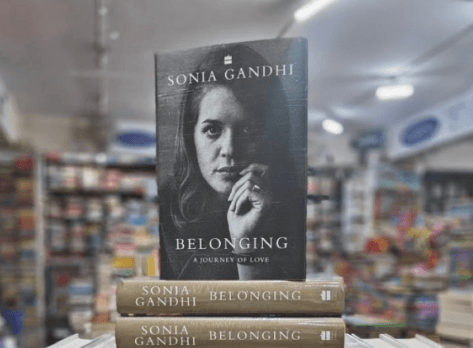
Mumbai (AsiaNews) – Belonging: A Journey of Love, the autobiography in which Sonia Gandhi recounts her life and political career, hit the bookshops on 10 November. The 544-page volume, published by HarperCollins, is causing a stir in India, not only for its account of personal and political events but also for the reflections it provokes on the country’s democratic history and its contradictions.
As readers may recall, the personal journey of Sonia Gandhi – now 79 years old, born in Italy and who has become one of the most influential figures in Indian politics – is marked by profound family and political experiences. Her marriage to Rajiv Gandhi in 1968 brought her into the Nehru-Gandhi family, whilst the assassinations of Indira Gandhi in 1984 and of Rajiv himself in 1991 represented dramatic moments in her life. After an initial reluctance to enter politics, Sonia Gandhi took the helm of the Congress Party, becoming a leading figure on the national stage.
A significant moment in her career was her decision to step down as Prime Minister in 2004, following the victory of the UPA alliance, in favour of Manmohan Singh. Her influence, however, was most evident through her chairmanship of the National Advisory Council, which supported the government during those years and helped to promote important social reforms, including the right to information, the rural employment guarantee scheme, the recognition of the rights of forest-dwelling communities and the Food Security Act.
Sonia Gandhi’s memoir also addresses the most controversial chapters of Indian history. Among these is the state of emergency declared by Indira Gandhi between 1975 and 1977, during which civil liberties were curtailed, political opponents were imprisoned and restrictions were imposed on the press. In the book, Sonia Gandhi acknowledges that this decision was a mistake. This is an important admission, though it does not absolve her of historical responsibility. Similarly, the anti-Sikh violence of 1984 remains an open wound, requiring remembrance, justice and an objective examination of the political circumstances. The point is to truly view past events not as tools of propaganda against today’s opponents, but as warnings about the dangers arising from the abuse of power and the weakness of democratic institutions. Freedom of the press, the independence of the judiciary and respect for the rule of law are, in fact, achievements that no generation can regard as definitive.
The autobiography should therefore be accompanied by a balanced assessment that also takes into account the contradictions in Sonia Gandhi’s political career. For the Congress Party’s long-standing leadership also raises questions about dynastic politics, internal party democracy and the concentration of power within a single family. Her contribution to social reforms and her decision not to seek the premiership do not preclude the need to subject her political influence to critical scrutiny.
The most profound issue raised by the book, however, remains that of national identity. Should belonging to India depend on birth, religion, language or family origins? Or should it be based on a shared set of constitutional values? Sonia Gandhi’s personal story demonstrates that different cultural identities can coexist with a genuine commitment to one’s nation. In a country characterised by extraordinary religious, linguistic and cultural diversity, equality, freedom of conscience and minority rights must be guaranteed to all, regardless of the majority’s views.
Ultimately, Belonging calls on us to move beyond partisan divisions and to consider history in all its complexity. The younger generations should be able to learn about the successes and failures of every government, without inheriting political conflicts and selective narratives. For India’s greatness is not measured by the longevity of its dynasties or governments, but by its ability to guarantee dignity, freedom and equality to every citizen.