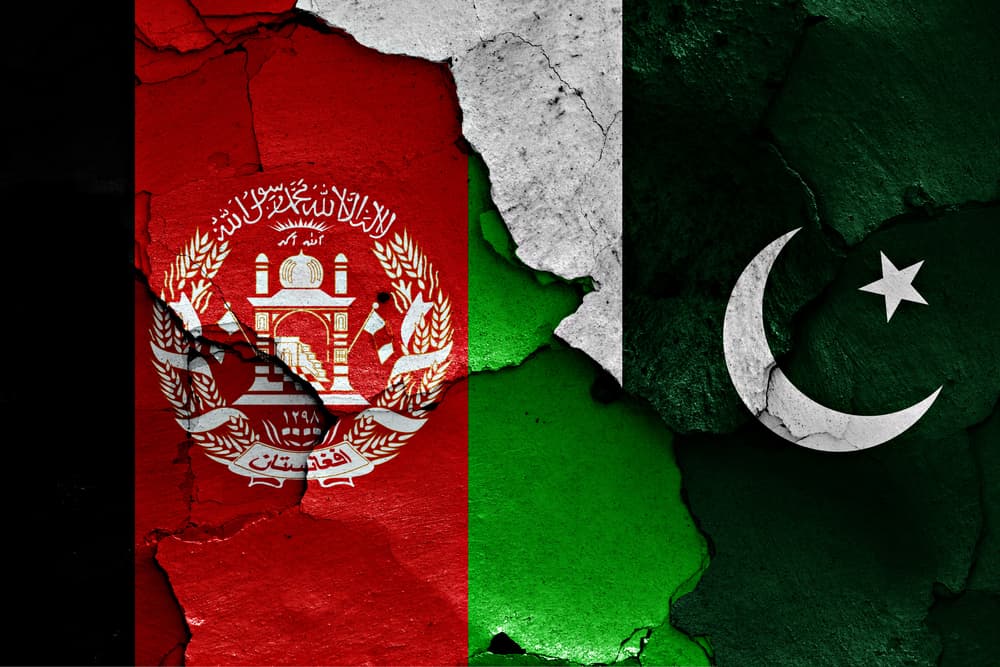
Islamabad (AsiaNews) – Last night, Pakistan launched airstrikes against Afghanistan, reviving a conflict that has tended to flare up periodically with violent clashes that almost invariably end up affecting the civilian population.
Pakistani authorities stated that the strikes were a response to a terrorist attack on a police compound in Kohat, Khyber Pakhtunkhwa, a Pakistani region bordering Afghanistan, last Friday.
Islamabad reported that the strikes were carried out against “hideouts" of groups linked to the Hafiz Gul Bahadur group resulting in the death of 28 terrorists.
As it has done in the past, Pakistan said that it would continue its strikes until Afghanistan takes "concrete steps" to halt cross-border terrorist operations, which are increasingly hard to deal with due to the cooperation among various groups.
New strikes
In Kabul, Taliban government spokesman Zabihullah Mujahid slammed the Pakistani operation, saying that "civilian areas" in the eastern provinces of Kunar and Paktika were shelled.
In Kunar, a woman and two men were killed, with another two women and two men wounded. In Paktika, a home and a shop were hit, though no casualties were reported.
For Afghanistan, these raids are an unjust act of “aggression" that would be met “with an appropriate retaliation”.
The escalation was triggered by an attack during last Friday prayers. An explosives-laden vehicle was detonated near a mosque within a police compound, followed by gunmen that stormed it.
A gun battle with security forces ensued, resulting in 24 deaths and more than a hundred wounded. Local authorities report that eight of the attackers were killed, while a group known as Ittehad-ul Mujahideen Pakistan (IMP) quickly claimed responsibility for the attack.
Statements from the Christian community
Pakistan’s Christian leaders immediately condemned the massacre.
Bishop Samson Shukardin of Hyderabad, who also chairs the Pakistan Catholic Bishops' Conference, expressed his condolences to the victims' families and unequivocally condemned the attackers.
“People go to mosques to pray,” the bishop said, “they go seeking peace,” adding that “such places of prayer should be places where people feel safe.”
The Anglican Bishop of Karachi, Rt Rev Fredrick John, also expressed solidarity with the affected families and paid tribute to the armed forces and law enforcement personnel who responded to the attack, honouring those who lost their lives in the line of duty.
Who is Hafiz Gul Bahadur?
Compared to previous attacks in Pakistan, mostly by the local Taliban faction, the Kohat attack highlights a growing and concerning overlap among extremist groups with differing structures.
Ittehad-ul-Mujahideen Pakistan is an alliance that emerged in April 2025. According to UN experts, it includes elements of al-Qaida in the Indian Subcontinent (AQIS), joined by the men of Hafiz Gul Bahadur, who now leads the group, and Lashkar-e-Islam, a jihadi group formed in 2004 in the Khyber region that has, at times, been an ally and, at other times, an enemy of the Pakistani Taliban.
The Tehrik-e-Taliban Pakistan (TTP, the Pakistani Taliban, is an umbrella organisation for extremist groups fighting the Pakistani state in order to set up an Islamic Emirate modelled Afghanistan’s.
Hafiz Gul Bahadur’s faction is emerging as a rival power centre, although the two groups maintain ties.
Gul Bahadur himself has been active for decades in the tribal areas along the Pakistan-Afghanistan border. A former Taliban commander in North Waziristan, his network focused its operations during the US-led war in Afghanistan primarily against US, NATO, and Western-backed Afghan government forces, while maintaining a structure distinct from the TTP.
The group has long maintained relationships with other jihadi entities, particularly the Haqqani network (a key Taliban power centre) and al-Qaida. In 2012, Bahadur banned the polio vaccination campaign in North Waziristan, claiming it could be exploited by the CIA for intelligence-gathering purposes.
When Pakistan launched a major military operation in North Waziristan in 2014, Bahadur sought refuge in Afghanistan where his group has maintained an autonomous structure while keeping ties with other organisations.
Overlapping jihadi groups
Last year, Gul Bahadur’s network merged into the Ittehad-ul-Mujahideen Pakistan (IMP). A report by the UN Security Council’s monitoring team estimated the IMP’s strength at around 500 armed fighters, 200 of whom belonged to Gul Bahadur’s group.
The latest report, published in August, states that although Hafiz Gul Bahadur has been placed in charge of the IMP, the group’s backbone consists of the regional al-Qaida faction, al-Qaida in the Indian Subcontinent (AQIS), whose leadership remains based in Kabul.
Here, according to analysts, the group’s leaders received Afghan identity documents enabling them to move freely to training camps, a detail confirming the close cooperation between al-Qaida and Taliban authorities.
The IMP thus appears to function as a meeting point for various terrorist networks. The relationship between al-Qaida and the TTP should be viewed in this light, although experts find it hard to determine the precise extent of their collaboration.
A UN report highlights that al-Qaida continues to provide the TTP with ideological guidance, training, and support. Furthermore, on 28 April, al-Qaeda’s media arm publicly endorsed TTP operations against Pakistan for the first time.
The boundaries between the various jihadi organisations thus appear increasingly blurred; while a complete merger has not occurred, their growing overlap makes it ever harder for Pakistan to counter the threat.
What is certain is that Afghan territory continues to provide operational room for numerous armed groups, while airstrikes against Afghanistan have so far yielded no results, nor have diplomatic efforts.
Moreover, threats to Pakistan arise from all fronts, not just the Afghan one. To the east, the issue of Kashmir, a region disputed with India, remains unresolved.
Just recently, New Delhi challenged a new cooperation mechanism signed with China regarding the Himalayan border, involving the Shaksgam Valley, a territory administered by China but claimed by India as part of Ladakh.
Inside Pakistan, another major terrorist threat comes from the Balochistan Liberation Army (BLA), an umbrella group that includes factions that have been fighting the Pakistani state for decades in a bid for greater independence.
Balochistan also extends into Iran, a country likewise grappling with conflict. It is not unrealistic to imagine that, at some point, other such groups might come together against the Pakistani state.
This proliferation of threats confronts Islamabad with a problem to which it is responding solely with targeted raids and military operations, thus fuelling the spiral of violence.
(Shafique Khokhar contributed to this article)






.jpg&w=3840&q=75)