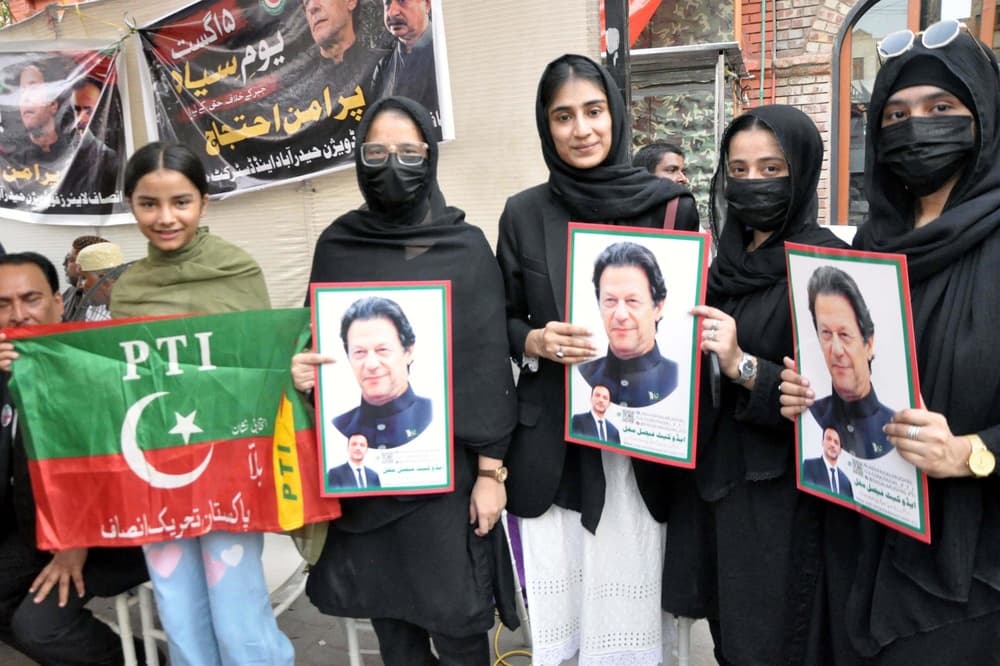
Islamabad (AsiaNews) – More than 5,000 supporters of former Prime Minister Imran Khan departed yesterday from Lakki Marwat, northwestern Pakistan, heading for the capital, Islamabad.
The march – organised by the Pakistan Tehreek-e-Insaf (PTI), the party of the former prime minister, who has been in prison since 2023 – began after two days of talks with the government aimed at averting the action failed.
The authorities, in the meantime, have set up roadblocks deploying shipping containers along the main access routes to the capital and are threatening to take action against protesters.
Islamabad and the Khyber Pakhtunkhwa government on a collision course
The protest, originally set for 27 September, was postponed to allow for talks between the government and the PTI leadership. Khan’s party is demanding access to the former prime minister and calling for a new medical examination and adequate care for him while he is in detention.
Federal Interior Minister Mohsin Naqvi has accused the Chief Minister of Khyber Pakhtunkhwa province, Sohail Afridi, a PTI member, of deliberately causing the negotiations to fail.
According to the Pakistani press, the two sides also remain divided over security management in Khyber Pakhtunkhwa, a province bordering Afghanistan that is governed by the PTI and has for years been among the areas hardest hit by attacks from the Tehreek-e-Taliban Pakistan (TTP), also known as the Pakistani Taliban.
Islamabad has asked the province to cooperate with counter-terrorism operations, while the province accuses Islamabad of seeking to unilaterally impose its security policies without regard for local concerns.
“Terrorism cannot be defeated through force alone or through unilateral measures that could expose innocent civilians to further loss of life, property or displacement,” the PTI said in a statement, calling instead for a strategy that combined “firm action against terrorism with protection of civilian populations and sensitivity to local realities”.
The Dawn has reported that Interior Minister Naqvi met with the Khyber Pakhtunkhwa Governor Faisal Karim Kundi to discuss the possibility of imposing governor’s rule in the province, with the temporary transfer of provincial powers to federal authorities.
A government source cited by the paper noted that Islamabad is seriously considering this option in order to save the province from terrorism and violence.
The march launched by the PTI is expected to reach the city of Khairabad, located some 80 kilometres west of Islamabad, by Thursday. Here, according to Afridi, the next phase of the mobilisation will be announced. Still, the procession is expected to continue towards the capital, where the government is prepared to block the protesters.
Minister Naqvi noted that on 14 September Islamabad High Court ruled that political parties and their leaders do not have the right to occupy the capital's roads, highways, interchanges, toll plazas, or other public buildings.
Hence, “if they violate the orders, whether they are workers or politicians, whether they are protesting within KP or outside KP, we will pursue them one by one,” the minister declared.
Afridi travelled to Lakki Marwat in a provincial government helicopter to lead the march. Islamabad has accused him of violating a court order that prohibits provincial governments from using public vehicles and resources to facilitate the demonstration.
Naqvi reiterated that the government intends to put an end to the repeated protests that have caused unrest in Islamabad.
Fears of renewed clashes and Imran Khan’s popularity
For days, key access points to Islamabad have been blocked by shipping containers intended to stop protesters from passing, measures the government claims are necessary since “terrorists could be facilitated in safely crossing security checkpoints”.
In reality, authorities fear the mobilisation could escalate into fresh clashes. Protests following Khan’s arrest in May 2023 spiralled into violence involving the army – at least eight people died, and numerous demonstrators were subsequently arrested and prosecuted.
Some PTI supporters attacked military installations and the residence of a corps commander in Lahore, venting their anger at the Pakistani military, which continues to play a key role in the country's politics even after the end of military dictatorships in the past.
The family of the former prime minister, now 73, and PTI officials maintain that Khan’s conditions in prison have deteriorated, specifically citing a problem with his right eye that has reportedly impaired his vision.
In August, Khan was briefly transferred to a public hospital for medical examinations and treatment. While doctors declared him medically fit, his family challenged the authorities' refusal to allow an examination by physicians of a private facility, as mandated by a previous court order.
Tensions between the government and the PTI intensified following the arrest on 20 September of Khan’s sister, Aleema Khanum after the authorities accused her of chanting anti-government slogans and attempting to mobilise crowds to incite public disorder.
The PTI views the arrests and legal proceedings against Khan as part of a broader campaign of political pressure directed at the party.
Khan faces legal proceedings involving over a hundred charges, including allegations regarding the leaking of classified information and the sale of state gifts received during his term of office.
Many observers point out that, even from prison, the former prime minister continues to exert significant influence over Pakistani politics, retaining strong public support.
It is precisely the PTI’s ability to mobilise large crowds that worries the government in Islamabad, currently led by Prime Minister Shehbaz Sharif.
The government, already grappling with terrorism backed by Afghanistan, is afraid that fresh unrest in the capital could exacerbate an already complex security situation.
Khan, a former captain of Pakistan’s cricket team, became prime minister in 2018 and left office in 2022 following a parliamentary no-confidence vote.
The breakdown of dialogue between the PTI and the government leaves room for confrontation in the streets, raising the risk of renewed clashes.


.JPG&w=3840&q=75)