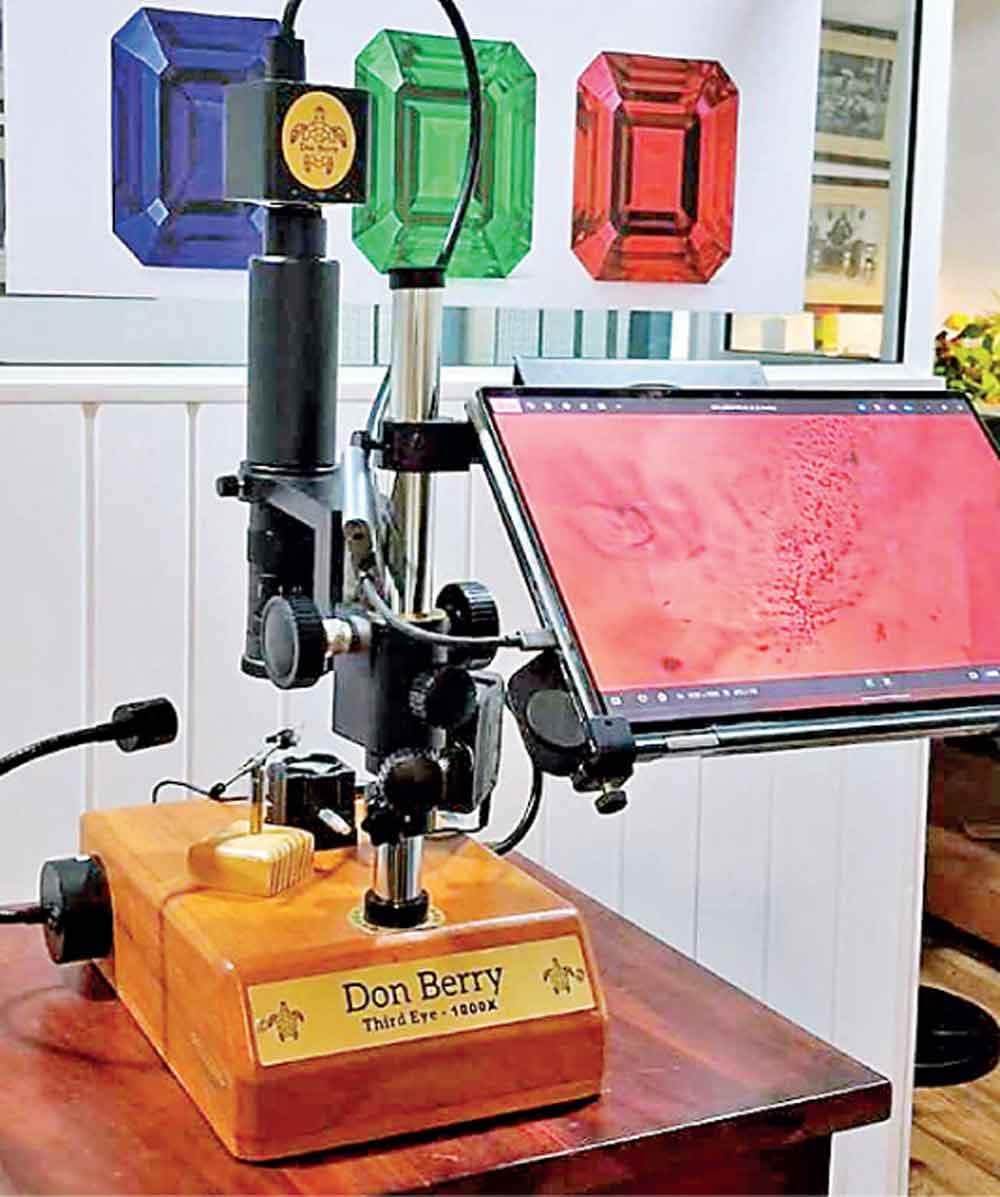
Colombo (AsiaNews) – Milinda Edirisinghe, a Sri Lankan gemologist and founder of the Gemological Report of Ceylon (GRC) laboratory in Colombo, has developed an ultra-high-magnification digital microscope.
The scientist's innovative instrument allows microscopic characteristics within precious stones to be revealed with a level of clarity rarely achieved with conventional equipment.
This exceptional result is the fruit of nearly two years of research and experimentation, and industry experts believe this innovation will improve the speed, accuracy, and transparency of gemstone analysis.
Sri Lanka’s gem and jewellery sector is the island nation’s most lucrative export industry, supplying sapphires, rubies, cat’s eyes, and many other precious stones to international markets.
In a press conference last week, Milinda explained that gem laboratories have long relied on optical microscopes to study the crystals, fractures, and growth patterns within gemstones. These natural characteristics help experts determine a stone's identity and origin, as well as if it has been treated.
High-quality conventional microscopes have optical limitations, particularly when examining extremely fine internal structures. To address this problem, Milinda has come up with a series of four digital microscope models capable of achieving magnifications of 450x, 600x, 1000x, and 1440x, named Don Berry 450x, Don Berry 600x, Don Berry 3rd Eye 1000x, and Don Berry 3rd Eye 1440x.
Thanks to these tools, the interior of gemstones, previously studied with great difficulty, can now be explored with ease and precision. This innovation opens up a new world of complex details that had remained beyond the reach of gemology until now.
Another plus of the new system is the time required to accurately and precisely examine a gem. With conventional methods, analysing a stone's internal characteristics can take from a few minutes to several hours, especially when inclusions are difficult to identify.
Thanks to the new microscope, the thorough examination of many stones can be done in less than a minute, as internal characteristics are visualised with far greater clarity.
Speaking to AsiaNews, gemologists Akash Mendis and Shirantha Thenabadu noted that this improvement “can significantly improve the efficiency of gem laboratories that process large numbers of stones daily."
In addition to magnification, the microscope “serves as a high-resolution imaging system capable of recording photographs and videos of the internal characteristics of gems,” resulting in digital recordings that “can be permanently archived and integrated into laboratory certificates, providing an additional level of documentation for gem buyers, dealers, and insurance companies."
This innovation, they note can “bolster trust in the gem trade, allowing customers to view microscopic characteristics that support lab findings rather than relying on written descriptions.” Thus, “Permanent image archives can help laboratories reexamine stones years later, providing objective visual documentation for comparison purposes.”
“Another feature currently under development is artificial intelligence-assisted image analysis. Rather than replacing the gemologist, the technology is meant to support professional judgment by helping them to identify mineral inclusions, such as geological characteristics associated with specific gemstone varieties and their possible origins.”
Complete digital documentation offers buyers of gemstones and diamonds an additional guarantee, by ensuring that the certification perfectly reflects the quality of the traded stones.
This is a necessary step to prevent fraud or malpractice, like some gemstone certification laboratories in Vietnam where diamonds were stripped of their original laser engravings from the Gemological Institute of America before they were re-engraved and accompanied by reports that unduly inflated their quality, thus allowing their sale at higher prices.
For their part, the authorities are currently investigating this illegal gemstone business, while several jewellers have had to temporarily close their stores.