

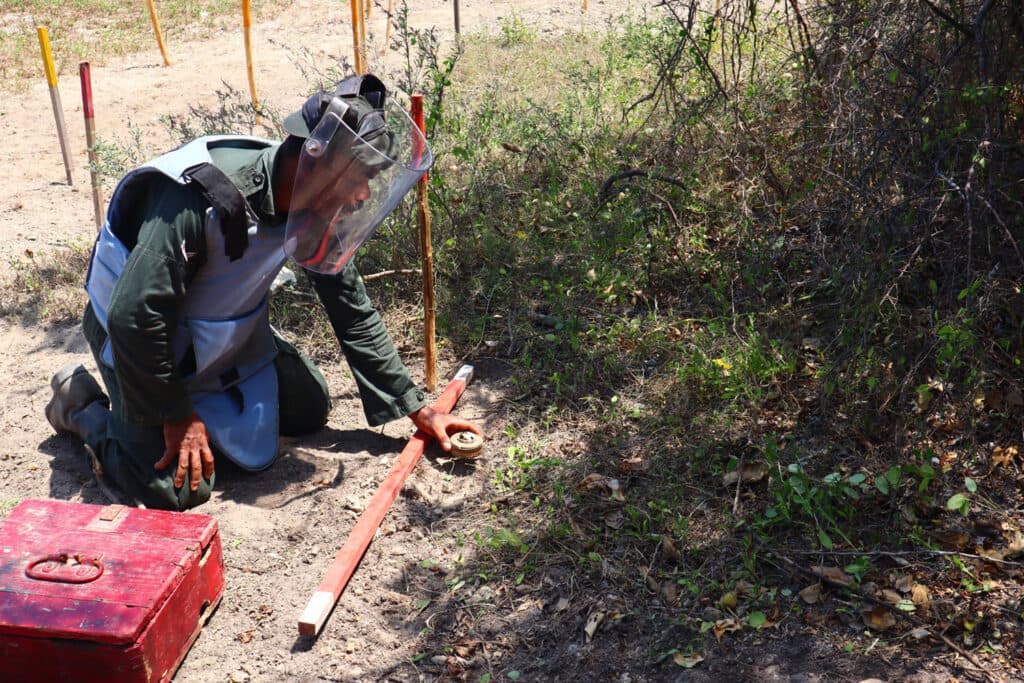
Colombo (AsiaNews) - Sri Lanka aims to become a country free of anti-personnel landmines by 2032, thereby completing its demining programme. This is according to the National Mine Action Centre (NMAC), which states that 20.5 km² of contaminated land (roughly half the total area of the Colombo district) remains to be cleared, located mostly in areas with complex terrain or difficult to access in the northern and eastern regions. Leading the work on the ground, alongside NMAC experts, are operatives from the HALO Trust (Hazardous Area Life-support Organisation), the world’s largest humanitarian organisation specialising in the clearance of areas formerly affected by war or armed conflict.
To date, some 231 km² of minefields have already been cleared and around 1.4 million anti-personnel mines have been safely removed. The NMAC has recovered over 2.8 million explosive ordnance, including more than one million anti-personnel mines (AP), 2,687 anti-tank mines (AT) and over 761,494 unexploded ordnance (UXO). “ The demining programme – as the experts explain – goes beyond mere removal: it is, rather, a national effort aimed at supporting development in the North and East, promoting tourism and strengthening trust and reconciliation between Sinhalese, Tamils and Muslims. Demining activities will be accelerated to facilitate the resettlement of communities, the development of livelihoods and tourism-related projects”.
In the Northern Province, where development is progressing most rapidly, there are still a large number of mines, particularly in the Muhamalai area, which was heavily affected during the conflict. Part of the area has been completely cleared, but priority must also be given to clearing mines from the remaining private land. The civil war in Sri Lanka ended in May 2009, with the Tamil Tigers (LTTE) declaring their surrender following their military defeat and the death of their leader Velupillai Prabhakaran, bringing an end to 26 years of violence.
According to senior officials at the NMAC, “the Mullaitivu district (Northern Province) is the most difficult area to clear, with 13.1 km² of contaminated land still requiring clearance. Since 2010, approximately 81 billion rupees have been invested in mine clearance operations. Of this, 250 million dollars, equivalent to approximately 76.8 billion rupees, has been received in the form of grants from international organisations. The government’s target for 2032 comes as Sri Lanka – they add – continues its long-term mine clearance programme, with most of the remaining contaminated areas concentrated in regions affected by the conflict.”
“In 2002, 252 staff members were injured during demining activities, whilst only two sustained injuries over the longer period from 2002 to 2025, which indicates the safety record and progress of demining operations,” the experts at the national centre continue. “It is also necessary,” they conclude, “to carry out demining operations in the catchment areas located in the forested areas surrounding water reservoirs to ensure safety. As these areas are under the control of the Department of Forest Conservation, it is advisable that measures be adopted subject to the approval of the department’s General Conservator regarding the use of demining machinery in these areas.”
When interviewed by AsiaNews, experts in the field, Tarika Harischandra and Udaya Dissanayaka, echoed the statements made by Rosamund Pike, ambassador for the Mines Advisory Group (MAG), who said that “Sri Lanka is nearing the conclusion of a decade-long effort”. For the British activist and actress, the objective (which is close to being achieved) is to “clear the country’s territory of landmines and explosive ordnance that have long contaminated it”. Pike made these remarks during a meeting with Susil Ranasinghe, Minister of Housing, Construction and Water Supply, at the Ministry in Battaramulla on 10 August. This historic milestone for the island’s future comes at a time when various counter-initiatives promoted by other countries are undermining the very foundations of the Convention on the Prohibition of Anti-Personnel Mines (APMBC). Added to this is the attempt by governments to withdraw from the Treaty (Convention on the Prohibition of the Use, Stockpiling, Production and Transfer of Anti-Personnel Mines and on Their Destruction), an international agreement “which prohibits the use, production, stockpiling and transfer of anti-personnel mines”. “Over 2,000 people have worked in the mine clearance sector, including conflict survivors and former combatants, amongst whom are also 500 specially trained members of the Sri Lankan Army. Their collaboration,” conclude Harischandra and Dissanayaka, “has contributed significantly to reconciliation, reintegration and the economic recovery of communities affected by the conflict”.








.webp&w=3840&q=75)







