Barong Tongkok (AsiaNews) – On 27 February 1926, three Missionaries of the Holy Family (Msf) arrived in Laham, in the interior of East Kalimantan.
From this settlement situated along the upper reaches of the Mahakam River, the mission spread to Tering, Barong Tongkok, Samarinda, Balikpapan, Banjarmasin, Tarakan and other areas. A century later, this journey is remembered as an important chapter in the growth of the Catholic Church in Kalimantan.
Three missionaries open a new chapter
The missionaries were Fr. Frans Groot, Fr. J. van der Linden and Br. Egidius Stoffels. The three had set out from Amsterdam on 1 January 1926 to undertake missionary work in Borneo. Their arrival did not mark the beginning of the entire Catholic missionary endeavour in East Kalimantan.
In fact, they continued the work begun by the Capuchin missionaries in 1907. Due to the limited number of personnel and the vast area to be served, the Capuchins requested that the mission be continued.
For the Missionaries of the Holy Family, their arrival in Laham marked the beginning of a long journey of missionary service in Indonesia. The three inherited a demanding field of work: vast territories, arduous journeys and villages accessible only by river or via narrow footpaths.
In the early years, they continued the pastoral and educational activities begun by their predecessors. They had to get to know the region, understand the local communities and build relationships.
Their efforts did not yield immediate or large-scale results. Nevertheless, the missionaries persevered, gradually finding ways to extend their work to a wider area.
1928: Tering becomes a centre for missionary development
Having assessed the conditions of the mission territory, the missionaries concluded that Laham was not strategically positioned to serve as the main centre for missionary activities. Its distance from administrative and commercial centres did not facilitate communications, the supply of essential goods, or the coordination of pastoral work.
In 1928, Tering began to develop as a missionary centre. In the years that followed, the focus of missionary activity was transferred from Laham to Tering, which was considered to be better situated to serve both the hinterland and the lower reaches of the Mahakam River. Some historical sources date the transfer of the missionary centre to 1932.
The transfer marked a significant turning point in the history of the Msf mission in Kalimantan. Pastoral work was no longer concentrated in a single village, but increasingly developed through a network of stations serving a wider region.
From Tering, the missionaries extended their work to various locations. Their ministry reached Balikpapan, Samarinda, Tarakan, Banjarmasin and several settlements along the upper reaches of the Mahakam, including Long Pahangai and Tiong Ohang.
The establishment of new mission stations took place gradually. Balikpapan began to receive the missionaries’ attention in the early 1930s, followed by the development of the ministry in Samarinda, Tarakan and other areas. And in the interior, at Long Pahangai, Tiong Ohang, Mamahak Besar and Barong Tongkok, they extended the mission to communities that had previously been difficult to access.
From the Hinterland to Banjarmasin
The mission was not confined to East Kalimantan. Its work also extended to South Kalimantan and, subsequently, to Central Kalimantan. In Banjarmasin, pastoral activities developed to serve the Catholic communities living in the city, including people from diverse backgrounds. The Church of the Holy Family eventually became one of the main centres of Catholic life in the region.
On 21 May 1938, the Apostolic Prefecture of Banjarmasin was established, comprising South, Central and East Kalimantan. P Jacobus Kuster became its first Apostolic Prefect. This establishment marked a new phase in the organisation of the Catholic Church in a region previously served through the missionary network of the Msf. On 10 March 1949, the Apostolic Prefecture of Banjarmasin was elevated to an Apostolic Vicariate. This change reflected the development of the Church’s organisational structure and the growing need to coordinate pastoral ministry across a vast territory.
From Banjarmasin, the missionary work gradually extended into the interior of Central Kalimantan. This process required exploration, long journeys and pastoral approaches adapted to the circumstances of the local communities.
1955–1961: Samarinda becomes an autonomous ecclesiastical territory
The development of missionary work in East Kalimantan led to the creation of a more independent ecclesiastical structure. On 21 February 1955, the Apostolic Vicariate of Samarinda was established, with a territory separate from that of the Apostolic Vicariate of Banjarmasin. At the time, the region had around 4,955 Catholics, served by 23 priests and four brothers.
On 3 January 1961, the ecclesiastical territories of Banjarmasin and Samarinda were elevated to dioceses: a significant milestone in the history of the Catholic Church in Kalimantan, as the communities that had developed through the missionary structures acquired a more consolidated institutional framework.
However, the establishment of the dioceses did not mean that the missionary work was complete. The vast territory of Kalimantan, the varied geographical conditions and the ongoing needs of the Catholic communities still required the presence of priests, friars, nuns and the active participation of the laity.
1993–2003: the establishment of four dioceses
The growth of the Catholic Church in Kalimantan continued between the end of the 20th and the beginning of the 21st century. In 1993, the Diocese of Palangka Raya was established, with Bishop Julius Aloysius Husin, Msf, as its first bishop.
This was followed in 2002 by the Diocese of Tanjung Selor, with Bishop Yustinus Harjosusanto, Msf. In 2003, Samarinda was elevated to an archdiocese. These developments led to the formation of four main ecclesiastical territories in Kalimantan: the Archdiocese of Samarinda, the Diocese of Banjarmasin, the Diocese of Palangka Raya and the Diocese of Tanjung Selor.
These four territories represent an important part of the history of the MSF mission. Starting from Laham and Tering, missionary activities expanded to form a network of Catholic communities and ecclesiastical institutions serving vast areas of Kalimantan.
This transformation also marked the growth of local responsibility within the Church. Indonesian priests and ecclesiastical leaders have increasingly taken on leadership roles, whilst local Catholics have become key players in the life and development of their communities.
From pioneering missionaries to the local Church
A century of MSF’s missionary work in Kalimantan cannot be measured solely by the number of mission stations, parishes or dioceses founded. One of its most significant achievements has been the emergence of Church ministers drawn from the Indonesian people themselves.
Bishop Julius Aloysius Husin and Bishop Florentinus Sului Hajang Hau, both from Dayak communities, have become leading figures in the history of indigenous participation in the leadership of the Church. In the years that followed, Indonesian bishops and priests continued their pastoral ministry throughout the region.
Their presence demonstrated that the mission had reached a stage where the local Church was increasingly taking responsibility for its own spiritual life and its own evangelising mission.
The legacy of the first missionaries lies not only in the institutions they founded, but also in the opportunities they helped to create so that future generations could become ministers, leaders and evangelisers in their own homeland. This journey was certainly not the achievement of the MSF alone.
The Capuchin missionaries who began their work in 1907, the sisters, the local pastoral workers and the communities that welcomed and supported the development of Catholic life have all contributed to this history.
2026: remembering history, carrying forward the mission
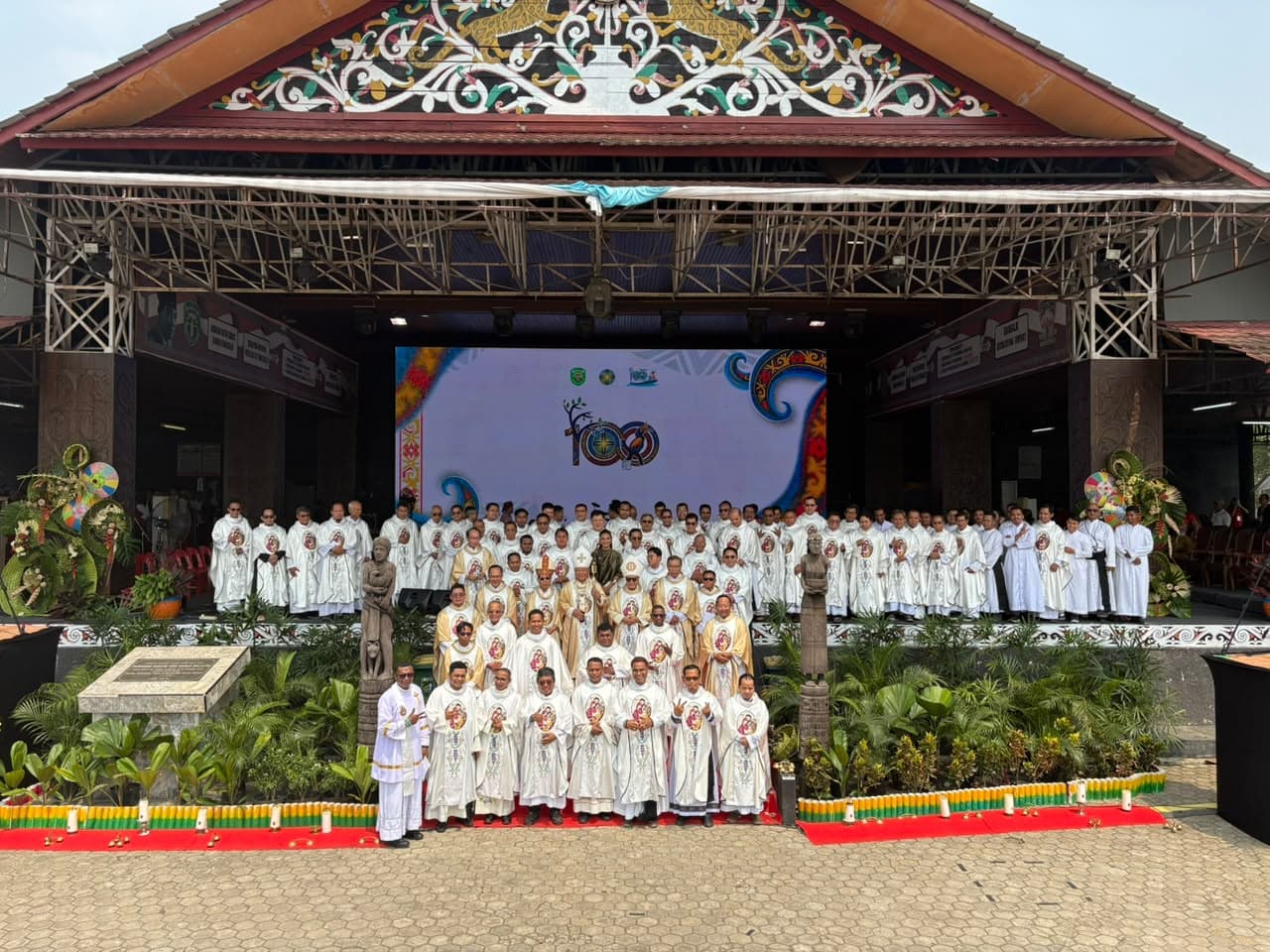
The year 2026 marks the centenary of the arrival of those first three MSF missionaries in Laham. The commemoration, held last Sunday, 18 October, draws attention to the starting point of the congregation’s journey in Kalimantan, whilst inviting the current generation to reflect on the significance of that history for the future.
The commemorative programme includes a historical pilgrimage to Laham, Tering and Barong Tongkok; seminars on history and missionary spirituality; as well as activities involving young Catholics and altar servers. The highlight of the celebrations took place last Sunday in Barong Tongkok, coinciding with World Mission Day. The programme included the inauguration of the Father Berthier Museum, a Eucharistic celebration of thanksgiving and cultural performances.