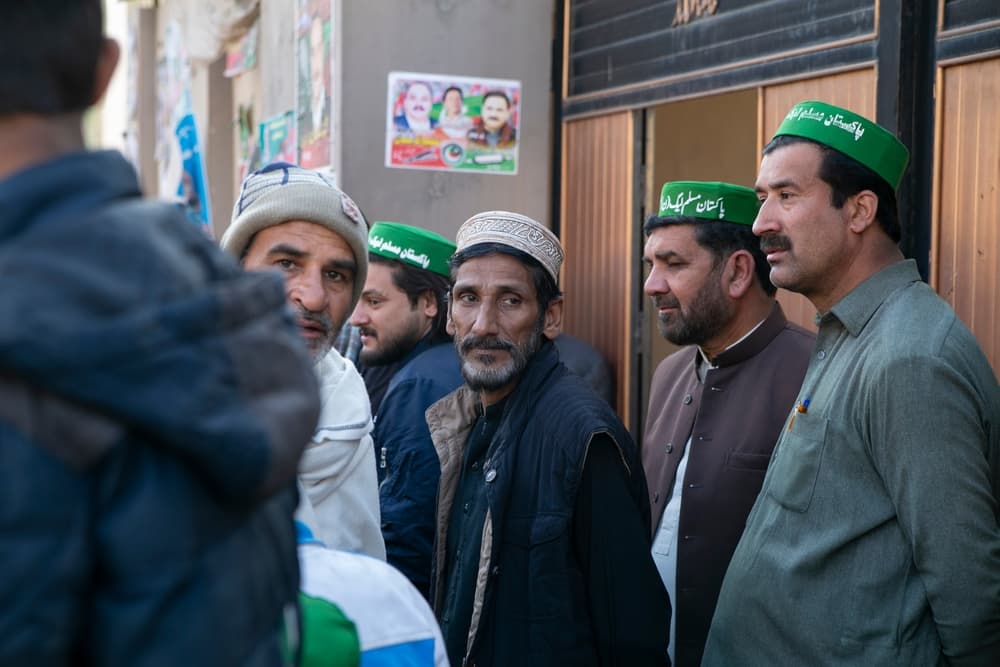
Muzaffarabad (AsiaNews) – The second of three rounds of voting for the Legislative Assembly of Pakistani-administered Azad Jammu and Kashmir (AJK) ended yesterday.
The poll in the Muzaffarabad Division, and for the 12 seats reserved for Kashmiri refugees who live in other parts of Pakistan, remains the most sensitive round of the entire electoral cycle.
The Pakistan Tehrik-i-Insaf (PTI), the party of former Prime Minister Imran Khan, called for a boycott, while the Pakistan Peoples Party (PPP) accused the government of fraud. For its part, the Joint Awami Action Committee (JAAC), which was banned in June by the local government under anti-terrorism legislation, continues its protests.
Election results
According to preliminary results reported by local media, the Pakistan Muslim League (PML-N), the ruling party in Islamabad, is clearly ahead in most constituencies in Muzaffarabad, while the PPP won some key seats, starting in the very heart of the region’s capital.
In the 12 seats reserved for Kashmiri refugees, however, the PML-N dominated almost unchallenged, winning, among others, the seats in Jammu-II, Jammu-III, and Jammu-IV, as well as several constituencies representing the Kashmir Valley. By contrast, the PPP was ahead in only two constituencies.
At the end of the second phase, Prime Minister’s Adviser on Political Affairs Rana Sanaullah stated at a press conference that the PML-N had already won enough seats to form the next Kashmir government, expecting to see the party win five or six of the nine constituencies up for grabs in this phase.
Sanaullah called the vote "free and fair" and rejected accusations of manipulation made by the PPP, the party that governs jointly with the PML-N at the federal level.
The adviser instead accused the PPP of working with the JAAC to cause unrest in Muzaffarabad before the vote, so as to discourage turnout in areas favourable to the PML-N. The PPP dismissed the allegation as untrue.
Context: protests and the PTI still excluded
The vote comes after weeks of tension. The JAAC protests, which began over rising energy costs and the cost of living in general, later shifted to demanding the abolition of the 12 seats reserved for refugees, which protesters say give Islamabad excessive influence over the Kashmir government.
The AJK government outlawed the movement in early June under anti-terrorism legislation, following weeks of clashes with security forces that, according to the JAAC, resulted in dozens of deaths among protesters and law enforcement before and during the vote.
Further complicating the political situation, the PTI of former Prime Minister Imran Khan, who is still in prison, chose to boycott the election, refusing to field its own candidates.
The third and final round of voting in the Poonch Division, an area where protests have been going strong, will be held next Monday. This round will determine the final composition of the next AJK Legislative Assembly.
The JAAC joined the PTI, calling for a boycott of the election. According to Al Jazeera, the movement's leadership openly called on voters to refrain from voting, arguing that the seats reserved for refugees allow major Pakistani parties to influence the composition of the local parliament from outside.
Ongoing tensions with Afghanistan
The vote is also linked to the deterioration of relations between Islamabad and Kabul.
In mid-June, just as the JAAC protests intensified, Pakistani Defence Minister Khawaja Asif accused Afghanistan of fomenting unrest in Kashmir.
Adding fuel to an already hostile climate, armed attacks in Pakistan's border regions continued. Yesterday, the Kabal police station in Swat, a district in Khyber Pakhtunkhwa province, was attacked by a suicide bomber. After three wounded people died in hospital, the death toll rose to 17 dead (seven officers and ten civilians, including the attacker) and 34 wounded.
In a statement, the Tehreek-e-Taliban Pakistan (TTP) claimed responsibility for the attack. Like their Afghan "cousins", the Pakistani Taliban want to set up their own Islamic Emirate.
Based on some statements on social media, Taliban leaders appear to have realised that they can exploit the unrest in Kashmir to their advantage.
Qari Saeed Khosty, an official linked to the Haqqani network and a spokesperson for the Taliban government's Interior Ministry until March 2022, wrote on X: “It's time” for “the people of Kashmir” to rise up “and determine their own future," followed by the hashtag #RightsMovementAJK.
This tweet doesn't represent the official Afghan government position, but it clearly illustrates how tensions between Pakistan and Afghanistan risk finding an echo in Kashmir.
(Shafique Khokhar contributed to this article)